One Man In Key Takeaways
by Christian Craighead
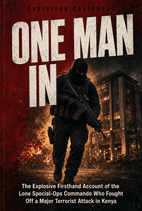
5 Main Takeaways from One Man In
When Institutions Freeze, One Prepared Person Must Move
Craighead repeatedly enters live sieges while formal chains stall. His training, staged gear, and willingness to act let him break the attack's momentum, coordinate scattered responders, and protect civilians who had no time for permission. The lesson is not vigilante bravado but readiness meeting a vacuum.
Real Preparation Determines Whether Courage Can Become Action
The book shows signals like 'Gen,' pre-staged kit, medical and less-lethal tools, and rehearsed room-clearing making action possible. You cannot invent competence, discipline, or a loadout in the middle of a mass-casualty event.
Treat Lethal Force as a Moral Act, Not Just Tactical
Chris carries a Bible and rosary beside his rifle and insists he must sort gunman from hostage before firing. Faith, accountability, and violence are not opposites in his worldview; they are fused into a single burden he prepares to carry.
Leadership Is Claimed by Action, Not Granted by Rank
At the siege, armed officers follow the person who states plainly who he is and what he can offer, while informal calls and written mandates redirect lethal force faster than official hierarchy. Waiting for perfect information or permission can be indistinguishable from doing nothing.
The Mission Outlasts the Gunfire and Demands Recovery
After the shooting stops, hidden injuries, psychological numbness, missing guests, competing accounts, and institutional anger remain. A successful operation is measured by civilians walking out, not only attackers killed, and the rescuer carries costs long afterward.
Executive Analysis
The five takeaways connect into a single argument: in a crisis, institutions are necessary but never sufficient. Craighead's account shows that when official response stalls, an individual with preparation, moral clarity, and willingness to act can buy the time that saves lives. His faith and violence are not opposed; they are held together by accountability. Leadership shifts to whoever moves, and the aftermath - injury, trauma, bureaucratic punishment - is part of the same moral ledger. The book therefore argues less for rogue heroism than for readiness, conscience, and responsibility when systems fail.
For readers, the practical impact is a framework for crisis response: prepare before you need it, act on clear signals, know when to bypass broken channels, and own the consequences. It also matters as a military memoir because it refuses to separate tactical detail from moral and emotional cost. In a genre full of glorified operators, One Man In stands out by showing the rescue, the killing, the faith, the injuries, and the institutional backlash as one continuous story. It is both an action narrative and a caution about what heroism leaves behind.
Chapter-by-Chapter Key Takeaways
Stranger on the Road (Chapter 1)
Chris's skill with a weapon and his belief in God are not in conflict. They are the same thing to him.
He volunteered for Kenya wanting to meet al-Shabaab. His religion doesn't stand apart from violence. It lives right inside it.
The peace that came after his first killing, delivered by a padre with Communion, suggests a faith that forgives war rather than objecting to it.
Chris never figures out whether Simon was a messenger or a coincidence. He just lives with that question.
Try this: Reconcile your deepest beliefs with your hardest actions before conflict arrives; don't assume faith and force are separate, and learn to live with unanswered signs rather than forcing certainty.
I Wanna Be Tough (Chapter 2)
In a city that's already been hit, you need your gear packed and staged well before anything happens. You can't figure it out in the moment.
A two-week search that finds nothing doesn't mean it failed. Abductions often get resolved through channels the searcher has no access to, and over months instead of days.
You can often hear who really holds power in a place through its jokes, not through its official rules.
The people who move first and most effectively in a massacre are usually the ones already living and working in the country, not the ones who show up once it hits the news.
Try this: Stage your equipment and contacts before crisis, treat unresolved searches as ongoing rather than failed, and listen for jokes and local operators to learn who really moves first.
Prologue (Prologue)
When officials refuse to believe a threat is real, they clear the ground for the attackers.
What matters most is whether a security service answers at midnight on a holiday, not how big its budget is.
Ordinary home life and an attack about to happen sit just a few miles apart. Distance offers no protection. Paying attention is the only thing that varies.
A child's wish to grow up tough and five men preparing violence nearby are part of the same reality. The book asks how a society can hold both at once.
Try this: Test whether your support systems answer at midnight on a holiday, and treat official disbelief as a risk signal, not reassurance, while recognizing that ordinary life and violence sit closer than distance suggests.
Paradise Lost (Chapter 3)
A wall and a guarded gate only help if the attack is stopped before it reaches them. The first five people died outside the perimeter, so the gate never came into play. A bomb at the start of an attack can also work as a distraction. It pulls attention to one spot while the gunmen move in on foot. And when hundreds of people are gathered in one place, a small team can kill many of them in minutes. Help from outside can't get there fast enough to stop it. The victims were ordinary people from three countries, at work or just visiting. The attack was aimed at everyday life, not at any military or government target.
Try this: Assume perimeter defenses fail before they are tested, prepare for diversionary bombs, and design response around protecting ordinary gathering places, not just government or military targets.
Answer the Call (Chapter 4)
One word can tell you everything you need to know about a threat, if you agreed on its meaning ahead of time. "Gen" turned an ordinary call into a signal to move now.
Attacks from multiple directions are designed to overwhelm defenders and open the way for mass killing. The first job is to break up the attack and protect civilians.
Knowing who is likely behind an attack can help you act faster. The real question is whether that knowledge gets you moving sooner.
The group's hidden unit holds the power to kill large numbers of people, not its public face.
Moving toward gunfire while hiding your tattoos means weighing your own risk against the chance to save strangers.
Try this: Agree on one-word signals that turn normal calls into immediate action, identify the hidden unit behind an attack, and decide in advance whether you will move toward gunfire when it puts you at risk.
The Road to Hell (Chapter 5)
On the road to a crisis, a driver's only real standard is getting there in one piece. Traffic law comes second.
The rules that keep you alive under pressure are usually written in someone else's blood. That's why they stick harder than anything a classroom teaches.
A crisis will expose whether the coordinating bodies you depend on actually answer; when they do not, one person's judgment becomes the entire response.
Coming back from injuries that would end most careers does not restore caution; it leaves the hunger for the work untouched, and the job keeps picking people like that.
Try this: Write your pressure rules from others' failures, arrive first rather than legally, and expect coordinating bodies to fail so one person's judgment may have to become the response.
You Have Reached Your Destination (Chapter 6)
Getting to a live attack scene is a problem in itself: a police cordon can stop a capable responder as effectively as the attackers can, and the authority to pass it, real or asserted, is the first requirement of the response.
At an unfolding mass-casualty incident, dress functions as a credential; the same person reads as a threat, a bystander or an asset depending on what he is wearing.
What an operator leaves behind says as much about his plan as what he carries, and shedding a helmet and tomahawk for speed fits an interior fight where mobility matters more than full protection.
A loadout built for an active shooter has to address the whole problem at once: lethal force, less-lethal control, and medical care for people who are already wounded.
Carrying a Bible and rosary alongside a rifle signals that the operator treats killing as a moral act he must prepare for, not merely a tactical one.
Try this: Plan access, appearance, and loadout as one system: carry credentials, lethal and less-lethal and medical tools, and moral reminders so you can pass cordons and address the whole incident.
Bring It On (Chapter 7)
A building full of armed men is not a defended building. When nobody inside can say who the enemy is, the guns are as much a danger as an advantage. Not knowing an attacker's numbers or entry route is part of the problem to be solved, not a reason to hold position and wait. Going in alone and accepting that the likely outcome is killing rather than capturing are the two choices that make him the one who can actually respond. At contact distance the decisive skill is not marksmanship but the discipline to sort gunman from hostage, bystander, and police officer in the instant before firing.
Try this: Enter when waiting is more dangerous than moving, accept that contact may mean killing rather than capture, and train the instant discipline to sort gunman from hostage before firing.
Getting to Work (Chapter 8)
A suicide bombing leaves bodies and threats on different floors and nearby buildings, so no single room can be treated as the only threat zone.
Inside a room of injured and panicked civilians, the rescuer has to make his presence known before he appears, then move the first reachable person out and keep returning until no one is left.
Volunteers who join mid-crisis are sorted by posture, movement, and weapon discipline; a survivor who advertises his past combat is a liability, not an ally.
Taking photos is part of the job: it gives commanders and local agencies a record and turns anger into the drive to clear the next space.
Try this: Clear across floors and buildings, announce yourself before entering rooms, reject undisciplined volunteers, and document the scene to turn anger into operational momentum.
Geordie Boy (Chapter 9)
Being unkind to someone you love is a debt you cannot repay once they are gone.
Bad exam results at sixteen close no doors. Hard languages and trades can be learned later by anyone who finds one thing to do well.
Try this: Repair kindness with loved ones before it becomes an unpayable debt, and remember that poor early results do not close the door on hard skills or trades learned later.
Finding the Way (Chapter 10)
The monthly titles were not decorations. They gave him the stability no adult did.
He made his own direction, forming a private squad around a decorated commando when no mentor appeared to show him the way.
He learned to cook and clean because he was neglected, and the adults who saw what was happening chose to look away.
When recruiters offered a smaller, safer path, he refused it and held out for the one he had chosen.
Try this: Build your own direction when no mentor appears, create routines that supply stability, and refuse the safer path if it does not match the person you intend to become.
Time to Do Gangster Shit (Chapter 11)
A space isn't clear just because a unit says so. Every closed door inside it still has to be opened and searched.
When no local force will move toward active gunfire, the person who goes first takes the lead and has to act like it, not wait for permission.
Survivors of a complex attack often last for hours in makeshift hiding spots. Rescue teams have to search desks, cabinets, and locked compartments, not just the people they can see.
Going in alone with a stun grenade can be the right call when the other option is leaving part of a building unchecked.
Try this: Open and search every closed door, take the lead when no one else will move toward gunfire, and check desks, cabinets, and locked compartments for survivors who may last hours in hiding.
‘Jambo!’ (Chapter 12)
Breaking into a room during a rescue means doing two things at once: getting inside, and convincing the people in there that the armed figure at the door isn't the danger they ran from.
Untrained armed volunteers on an active scene make things more deadly. Panic and unfamiliar weapons kill people the attackers never reached.
Evacuating hidden civilians or leaving them in place is a tough call either way. Staying hidden means the wounded don't get treatment and gunmen can move freely. Clearing rooms means the attackers have less space to move.
How fast people get out depends on how many escorts you have. Pairs waste a covering gunner's time, while larger groups move the same number of people in fewer trips.
Try this: Breach rooms with a plan to convince civilians you are rescue, not threat, move them in larger escorted groups, and exclude untrained armed volunteers from the scene.
The Brave 6 (Chapter 13)
Survival at Westgate came down to split-second choices made by colleagues already inside the building, not outside help arriving in time.
The woman under the staircase lived because five men put themselves between her and the gunmen. Courage is about where you choose to stand, not what you can do.
A careful sweep, floor by floor, is not the same as a safe one. Routine and fatigue nearly turned the twelfth-floor searchers into killers of the person they had come to save.
Honoring the whole group instead of singling out its leaders treats the evacuation and the staircase as one shared act. Mbaria's two roles become one.
Try this: Honor the whole team's choices, not just leaders, and treat routine sweeps as dangerous; fatigue can make rescuers kill the person they came to save.
I’m the Captain Now (Chapter 14)
One phone call through the right informal channel can redirect lethal force faster than any formal chain of command. A diplomatic contact who knew the local police chief mattered more in that moment than whoever was nominally in charge.
Sending willing but unequipped officers into a live siege gets more people killed instead of resolving it. Turning them away was a command decision, not a bureaucratic one.
In an emergency, the people on the ground decide who leads. They give that authority once someone states plainly who they are and what they can offer. Rank, uniform, and paperwork mean nothing.
Leading an assault with multiple gunmen, grenades, and a rising death toll means accepting one thing: you can't wait for perfect information before you act.
Try this: Use the right informal contact when formal command is too slow, turn away unequipped volunteers, and state plainly who you are and what you offer so people on the ground can decide to follow.
Becoming the Man (Chapter 15)
Getting into the regiment is not the same as belonging to it. The ones still standing at the end are the ones who liked how hard it got.
Aggression is graded as a display, not a contest. A minute of boxing can decide a career without anyone needing to win.
A feared task loses much of its power once you have faced it beforehand. That habit held under far greater pressure later on.
The warrior culture a young man expects to join is often a unit of men serving out their time. The real soldiers are few enough to be named.
A pledge to die fighting sounds different to the institution that receives it than it does to the mother who finds it at home.
Try this: Face feared trials beforehand so they lose power, treat aggression as a controlled display rather than a contest, and distinguish real soldiers from those merely serving time.
Evolution (Chapter 16)
In a specialist reconnaissance unit, a man's standing comes from time served and hard times endured, not from rank.
In a peacetime army, discontent comes from sitting idle and from comparing your unit to better ones, not from the risk of combat.
Searching out a biological parent can be worth doing even when the relationship stops at the first meeting. What matters is that you looked.
Elite selection depends on physical luck as much as ability. A badly timed injury can cost years, and the deployment that finally comes may bring real responsibility long before the tier you were chasing.
Try this: Measure standing by time served and hardship endured, not rank; seek out unanswered origins if it matters, and accept that physical luck can delay elite goals without canceling them.
I Can Smash In Doors (Chapter 17)
When I commanded a live siege with officers who weren't trained for rescue, I knew that if any of them shot a civilian, I would have to answer for it.
Julius opened a path no one else could, but he paid for it with cut arms and broken glass.
Making my officers wait for me to shoot first stopped panic volleys, but it also meant I had to stand in front of them and hold their discipline together.
The specialized relief force arriving at dusk restored order, but the handover was a dangerous moment, when accidental gunfire and self-inflicted casualties were most likely.
Try this: Control untrained officers by setting first-shot rules, recognize the cost to those who open paths, and manage relief handovers as dangerous transitions.
All the President’s Men (Chapter 18)
One WhatsApp message to Kenya's intelligence chief changed everything. The commander who wanted Chris gone suddenly cooperated, because in a hierarchy, people obey whoever the boss clearly backs.
Chris insisted on written confirmation before accepting authority from the president and the intelligence director. That wasn't stalling. It was the only way to make sure the mandate held up once the crisis was over.
The British military support was approved after Chris was already deployed. In fast-moving operations, the paperwork often catches up to what's already happened.
The terrorists held the seventh floor. The main assault team waited on the sixth. A smaller team was already above the enemy. Chris's climb to the sixth floor linked all three, and that made the coordination possible.
Try this: Get written confirmation before accepting authority, use direct backchannels when hierarchy obstructs, and link separated teams by physically connecting their positions even if paperwork follows later.
Welcome to Da Party (Chapter 19)
Spreading assault elements across a floor's wings buys little once grenades arrive at the stairwell; the fight then turns on who controls that opening.
A report of a wounded gunman is not a report of a neutralized one; an injured defender can still fire, move, and shape the fight.
When all noncombatants are out of the upper floors, the operation's purpose changes from extracting them to finishing the remaining shooters.
Waiting for a cornered enemy to descend surrenders the initiative and gives him time to exploit pre-scouted routes and hidden weapons.
Try this: Control the stairwell rather than dispersing across wings, treat wounded shooters as active threats, and once civilians are out, shift from rescue to finishing the remaining gunmen without waiting for them to descend.
Working the Problem (Chapter 20)
The Grosvenor marksmen missed because glass deflected their rounds.
With the elevator ruled out, the stairwell was the only way up, and a rushed advance there was hopeless.
No one had checked what lay above the gym. The breach was aimed at a roof slab about a yard thick, so both charges failed.
The gunmen returned fire, darkened the building, and dropped another grenade into the stairwell. Pulling the marksmen back left two directions of pressure. Bringing them back added a third.
Try this: Check what lies behind or above a breach before relying on charges, account for glass deflection, and keep pressure from multiple directions instead of pulling marksmen back and surrendering angles.
Hail Mary (Chapter 21)
A commander has to own the small calls that keep his men going, like letting them eat minibar food. But he also has to tell them exactly what to do after a breach works. Without that, the opening gets wasted.
A thrown IED can shake an assault even when no one is badly hurt. It pushed the attackers back to tactics that had already failed.
The stairwell came down to a narrow funnel and disciplined fire. A charging gunman went down only when the defenders moved their aim from his torso to his head. The second attacker died before he reached the landing.
The enemy's first-light prayer tipped off the attack. The commander's own Hail Mary marked the line he crossed right before it came.
Killing up close can shut down your feelings until a body looks like an object. That numbness did not start at this siege. It built up over years of earlier deployments.
Try this: Own small morale calls but give explicit post-breach instructions, keep disciplined fire in the stairwell funnel, and recognize that emotional numbness is accumulated cost, not just a moment of combat.
This Is War (Chapter 22)
The patrol could have walked away from a job they didn't have to take. They didn't. That's what professional reconnaissance units do: they study an enemy far bigger than themselves without having to fight him.
A few men on foot can scout ahead only because the vehicles behind them carry the firepower, the radios, and the way out.
A dozen soldiers and four light vehicles against an armored division makes sense when the job is watching, not fighting.
No matter how carefully a night operation is planned, chance steps in. The delay and refit that follow are part of the mission too.
Try this: Study enemies far larger than you without needing to fight them, ensure your support elements carry firepower and extraction, and build delay and refit into the plan as normal parts of the mission.
Get the Bazooka (Chapter 25)
The place where a fight happens can matter more than the weapons used: the attackers had picked the waterlogged basement in advance, and it slowed the response as much as their grenades did.
Your first rounds probably won't get through a hard barrier.
Switch to stronger weapons step by step, from tear gas fired out of a shotgun to an anti-armor rocket, instead of repeating an attack that has already failed.
A hit is not a kill: the second man kept throwing grenades and shooting while wounded, and the fight ended only once both were confirmed dead.
Try this: Choose terrain that slows attackers, expect first rounds to fail against hard barriers, and escalate deliberately from less-lethal to anti-armor rather than repeating a failed attack; confirm kills, not just hits.
For Kenya (Chapter 26)
Judge a siege by how fast it ends and how many civilians walk out, not by how many attackers are killed; ending it in one day instead of four is what matters most.
Clearing a site is not over when the firing stops; the last missing guests still had to be found before the building could be called clear.
From a pre-dawn practice session to the gate, he stayed on the job for thirty-three hours straight.
The officer at the gate assumed a man would only rescue his own family and then leave. The siege had already proved otherwise.
Try this: Measure success by how fast the siege ends and how many civilians walk out, keep searching until the last missing person is found, and don't assume people act only for their own; sustain the job for as long as it takes.
Time for a Nice Cup of Tea (Chapter 27)
The end of an operation marks the start of a toll on body and mind that outlasts the threat itself.
Competing accounts of the same incident are routine, and the most complete version often comes from an official senior enough to hear what subordinates left out.
Terrorist groups attach their violence to distant political decisions, so a diplomatic gesture made far away can be cited as justification for striking a target with no part in it.
Resuming ordinary social life means standing among people who have no idea what has just happened, which takes its own kind of discipline.
Try this: Plan for the after-action toll on body and mind, expect competing accounts, and practice returning to ordinary social life even when others have no idea what happened.
Damaged Goods (Chapter 28)
Injuries absorbed in the urgency of a rescue can stay hidden until the crisis passes, then surface as lasting costs that the rescuer alone carries.
The path that draws no criticism is often the path that demands the least, not the path that answers the emergency.
When the threat moves faster than official approval, waiting for permission can look a lot like doing nothing.
Public admiration can push institutions into backing an intervention they might otherwise have walked away from.
Try this: Surface hidden injuries after the crisis, choose the path that answers the emergency even if criticized, and use public support to push institutions when approval moves slower than threat.
Council House to White House (Chapter 29)
A successful counterterrorism mission can get you into briefings with top American military and intelligence leaders, even a meeting with the vice president. But none of that protects you from your own government's anger.
A president's thanks, a request for advice, and a job offer made him a political asset in Washington and a diplomatic headache in London.
His superiors treated an unapproved meeting with a head of state as worse than the lives saved that made the meeting happen. They cared more about following the rules than about the results.
He wouldn't apologize. To him, being recognized by allies and being accountable for results mattered more than getting permission from the chain of command.
Try this: Accept that results can create political blowback, document your mandate, and decide in advance whether you will prioritize allied recognition and lives saved over chain-of-command approval.
Epilogue (Epilogue)
The army gave him skills and chances he couldn't have gotten anywhere else, even as it shrank and let him down.
Years of training and deployments are what let him act fast when no one told him to.
Going outside official channels gave him a sense of purpose that sanctioned missions sometimes didn't.
One soldier stepping up in a crisis can push others to take real risks when their own moment comes.
Try this: Use hard-won training to act when no one gives the order, accept that unofficial channels can create purpose, and remember that one person stepping up gives others permission to take real risks.