Master Plan Quotes
by Farzad Mesbahi
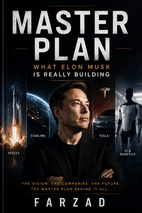
This page collects the sharpest lines from Farzad Mesbahi's Master Plan. You will find predictions that sound like science fiction but come from careful observation of Elon Musk's companies. Some quotes capture the raw emotion of waiting for a promised future. Others explain how technology will reshape everything from currency to daily work.
The book is quotable because it mixes technical insight with human truth. It does not shy away from the struggle between grand visions and the people who must live through the transition. Each line here offers a new way to see what is being built right now.
Top Quotes from Master Plan
“Elon Time “I may be late, but I always deliver.””
Opening line of the prologue, attributed to Elon Musk.
It captures Musk's brash confidence and his reputation for delays, making it a memorable motto for his entire career.
“Living through the waiting period - the years between the promise and the delivery - is psychologically brutal.”
The author reflects on his personal experience investing in and working at Tesla.
It resonates with anyone who has endured long-term uncertainty, capturing the emotional toll of betting on visionary ideas.
“And all of these technologies will drive the cost of energy, labor, and intelligence to near zero.”
The author projects the economic impact of Musk's integrated system.
This concise, almost shocking prediction encapsulates the revolutionary promise of Musk's projects—making it a powerful hook for readers questioning the grand thesis.
“The concept of currency itself may disappear when Al meets all material needs. If there is an ultimate equivalent, it will be energy.”
Elon Musk on the Nikhil Kamath podcast later in 2026, as quoted in the chapter.
This provocative prediction challenges fundamental assumptions about money and value, making readers question what scarcity really means in a post-scarcity world.
“Every mile Tesla drives makes it harder for a competitor to catch up.”
Following the description of Tesla's compounding learning loop.
This succinct line crystallizes the self-reinforcing moat created by Tesla's fleet, a core thesis of the chapter.
“The crisis of meaning is the central human challenge of the next 20 years.”
The author reflects on the societal impact of automation and technological disruption.
This line captures the existential threat posed by a world where work loses its purpose, prioritizing human meaning over economic efficiency.
“SpaceX caught a returning rocket booster out of the sky with a pair of mechanical arms on the very first attempt.”
The author describes the historic moment when SpaceX's launch tower caught a returning booster.
This line captures the sheer audacity and success of the engineering feat. It is a defining moment in the chapter and in SpaceX's history.
Themes Behind the Quotes
The quotes reveal a central tension between ambitious promises and the painful waiting period before they are delivered. Another major theme is the relentless drive to reduce the cost of energy, labor, and intelligence toward zero, which could make currency itself obsolete and trigger an explosion in the global economy. The rise of autonomous systems, from cars to edge AI agents, is portrayed as inevitable and economically compelling.
Alongside these technological shifts, a human theme emerges: the crisis of meaning when traditional jobs disappear. The book insists on addressing what people will do next Tuesday, not just the distant future. It also emphasizes the importance of organizational culture that treats failure as data. The precision required in manufacturing and the cumulative advantage of real world data are recurring ideas that ground the grand vision in practical execution.
Quotes by Chapter
PROLOGUE
“By 2050, most of the things people interact with daily will be directly created, or heavily influenced, by Elon Musk.”
Author's bold prediction about Musk's long-term impact.
This sweeping statement sets the stakes for the book and challenges readers to consider the scale of Musk's influence.
“Now the Model Y is the bestselling car in the world.”
After describing Tesla's near-bankruptcy and the Model 3 ramp.
It delivers a stunning turnaround story in one simple sentence, underscoring how the impossible became reality.
CHAPTER 1
“What Elon Musk is building - and what this book is truly about - is the foundation that the next generation of civilization will be built on top of.”
The author explains the overarching thesis of the book.
This line crystallizes the book's central claim—that Musk's ventures are not separate bets but a unified foundation for future civilization—making it both provocative and memorable.
“Every layer the next century will run on. Energy. Transport. Compute. Robotics. Networks. Off-world reach. Being built right now, mostly by one person.”
The author lists the technological pillars that Musk is constructing.
The staccato rhythm and bold scope create a sense of inevitability and awe, emphasizing the unprecedented concentration of ambition and execution in one individual.
“I remember standing in the parking lot during a break thinking this is either going to be the most important manufacturing story of the century, or the most expensive lesson in Silicon Valley hubris.”
The author recalls a tense moment during Tesla's Model 3 production ramp.
This personal, high-stakes reflection humanizes the narrative and captures the knife-edge uncertainty that makes the eventual success feel earned and improbable.
CHAPTER 2
“If you have ubiquitous Al that is essentially free or close to it, and ubiquitous robotics, then you will have an explosion in the global economy.”
Elon Musk at Davos in early 2026, as recounted in the chapter.
It captures a bold vision of how free AI and robotics could transform the entire economy, resonating with anyone interested in technological utopia or disruption.
“Currency always migrates to denominate the era's scarcest essential input.”
The author presenting a key principle in the chapter's discussion of monetary evolution.
This concise, pattern-based insight gives readers a simple lens to understand how economic standards shift across history, making it highly memorable and applicable.
“The medicine was simply available, the way the air was available.”
Amina reflects on a mother receiving free medication at the clinic in Huye, Rwanda.
This poetic line crystallizes the chapter's theme of abundance becoming so natural it feels invisible, evoking deep emotional resonance about the end of scarcity.
CHAPTER 3
“Tesla's fleet is millions of cars encountering real deer, real construction zones, real humans doing unpredictable things on real roads in all 50 states - and then some.”
The author contrasts Tesla's real-world data with Waymo's simulated miles.
It vividly captures the scale and authenticity of Tesla's training advantage, making the abstract concept of data superiority tangible.
“If you'd told any auto exec in 2020 that a consumer vehicle running on cameras alone - without LIDAR or HD maps - would do that, they'd have laughed you out of the room.”
The author reflects on the skepticism Tesla's camera-only approach faced.
It highlights the audacity of Tesla's bet and how dramatically the landscape has shifted, making the reader appreciate the underdog narrative.
“A teenager in a suburb without bus service gets autonomously driven to an after-school job because the trip costs less than what she earns in the first 15 minutes of her shift.”
Part of a series of hypothetical robotaxi use cases illustrating cost disruption.
This relatable scenario makes the economic argument personal and concrete, showing how cheap autonomy can transform daily life.
CHAPTER 4
“The guy who drove the truck for 30 years can't eat a PowerPoint slide about the abundant future.”
The author illustrates the plight of displaced workers during the transition to automation.
The vivid metaphor makes an abstract crisis tangible, highlighting the gap between utopian promises and the immediate needs of those affected.
“He needs to know what he does next Tuesday.”
Continuing the same thought about the displaced truck driver.
Its stark simplicity forces readers to confront the urgent, concrete human question that distant visions cannot answer.
“I refuse to ignore the journey by pointing at the destination.”
The author acknowledges his own discomfort with the disruptive transition period.
This line expresses a commitment to honesty and empathy, rejecting the temptation to focus only on a positive end result.
CHAPTER 5
“If you're doing an expense report with forty mechanical steps and one judgment call about whether a dinner is a business expense, Digital Optimus handles the forty locally, pings Grok for the one, and finishes in fifteen seconds instead of twenty minutes.”
Illustrating how Digital Optimus handles routine tasks locally and only offloads judgement calls.
This vividly contrasts the tedium of manual work with the speed of AI, making the efficiency leap tangible and memorable.
“Cloud Al agents today are mainframes: shared and metered by all of us with tokens. Digital Optimus is the PC: owned, instant, local.”
Drawing a historical parallel between mainframes and PCs to explain the shift from cloud to edge AI.
The analogy is instantly understandable and frames the technological shift as inevitable, echoing a familiar computing revolution.
“The question is how fast these edge Al systems win. The economics are identical to the mainframe-to-PC transition.”
Author's analysis of the economic forces driving edge AI adoption.
It distills a complex market prediction into a clear, provocative question that resonates with anyone who remembers the PC revolution.
“He did the thing he had opened the brewery to do. The back office ran itself.”
Describing Ren, a brewery owner, after his AI system took over administrative tasks.
This simple, human payoff shows technology enabling purpose and passion rather than replacing it, offering a hopeful, relatable vision.
CHAPTER 6
“You're firing a laser at tin droplets in a vacuum, creating plasma hotter than the sun, bouncing that light off mirrors that are the smoothest objects ever manufactured by humans, to print patterns smaller than a virus, ona thin slice of purified sand. Fifty thousand times per second.”
The author describing the EUV lithography process.
This line captures the astonishing complexity and scale of semiconductor manufacturing in vivid, almost poetic terms. It makes the reader marvel at the engineering required to produce modern chips.
“That's the technology stack civilization is running on right now.”
The author after listing the technologies that depend on EUV machines.
A succinct and sobering reminder of how fragile and advanced our technological foundations are. It resonates because it ties everyday devices to an invisible, monumental infrastructure.
“Her job was the gap between measurement and perfection.”
Priya, an engineer at TSMC, reflecting on her role.
This elegantly captures the human element in high-tech manufacturing, where precision is a constant pursuit. It resonates with anyone striving for excellence in a field that demands near-impossible accuracy.
“This was why she had come. This - the moment when a machine drifting by a fraction of a nanometer met a person who refused to let it.”
Priya catches a thermal drift anomaly in the alignment stage.
Highlights the irreplaceable intuition of experienced engineers who feel the 'wrongness' of a trend line before algorithms do. It emphasizes that human expertise remains critical even in automated factories.
CHAPTER 7
“The philosophy sounds simple, but it's brutally difficult to execute, because it requires an organizational culture that treats failure as data rather than disaster.”
The author explains SpaceX's iterative development philosophy.
This quote encapsulates a counterintuitive but powerful approach to innovation. It resonates because many organizations fear failure, yet SpaceX leverages it.