Master Plan Key Takeaways
by Farzad Mesbahi
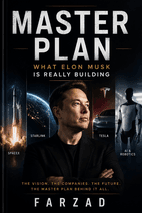
5 Main Takeaways from Master Plan
Musk's companies form a single integrated system, not separate ventures
What appears as a portfolio of disconnected companies (Tesla, SpaceX, Boring Company, Neuralink) is actually a tightly integrated system where each business feeds data, compute, or energy to the others. For instance, Boring Company tunnels train Tesla's Full Self-Driving, which feeds SpaceX AI, which powers Grok running in Teslas on Tesla Energy.
AI intelligence costs are dropping to near-zero, transforming economics
The cost of AI compute is falling by factors of 30-100 every two years, approaching zero marginal cost. This shift will eventually make currency obsolete, replaced by energy as the ultimate equivalent, as seen in Rwanda where falling costs are already reshaping physical infrastructure and daily life.
Tesla's fleet data creates an unbeatable autonomy feedback loop
With over 9 million cars collecting real-world driving data at 2,000 times the rate of simulation-heavy approaches, every mile driven improves the system for every subsequent mile. This compounding loop makes Tesla's approach to self-driving far more scalable than building dedicated robotaxi fleets.
Infrastructure (compute, energy, launch) is the true AI moat
The model itself is not the competitive advantage; the real moat lies in owning the infrastructure—compute clusters, energy production, and launch capability. SpaceX has already become an AI infrastructure provider (Anthropic renting its Colossus 1), and lunar manufacturing could make AI compute cheaper on the Moon than Earth.
Second-order effects of AI will reshape society faster than expected
First-order effects like mobile salons are predictable, but second-order effects—such as real estate inversion, autonomous mobile businesses, and exponential labor multiplication—will transform society within a decade. The transition from horse-drawn carriages to automobiles happened in just 13 years; similar speed applies to autonomous systems.
Executive Analysis
These five takeaways converge on a single thesis: the convergence of AI, energy, and space infrastructure is creating a self-reinforcing system that will fundamentally change how we work, travel, and live. Farzad Mesbahi argues that what looks like a chaotic collection of Musk ventures is actually a meticulously designed master plan where each piece accelerates the others—from Tesla's data feeding autonomy to SpaceX's launch capacity enabling lunar AI factories. The result is an economic transformation where intelligence and labor become nearly free, forcing society to grapple with new currencies, new forms of business, and a crisis of purpose.
This book matters because it provides a rare inside view from someone who lived through Tesla's near-death moments and observed Musk for 14 years. It cuts through both hype and criticism to offer grounded, data-rich analysis of how technology actually scales. In a genre crowded with futurist speculation, "Master Plan" stands out for its practical skepticism—acknowledging Musk's key-man risk and manufacturing scars while showing why the system is already gaining momentum. For investors, entrepreneurs, and anyone trying to understand what comes next, the book delivers actionable frameworks (like the 85/15 rule for AI deployment and the unit economics of robot labor) that are immediately useful today.
Chapter-by-Chapter Key Takeaways
PROLOGUE (Prologue)
The author has 14 years of close observation of Musk and his companies, plus direct leadership experience at Tesla during critical growth phases.
Tesla’s survival and success (Model Y as global #1 car, self-driving capability, affordability) defied every conventional assumption, including near-bankruptcy in 2018.
Having a concentrated financial stake doesn’t cloud judgment—it forces deeper analysis and a higher tolerance for doubt.
The prologue hints at a larger narrative where Musk’s influence extends beyond consumer products into foundational human experiences, like healthcare and caring for the vulnerable.
That final vignette (Naia and the child) suggests the book will weave together cold technology with warm, irreplaceable human gestures—the kind of detail engineering alone can’t replicate.
Try this: Concentrate your research on a single deep thesis, accepting that doubt is part of the process—let the evidence, not consensus, guide your conviction.
CHAPTER 1 (Chapter 1)
What looks like a portfolio of disconnected companies is actually a single, integrated system where each business feeds data, compute, or energy to the others.
The convergence is real and structural: Boring Company tunnels train Tesla FSD, which feeds SpaceXAI, which powers Grok, which rides in Teslas — all running on Tesla Energy.
Criticisms about governance, missed deadlines, and key-man risk are valid, but they’re the price of building something the financial system wasn’t designed for.
The biggest single risk is Elon Musk himself as the sole strategic integrator, though that risk diminishes as the system gains its own momentum.
The Model 3 ramp nearly killed Tesla, but the manufacturing scars from that period are now the bedrock for scaling robots, energy storage, and everything else.
Try this: Audit your portfolio or business model to see if each component feeds another; look for hidden integration where data, compute, or energy flows can create compounding advantages.
CHAPTER 2 (Chapter 2)
AI intelligence costs are dropping by factors of 30–100 every two years, approaching near‑zero marginal cost.
The historical pattern of currency shows it always shifts to track the era’s scarcest resource—likely mass and energy in the age of the Three Convergences.
Musk’s framing points to a world where currency itself may become obsolete, replaced by energy as the ultimate equivalent.
The story from Rwanda illustrates that this isn’t abstract theory—it’s already reshaping physical infrastructure and human lives where costs have fallen below the threshold of practicality.
Try this: Assume that the marginal cost of intelligence will hit zero within five years—restructure your business model around abundance rather than scarcity of computation.
CHAPTER 3 (Chapter 3)
Tesla's 9-million-car fleet generates real-world driving data at a rate over 2,000 times faster than Waymo's simulation-heavy approach.
The compounding feedback loop means every mile driven improves the system, which then improves every subsequent mile for every car.
Fleet activation (using existing consumer vehicles) scales far faster than building a dedicated robotaxi fleet from scratch.
The economics of cheap autonomous transport create entirely new use cases, from overnight intercity travel to on-demand cargo shuttling.
A single self-driving platform can eventually power multiple vehicle form factors, from passenger cars to semis and RVs.
Try this: Prioritize real-world data collection over simulated data; even a small deployed fleet creates a compounding feedback loop that competitors cannot replicate quickly.
Next chapter: “CHAPTER 4” is locked
Keep learning from Master Plan — and unlock all 600+ book summaries with audio, mindmaps and AI Q&A.
$0.00 due today · 7 days free, then $89.99/year ($7.49/mo) · Cancel anytime before day 7
plus sales tax where applicable