I Told You So! Quotes
by Matt Kaplan
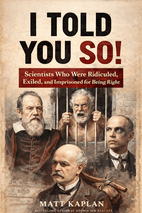
You will find lines that cut deep, make you laugh nervously, and sometimes leave you shaking your head. Some come from doctors haunted by their own mistakes, others from scientists who refused to stay quiet when lives were on the line. A few are blunt observations about how easily people believe a good story over the truth. What makes this book so quotable is how often the past echoes into the present. These aren't just historical footnotes. They are moments when someone was right far before anyone else was ready to listen, and the consequences were enormous.
Top Quotes from I Told You So!
“A physician without a knowledge of astrology has no right to call himself a physician.”
Hippocrates is quoted as saying this, despite being considered the father of medicine.
This ironic statement highlights how even the most revered historical figures held beliefs that now seem absurd, reminding us that science evolves and our own certainties may be similarly flawed.
“I asked the triage nurse by my side with a voice that, despite my best efforts, I could not keep from quavering, “Why do we have him on life support?” She shrugged in a nonchalant manner and said, “Organ donor.””
The author recounts a personal experience as an emergency medical technician, witnessing the emotional detachment required in medicine.
This chilling exchange captures the stark emotional survival mechanism that healthcare workers adopt, and how compassion can be masked by clinical necessity.
“It is a disagreeable declaration for me to mention, that I myself was the means of carrying the infection to a great number of women.”
Gordon admits in his journal that he personally spread puerperal fever to many patients.
A powerful moment of humility and self-blame that humanizes the scientist and underscores the tragic irony of a healer becoming a vector of disease.
“Out of a hundred persons inoculated not two die, whereas on the contrary, out of a hundred persons that are infected with the smallpox the natural way, there die commonly about thirty.”
Cassem Algaida Aga, ambassador from Tripoli, reports on the effectiveness of inoculation in a letter.
This striking statistical comparison makes the life-saving power of early vaccination undeniable and gives the reader a visceral sense of the gamble people faced.
“The work of Pierre Louis was so incredibly important because numbers don't lie.”
The author explains why Louis's numerical methodology was revolutionary for medicine.
This concise statement champions objectivity and evidence-based reasoning, resonating in any era where data is contested.
“It is impossible to quantify those who remain silent. Even so, they are there, and we ignore them at our peril because their unpalatable views may well yield solutions to our most important unsolved problems.”
The author reflects on younger scientists who choose not to challenge established ideas due to harsh criticism.
A compelling call to value dissent and protect those who speak up, warning that silencing unconventional ideas can cost us breakthrough discoveries.
“Science is at its best when there is disagreement and debate, because these processes drive everyone involved to think carefully about which arguments are right and which are wrong.”
The author argues against the idea that underhanded competition makes a better scientist.
It articulates a core value of scientific progress—that open debate, not deception, leads to stronger, more reliable knowledge.
Themes Behind the Quotes
One major theme is the painful gap between knowing the truth and getting others to accept it. Again and again, people with clear evidence faced ridicule, sabotage, or indifference. The book shows that being correct is not enough. You also need timing, allies, and sometimes a thick skin. Another theme is the human cost of stubbornness. Whether it is a physician who refuses to wash his hands or a public that prefers a comforting lie, the price is paid in lives. The quotes also highlight the quiet heroism of those who kept pushing despite personal attacks, depression, or professional ruin. Science, as the book presents it, is not a smooth march forward. It is a messy, emotional struggle where the loudest voices are not always the most accurate.
Quotes by Chapter
Chapter 1
“He had what historians describe as a “corrosive fanaticism” for all that he had been taught by Boerhaave.”
Describes Anton de Haen, a doctor who rigidly adhered to humoral theory and opposed new ideas.
The vivid phrase 'corrosive fanaticism' perfectly illustrates how intellectual rigidity can poison medical practice and stifle innovation.
“You have made your mark! You opened the doors, this field that you established ... it is steadily growing!”
Johan Lindgren reassuring Mary Schweitzer about her legacy after years of resistance.
This triumphant line celebrates perseverance and the eventual vindication of a scientist who faced years of hostility. It inspires readers to recognize that even when doors are closed, pioneers can break through.
Chapter 2
“That the cause of the epidemic puerperal fever under consideration was not owing to a noxious constitution of the atmosphere, I had sufficient evidence, for had it been owing to that cause, it would have seized women in a more promiscuous and indiscriminate manner.”
Alexander Gordon writes in his journal about his observation that puerperal fever was not caused by weather or stars.
This line demonstrates early scientific reasoning by ruling out a popular theory through logical deduction, highlighting the power of careful observation.
“The ungenerous treatment which I met with from that very sex whose sufferings I was at so much pains to relive; for, while I was using my best endeavours to mitigate the calamities of many miserable sufferers ... others were very busy traducing my character ... on purpose to raise an odium against my practice.”
Gordon laments in his journal the hostility he faced from the midwives and public despite his efforts to help.
This evokes deep sympathy for a pioneering doctor who was vilified instead of celebrated, illustrating how society often punishes those who challenge accepted norms.
Chapter 3
“This was, quite literally, germ warfare, and it forced George Washington to do what he did best: adapt.”
After learning that British commander General Howe was intentionally infecting displaced residents with smallpox.
It vividly captures the grim reality of early biological warfare and highlights Washington's adaptive leadership in a crisis.
“Should the disorder infect the Army in the natural way and rage with its usual virulence we should have more to dread from it than the Sword of the Enemy.”
Washington wrote this to William Shippen, Director of Hospitals for the Continental Army, regarding the smallpox threat.
This line reveals Washington's strategic foresight, ranking disease as a greater danger than the British military, a timeless lesson in public health.
“It is not an understatement to say that George Washington's understanding of the disease, and his willingness to employ inoculation, paved the way for the thirteen colonies to soon become the United States.”
The author summarizes the impact of Washington's mass inoculation campaign during the Revolutionary War.
It directly connects a medical decision to the founding of a nation, underscoring how scientific insight can shape history.
Chapter 4
“Semmelweis knew that this could not be true and, rather than keep his mouth shut in front of the politicians, he intervened.”
Semmelweis corrects his supervisor Klein during a commission interview about high puerperal fever rates.
Shows Semmelweis's courage to speak truth to power despite professional risk, making it a memorable example of integrity in science.
“Regardless of how he felt about government, he needed to align himself politically with those who were in power if he wanted to get ahead.”
Pasteur learns this lesson after watching his mentor Laurent be denied promotions due to leftist politics.
Highlights the pragmatic, often uncomfortable choice between principles and career advancement, resonating with anyone navigating institutional power dynamics.
“Even to me myself it had a strange effect upon my nerves when I heard the bell hurried past my door; a sigh would escape my heart for the victim.”
Semmelweis describes the dread caused by the death bell rung by priests in the hospital.
The visceral, emotional language humanizes the tragedy of puerperal fever and underscores the psychological toll of working in a high-mortality ward.
Chapter 5
“It is not an understatement to say that we are all very lucky Kati proved so resilient.”
The author reflects on Kati Kariko's perseverance despite years of mistreatment at the University of Pennsylvania.
This line concisely captures the immense significance of her resilience, reminding readers that her refusal to quit ultimately saved countless lives.
“When she arrived, she found a pile of trash bags filled with her things in the hallway.”
Kati returns to her lab after being forced out and discovers her belongings discarded.
This vivid, humiliating image powerfully conveys the disrespect and cruelty she endured, making the injustice deeply personal and memorable.
“The work that Kati and Drew conducted with mRNA that rendered it usable without triggering an inflammatory response helped BioNTech, Pfizer, and Moderna develop the Covid-19 mRNA vaccine that ended the pandemic and earned them both the Nobel Prize in Medicine.”
The author summarizes the groundbreaking achievement of Kati Kariko and Drew Weissman.
This sentence ties their long struggle to the monumental outcome, highlighting the world-changing impact of their scientific perseverance.
Chapter 6
“Day and night the vision of Kolletschka’s malady haunted me, and with ever increasing conviction I recognised the identity of the disease from which Kolletschka died with the malady which I had observed to carry off so many lying-in women.”
Semmelweis writing in his personal journal after the death of his colleague Jakob Kolletschka from an infection similar to puerperal fever.
This line captures the obsessive, haunted realization that links the doctor's death to the mothers' deaths, driving his breakthrough.
“My conscience tells me that I must reprove myself, as God only knows the number of those who have died as a result of my activity. Few of the obstetricians have had more dealings with cadavers than myself ... However painful and distressing this fact is, there would be no sense in denying it.”
Semmelweis realizing that his own hands carried deadly particles from corpses to patients, causing countless deaths.
It shows his profound guilt and moral awakening, a powerful moment of personal responsibility that resonates with anyone who has faced unintended consequences.
“Like a river of fire, it flowed upstream through his veins toward his heart.”
Describing the spread of infection from Kolletschka's cut finger after a dissection accident.
The vivid imagery of infection as a river of fire makes the invisible process visceral and memorable, highlighting the relentless progression of sepsis.
“I was greatly struck with the clear evidence which these cases seemed to afford that the disease was of the nature of a purely local poison.”
Joseph Lister reflecting in 1900 on his observations of hospital gangrene infections in 1852.
It illustrates Lister's early insight that infection was a local poison, a key step toward antisepsis and germ theory.
Chapter 7
“The tale was nonsense, but everyone believed what they were being told because it was engaging and easy to digest.”
Pasteur fabricated a story about the discovery of the chicken cholera vaccine.
It highlights the power of narrative over truth in science communication. Engaging stories can overshadow factual accuracy.
“He did not need to resort to drama, but he did so over and over again.”
This summarizes Pasteur's theatrical approach to presenting his scientific work.
It succinctly captures the unnecessary yet effective showmanship that defined his career. The line emphasizes that results alone were not enough for him.
“These poor people became hypersensitive to bright light and were desperately thirsty but could not stand the sight of water, as the act of drinking was exquisitely painful for them.”
This describes the symptoms of rabies.
The vivid and harrowing description makes the disease's horror palpable. It explains why rabies was so feared despite its low death toll.
“[Michaelis] sank into a deep melancholy and threw himself under a train speeding into Hamburg.”
This is the tragic outcome of Michaelis after he adopted Semmelweis's chlorine wash.
It illustrates the emotional toll of realizing personal responsibility for deaths. Guilt can destroy even those trying to do good.
Chapter 8
“Frankly, the notion of suppressing information to craft a more convincing narrative would never have even occurred to Semmelweis. That sort of behavior just wasn’t in his nature.”
Authorial commentary on Semmelweis's character after von Hebra's misleading article.
This line underscores Semmelweis's integrity and naivety, contrasting him with more politically savvy scientists and highlighting a key reason for his failure to gain traction.
“He could have easily authored an article or accepted the invitation to speak to help his findings gain momentum and to set the record straight about puerperal fever being caused by more than just corpse particles. He did nothing.”
Describing Semmelweis's inaction after multiple opportunities to clarify his discoveries.
The repetition of 'He did nothing' emphasizes the tragic missed opportunity that allowed misinformation to spread, making it a poignant reminder of the cost of silence.