I Told You So! — Interactive Mindmaps

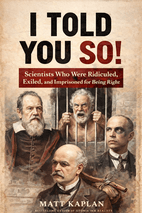
I Told You So! by Matt Kaplan Book Cover

by Matt Kaplan

Matt Kaplan's I Told You So! argues that lifesaving medical discoveries are routinely delayed by institutional inertia and human resistance, not a lack of evidence. Through historical and modern case studies, it reveals why good ideas fail and is intended for readers interested in the history of science and the psychology of innovation.

On Insta.page you also get an Apply This Book tool that lets you combine insights from up to 3 books to solve your specific situation.

Chapter mindmaps

Free preview: chapters 1–4 are fully interactive. Click any node to expand or collapse. Subscribe to unlock the rest.

Chapter 1: Chapter 1

Key concepts: Chapter 1

1. Chapter 1

The Hippocratic Legacy

  • Shifted medicine from gods to natural causes
  • Four humors theory became a medical straitjacket
  • Led to often harmful, balance-restoring treatments

Renaissance Backslide

  • Hippocratic ideas revived as dogma
  • Figures like Sydenham re-entrenched astrology
  • Actively stifled empirical inquiry in Europe

Ignaz Semmelweis's Struggle

  • Confronted rampant childbed fever in Vienna
  • Crucial observation linked fever to doctors' wards
  • Collision course with medical establishment

Scientific Bias in Practice

  • Preservation bias shapes the fossil record
  • Observation bias blinds researchers to evidence
  • Aesthetic biases shape entire fields of study

Tyranny of Paradigms

  • Comforting consensus views fiercely protected
  • Challenges to paradigms meet intense hostility
  • Gates of progress guarded by establishment

Mary Schweitzer's Modern Parallel

  • Discovery of dinosaur soft tissue challenged dogma
  • Met hostility threatening her career
  • Persevered with contamination-proof science

Human Drama of Discovery

  • Fight for new ideas is never just about data
  • Obsession fuels discovery but invites destruction
  • Acceptance requires tolerance for professional siege

Chapter 2: Chapter 2

Key concepts: Chapter 2

2. Chapter 2

Alexander Gordon's Medical Training

  • Educated in Herman Boerhaave's humoral theories
  • Served as a naval surgeon before Aberdeen
  • Became a city physician in Aberdeen

Puerperal Fever Discovery

  • Traced epidemics to caregivers, not air
  • Admitted his own role in spreading infection
  • Used meticulous notes and charts as evidence

Link Between Puerperal Fever and Erysipelas

  • Observed simultaneous outbreaks of both diseases
  • Theorized both required an entry point to infect
  • Correctly identified streptococcal connection

Gordon's Downfall and Legacy

  • Named midwives as carriers, causing public anger
  • Used brutal treatments like bleeding and purging
  • Fled Aberdeen; his preventive insights were forgotten

Smallpox and Inoculation Origins

  • Smallpox was deadlier than modern Covid-19
  • Inoculation practiced for centuries in China
  • Technique involved introducing pustule matter for immunity

Lady Mary Wortley Montagu's Advocacy

  • Championed inoculation after seeing success in Constantinople
  • Had her children inoculated despite risks
  • Her work led European royalty to adopt the practice

Corruption of Medical Knowledge

  • Doctors monopolized inoculation, increasing risks
  • Greed and secrecy hindered progress in medicine
  • Parallels modern issues like data hoarding in science

Chapter 3: Chapter 3

Key concepts: Chapter 3

3. Chapter 3

Washington's Military Medical Crisis

  • British reportedly used smallpox as germ warfare
  • Washington defied Congress to inoculate troops secretly
  • Created an immune army pivotal for victory

Pierre Louis: Statistical Medicine Pioneer

  • Used statistics to challenge bloodletting tradition
  • Proved early bleeding increased pneumonia mortality
  • Laid foundation for evidence-based medicine

Oliver Wendell Holmes & Childbed Fever

  • Applied statistical rigor to puerperal fever epidemic
  • Proved doctors spread disease from autopsies
  • Faced furious backlash from medical establishment

Social Resistance to Medical Innovation

  • Holmes's mentor publicly betrayed his findings
  • Personal attacks forced Holmes to retreat from practice
  • Shows evidence can seem heretical to professionals

Core Theme: Revolutionary Ideas from Margins

  • Transformative ideas often face immense social resistance
  • Path to truth requires resilience alongside data
  • Science operates as a social minefield

The Power of Statistical Evidence

  • Skoda taught Semmelweis the scientific method
  • Statistical analysis revealed Boer's low fever rate
  • Data exposed the impact of cadaver use

The Cost of Scientific Dogma

  • Boer was fired for refusing cadaver mandates
  • Woese's Archaea discovery met with hostile silence
  • Established paradigms actively resist fundamental change

Chapter 4: Chapter 4

Key concepts: Chapter 4

4. Chapter 4

Scientific Resistance and Hatred

  • Resistance to new ideas blends personal and scientific animosity
  • Established dogma is defended through attacks on pioneers
  • Modern examples include Carl Woese and Mary Schweitzer

The Outsider's Advantage

  • Outsiders see past orthodoxies due to lack of indoctrination
  • Examples: Schweitzer's faith, Horner's dyslexia
  • Backlash often silences brilliant researchers prematurely

Semmelweis vs. Klein Conflict

  • Fueled by professional humiliation and 1848 Revolution politics
  • Klein used political power to suppress Semmelweis's findings
  • Highlights the role of ego and institutional power

Pasteur's Political Survival

  • Learned to align with powerful from mentor's destruction
  • Erased mentor's contributions to secure his own career
  • Demonstrates political realities of scientific advancement

Methodical Investigation Under Fire

  • Semmelweis eliminated false clues to find cause of childbed fever
  • Identified contaminated doctors' hands as transmission vector
  • Rigorous data collection contrasted with political opposition

Katalin Karikó's Systemic Struggle

  • Faced professional sabotage and neglect for mRNA research
  • Highlights the grant dilemma undervaluing long-term research
  • Collaboration with Weissman led to pseudouridine breakthrough

Scientific Inertia and Cost of Change

  • Fear of shame and practical hassle maintains status quo
  • Modern case: Betsy Repasky's lab mouse temperature findings
  • Greatest barrier is entrenched power, pride, and inertia

Continue exploring I Told You So!