How to Rule the World Quotes
by Theo Baker
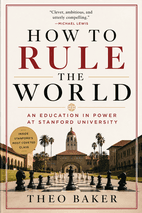
This collection pulls the sharpest lines from Theo Baker's investigation into the hidden machinery of power at Stanford. You'll find quotes that cut deep into ambition, privilege, and the price of trying to be extraordinary. Some are funny, some are brutal, and all of them make you think twice about who really runs things.
The book is quotable because Baker captures the exact moment when a system's glossy surface cracks. His subjects say things they probably shouldn't, and he writes with a reporter's eye for the telling detail. These aren't inspirational one liners. They are uncomfortable truths wrapped in clean prose.
Top Quotes from How to Rule the World
“We rule the world. The world doesn't know this yet.”
Bob Martin, an influential software pioneer, said this a decade ago.
This line encapsulates the hidden power of tech elites and the ignorance of the public, making it strikingly relevant in the age of AI and tech dominance.
“This is a book about the kids being raised to rule the world, and what they’re learning from those who already do.”
The author's concluding statement about the purpose of the book.
It succinctly summarizes the book's thesis and creates a powerful, provocative hook that resonates with readers interested in power dynamics.
“There's no party like a Stanford party,” someone joked to me after I arrived, “because a Stanford party was approved by a panel of administrators weeks ahead of time, has no alcohol, and gets shut down after twenty minutes.”
A student joking about the strict regulations on social events at Stanford.
This line wittily encapsulates the absurdity of bureaucratic overreach, making it a memorable and sharp critique of the 'War on Fun.'
“Impostor syndrome is rampant, especially among freshmen. Valedictorians go from the best of the best to just another straight-A kid in a place stuffed full of them.”
The author reflects on the pervasive feeling of inadequacy at Stanford.
It captures the universal, crushing experience of not belonging, even among the most accomplished, making it deeply relatable to anyone in a high-pressure environment.
“Because once you know that the Stanford inside Stanford exists—and once you get offered a seat at the table—you can never go back.”
The author describes the moment of realizing there is an exclusive insider world beyond the surface of Stanford.
Captures the irreversible nature of gaining access to elite networks and the permanent shift in perspective that comes with being 'plucked.'
“At Stanford, smiling, vital students appeared to glide across the water, serene, presenting effortless achievement. But beneath the surface, their legs, like a duck's, paddled desperately, relentlessly, just to keep afloat.”
The author explains the term 'Duck Syndrome' coined at Stanford to describe the gap between students' projected ease and their hidden struggles.
This metaphor perfectly captures the pressure-cooker culture of elite institutions, making the hidden anxiety of high achievers instantly relatable and unforgettable.
“I cannot describe how depressing that felt, that at seventeen I'd already lost the chance to be seen as a blank slate.”
The author reflects on how his investigative reporting made him a polarizing figure on campus before he could reinvent himself.
It articulates a deep, universal longing for anonymity and the pain of being prematurely defined by others, especially at a young age.
Themes Behind the Quotes
One major theme is the gap between appearance and reality. The Stanford students who seem to glide effortlessly are actually paddling frantically underneath. The institution projects merit and fairness, but back channels and secret societies decide who gets real access. This disconnect runs through nearly every quote, from the joke about controlled parties to the bitter awareness that you can never unsee the inner circle once you glimpse it.
Another theme is the cost of striving for elite status. Impostor syndrome haunts even the most accomplished freshmen. The pressure to say the right things and be the right kind of person warps behavior, sometimes leading to fraud and cover ups. And beneath it all lies a quiet question about whether the game is worth playing, especially when the deck is stacked from the start.
Quotes by Chapter
Prologue: Fear the Tree
“The Stanford inside Stanford comprises the group of students who are expected to inherit the earth, those courted constantly by the rich and powerful because they might be the Next Big Thing.”
The author describes the hidden elite student network at Stanford.
It vividly portrays the sense of destiny and privilege, capturing the core theme of the book: how a select few are groomed for power.
“It was more like a secret society, a Skull and Bones for the aspiring tech elite.”
Describing the nature of Justin's class at Stanford.
This line evokes the mystique of elite, secret organizations and resonates with readers who are fascinated by the hidden power structures that shape the tech world.
Chapter 1: Drafted to the War on Fun
“It was like watching someone strangle themselves and then appointing a committee to investigate the cause of death.”
The author's commentary on Stanford creating a task force to study the decline in social life.
This powerful metaphor perfectly captures the self-inflicted, futile nature of the administration's response, making the critique both dark and unforgettable.
“You had to take a class. And pass an exam. To be able to apply to host a college party.”
Explanation of the bureaucratic hurdles required to host a party at Stanford.
The stark, repetitive structure underscores the absurdity of the requirement, driving home the extent of overregulation in a punchy, quotable way.
“I am on stolen land,” it began, continuing in part, “I will commit to uplifting Indigenous and Black voices.”
The mandatory pledge that party attendees had to recite before entry.
This line exposes the performative wokeness that coexists with strict control, adding a layer of irony to the university's approach to social life.
Chapter 2: The Impostor
“Lies flowed from his mouth as easily as spent breath, building upon one another to erect a tower of elaborate deception.”
The author describes Will Curry, the impostor who infiltrated Stanford dorms.
This vivid metaphor paints a chilling picture of a compulsive liar, making the passage memorable and emphasizing the scale of his deceit.
“To get into Stanford is to be told you are extraordinary—among the high achievers and the strivers, it is treated as a value judgment on your worth as a person.”
The author critiques the harmful mindset around elite college admissions.
It exposes the toxic link between admission and self-worth, resonating with anyone who has felt their identity tied to external validation.
“When you have a Basquiat in your bathroom, what's anyone going to do about it?”
Logan explains how extreme wealth insulates people in Silicon Valley.
The absurd, concrete image of a priceless artwork in a bathroom perfectly illustrates untouchable power and privilege.
Chapter 3: Coupa Circuit
“But there are two mistaken assumptions that underpin that belief: (1) Simply wanting to be a great entrepreneur makes you one, and (2) opportunities are equitably distributed. Neither is true.”
The author reflects on the inner circle at Stanford and the myths surrounding entrepreneurial success.
It succinctly debunks two common delusions among aspiring entrepreneurs, exposing the reality of unequal opportunities and the gap between desire and achievement.
“What makes a city great is great management,” he said, “and amassing great wealth is proof you're capable of it.”
Julian, a student in a philosophy class, argues against Plato's view of private property and defends wealth as a sign of competence.
This blunt statement encapsulates the ideology of the Coupa Circuit, equating wealth accumulation with merit and managerial ability.
“Identifying yourself as the kind of person who wanted to be an entrepreneur did not make investors more likely to fund you.”
The narrator explains that membership in Stanford's entrepreneurship clubs was considered an 'anti-signal.'
This line captures the counterintuitive reality that overt ambition can actually repel investors, forcing readers to rethink how status and signaling operate in elite networks.
Chapter 4: Binary Bomb
“Don't do this,” he said sharply. “Marc Tessier-Lavigne is unassailable, and you do not want to go after him.”
Karsten, a scientist the narrator consulted, warns him not to investigate Marc Tessier-Lavigne's research.
This line captures the intimidation and deference to authority that can suppress investigative journalism, making it a powerful statement about the challenges of challenging powerful figures.
“I put mine up and looked around. Not a single other arm was in the air. People didn’t even care enough to pretend ethics mattered to them.”
The narrator raises his hand when a teaching assistant asks who cares about ethics, but no one else does.
This stark image reveals the apathy toward ethics in a competitive, tech-oriented environment, resonating as a critique of Silicon Valley culture.
“In Silicon Valley, he wrote, there were only “winners and losers,” fighting a “dumb game” to “say all the right shibboleths so everyone likes us.””
Sam Bankman-Fried's text message admitting his effective altruism was a front.
This candid confession exposes the cynical mentality behind many successful tech figures, making it a memorable indictment of performative morality.
“The code hadn't been independently reviewed, nor had the combination of hardware and software been tested before the machine was deployed in a hospital. Arrogance, a rush to produce a product, and unwillingness to address problems had deadly effects.”
Jerry Cain's lecture about the Therac-25 radiation therapy machine disaster.
This passage encapsulates how systemic failures in engineering and ethics lead to tragedy, serving as a timeless lesson on the importance of thorough testing and humility.
Chapter 5: A Fucking Menace
“If I woke up tomorrow with my head sewn to the carpet, I wouldn't be more surprised than I am right now.”
A British person on Twitter expressing astonishment at the story's revelation.
The vivid, absurd imagery makes the shock palpable and memorable, capturing the unexpected nature of the scandal.
“Decades from now, today will be seen as a pivotal moment in the collapse of the big charade that represents our institutions. This is Theo Baker's Watergate moment and he is an astounding journalist.”
A comment on Fizz from a Daily editor, Tammer, praising the author.
It captures the dramatic significance and self-aware ambition of the moment, while foreshadowing the long-term impact on institutional trust.
“I recognize the pattern because it happens all the time. They're going to have an internal, non-expert, conflicted, confidential investigation, and then guess what?”
Whistleblower Nancy Olivieri commenting on the board's investigation.
Her cynical prediction resonates with anyone skeptical of institutional cover-ups, and it proves prescient as the story unfolds.
“Indicates that not only were two separate blots copied and pasted within the same published image, but that the positioning and brightness/contrast of these blots were modified so as to conceal the fact they are copies. This indicates an intent to deceive readers.”
Researcher Bryon Hughson explaining a new manipulation finding in a 2003 Nature paper.
The technical detail and explicit mention of intent to deceive provide concrete, damning evidence, raising the stakes of the investigation.
Chapter 6: Rule
“He “preyed on our desire for exclusivity,” one recalled.”
A student describes how Justin, the Rule professor, attracted students.
It exposes the psychological manipulation behind exclusivity, resonating with anyone who has felt drawn to something forbidden.
“The purpose of Rule,” she said, “is to separate who was in and who was out.”
Janet, a former student, explains the class's real purpose.
It cuts through the mystique to reveal the gatekeeping mechanism, striking a chord with those skeptical of elite institutions.
“You're treated like royalty if you say the right things.”
A student reflects on the rewards of conforming to insider culture.
It highlights the shallow incentives that drive behavior in exclusive networks.
“For a select group of people—those with increased agency—a great amount of value can be extracted from the people around you.”
The author summarizes Justin's teaching philosophy in the Rule class.
It encapsulates the predatory mindset at the heart of the chapter, revealing how the course frames exploitation as a skill.