How to Be Good at Life Quotes
by Ben Meer
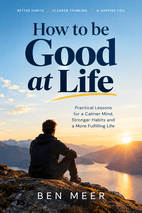
This page collects lines from the book How to Be Good at Life. You will find thoughts on systems, routines, discipline, focus, resilience, and the quiet work of facing what actually holds you back. Some are practical. Some are sharp. A few will make you stop and rethink a habit you have been carrying for years.
What makes these quotes work is their directness. They turn big self-improvement ideas into simple observations you can use on a normal Tuesday. They are easy to remember, easy to share, and often land because they name a problem you already feel. Read one, sit with it, then see where it applies.
Top Quotes from How to Be Good at Life
“Every great life runs on two types of systems: the ones that hold the line, and the ones that move the line. Defense keeps you in the game. Offense changes the score.”
The chapter's core distinction between defensive and offensive systems.
It reframes personal growth as a balance between stability and progress. The paired cadence makes the idea easy to remember and apply.
“Routines preserve your floor while projects raise your ceiling. When they work together, you don’t just grow—you grow without collapse.”
The chapter describes how routines and projects complement each other.
The floor-and-ceiling metaphor clarifies why people need both stability and ambition. It promises growth without burnout.
“Sit near excellence, and your excuses start sweating.”
After describing how his roommate Dan’s standards influenced him, the author draws this conclusion.
It vividly shows how environment can raise standards and dissolve excuses.
“If willpower is a flickering candle, systems are electricity.”
The book’s opening to Part III appears immediately after Chapter 8’s System Snapshot.
The metaphor makes an abstract productivity principle concrete and memorable.
“What looks like superior discipline is actually superior design.”
After explaining that disciplined people save willpower for unpredictable moments, the author names the real mechanism.
It succinctly flips the common belief that self-control is a personal trait into a matter of environment design.
“The secret isn’t having more willpower. It's needing less of it.”
This line closes the section on using systems to minimize reliance on willpower.
It captures the book’s core paradox: freedom and follow-through come from needing less willpower, not more.
“Amateurs do what they feel like doing when they feel like doing it. Professionals have systems—repeatable methods for handling both the work they love and the work that just needs to get done.”
The author distinguishes amateur versus professional after realizing he avoided operational systems.
It reframes professionalism as infrastructure rather than motivation.
Themes Behind the Quotes
The book keeps returning to the idea that life improves when you deal with causes, not symptoms. Beliefs shape behavior. Systems shape follow through. Willpower is treated as unreliable, while design, routines, and constraints are treated as dependable. Protection keeps what already works intact. Pursuit moves you toward something better. Both are needed.
Another thread is attention and environment. The people you stand near, the patterns you notice, and the projects you choose all influence what you become. Progress comes from simplifying, starting small, and focusing on one meaningful move. Resilience is not just bouncing back. It is preparing for hard days and responding when plans break. Underneath it all is a quieter goal than maximum output: a calm mind and a life that can grow steadily.
Quotes by Chapter
Chapter 4: Fix the Right Thing, Fix Almost Anything
“Fixing the right thing could fix nearly anything.”
After explaining Donald Messersmith’s root-cause solution to the monument bird problem, the author states the lesson he took from it.
It compresses the chapter’s core promise into a simple, memorable phrase. It shifts effort from doing more to targeting the true cause.
“No matter how many changes you make, you'll stay stuck if you don’t uncover what's really holding you back.”
The author is explaining why the Define phase of DRIVE matters before building systems.
It warns that activity is not the same as progress. It pushes readers to diagnose before they try to fix.
“The quality of your life rises or falls with the number of root causes you're willing to face.”
This appears near the end of the Tomorrow Tax patterns section, after examples across the Life Engines.
It makes personal growth sound like a direct tradeoff between avoidance and quality of life. It is both confronting and empowering.
“Beliefs are the source code of your life. Change the code, and better systems become possible.”
The author says this after explaining the Iceberg Model’s deepest level, where beliefs drive systems and patterns.
It gives a clear metaphor for why mindset work matters. It connects inner assumptions to outer results.
Chapter 5: Protect and Pursue: The Systems That Create Breakthroughs
“The winning formula is to protect what matters while pursuing what's next.”
The chapter summarizes the Protect and Pursue formula.
It gives readers a simple decision rule: safeguard what you cannot lose while still reaching for what is next.
“Breakthroughs don't come from chasing everything at once. Rather than try to boil the ocean, you focus on one project that can move the needle.”
The chapter introduces the Ninety-Day Focus Rule.
It confronts the common mistake of scattering effort across too many goals. The ocean metaphor makes focus feel both urgent and achievable.
Chapter 6: Pattern Matching: Success Leaves Clues
“Success doesn’t begin with genius. It begins with paying attention.”
The chapter uses this line to summarize how Beyoncé, Michael Jackson, and James Brown built on earlier greatness.
It reframes success as attentiveness rather than innate brilliance.
“Pattern matching is the loophole that lets you skip years of trial and error. Not by copying, but by recognizing what works and making it yours.”
The chapter introduces pattern matching as a way to learn from others without direct access.
It promises accelerated learning while preserving authenticity instead of mere imitation.
“Pattern matching works because excellence is never born in isolation: It's observed, adapted, and passed forward.”
The chapter closes by explaining how successful patterns are transmitted across generations and fields.
It makes excellence feel learnable, communal, and repeatable rather than mysterious.
Chapter 7: The First Domino: The Secret to Building Momentum
“The secret of getting ahead is getting started. The secret of getting started is breaking your complex, overwhelming tasks into small manageable tasks, and then starting on the first one.”
The chapter opens with this attributed Mark Twain line.
It captures the entire chapter in two steps: start, then make the start small. It is instantly memorable and actionable.
“Procrastination is a systems problem, not a character problem.”
The chapter reframes procrastination in its section on beating it.
It removes shame by treating procrastination as a design flaw rather than a personal failing. It points readers toward clarifying the next action.
“Life doesn’t come with numbered bags, but you can create your own. Once you do, that paralyzing uncertainty fades.”
The chapter uses the LEGO Millennium Falcon to explain chunking and tells readers they can design their own small steps.
It turns a productivity principle into a hopeful metaphor. It reminds readers that structure is something they can create rather than wait for.
“What changed wasn’t my courage. It was my order. I out-systemed the fear.”
The author reflects on overcoming his fear of public speaking with the 4-Bullet Update.
It captures how structure, not sudden bravery, can defeat fear. The invented phrase 'out-systemed' is memorable and empowering.
Chapter 8: Plan Like a Bank Robber
“No contingency plan survives an armed barber who skips small talk.”
Lamm’s crew is ambushed by a shotgun-wielding barber during their meticulously planned escape.
It captures how an absurd, unplanned detail can defeat even a master contingency planner, making the lesson memorable.
“Lamm’s collapse reveals something essential about resilience: It requires both prevention and response. Prevention stops problems before they start; response keeps you moving when they break through.”
After detailing Lamm’s downfall, the narrator draws the chapter’s central resilience lesson.
It distills resilience into two complementary actions: stop what you can and prepare to respond to what you cannot.
“The best systems aren't built for the perfect day. They're built for the hard ones.”
The narrator concludes the Bulletproof Living list by explaining what systems are actually for.
It reframes resilience as designing for adversity rather than optimizing for ideal conditions.
Chapter 9: Chosen Constraints: The Rules That Set You Free
“Without banks, a river becomes a formless swamp. But the very constraints that seem to restrict water's movement give it power, direction, and the ability to carve canyons.”
The author uses a river as a metaphor for how constraints give human potential direction and force.
It reframes limits as the source of power and direction rather than something that merely restricts.
“Sometimes the fastest path to extraordinary results is temporarily limiting ordinary choices.”
The author offers this as the counterintuitive lesson of chosen constraints and Monk Mode.
It makes the counterintuitive case that narrowing choices can accelerate extraordinary outcomes.
Chapter 10: Success Is Scheduled
“Greatness doesn’t happen by accident. And neither does presence.”
The author reflects on Serena Williams scheduling relaxation and family time.
It reminds readers that both excellence and being present require deliberate design.
“The goal was never productivity. It was peace of mind.”
The author argues that scheduling is not just about output but mental calm.
It shifts productivity from doing more to reducing mental load.
“Show me someone who time blocks their priorities, and in a few years, I'll show you an “overnight” success story.”
The author describes the payoff of consistently scheduling big-rock priorities first.
It makes consistent planning the hidden cause behind sudden success.
Chapter 11: Automate: Systems That Never Sleep
“The most important use of a tool as powerful as Al is to augment humanity, not to replace it.”
Fei-Fei Li's epigraph opens the chapter.
It frames automation as a way to amplify human capability rather than replace people. That principle anchors the chapter’s practical advice.
“His genius wasn’t the soup cans. It was knowing what deserved his time—and what didn't.”
The chapter describes how Andy Warhol turned his art into a Factory-like system.
It locates genius not in output alone but in knowing what deserves your attention. A powerful reminder that automation starts with prioritization.