House of Fidelity Quotes
by Justin Baer
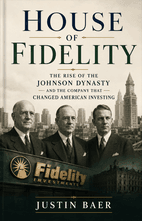
Looking for the best quotes from House of Fidelity by Justin Baer? Below are the lines that stand out most across the book.
The quotes are organized by chapter, each with a short note on where it appears and why it stands out.
Top Quotes from House of Fidelity
“Here was the picture of a world in which it was every man for himself, no favors asked or given. You were what you were, not because you were a friend of somebody, but for yourself.”
Ted Johnson describing the meritocratic ideal he saw in Jesse Livermore's story.
It articulates the powerful allure of self-reliance and personal accountability in the market, a philosophy that resonates with anyone seeking independence and fair reward.
“I sat on my little poop-deck potting away, and kept my capital intact.”
Ted Johnson reflecting on how he navigated the 1931-1932 market drop.
The vivid naval imagery combines humility and shrewdness, showing Ted's cool-headed discipline during the Great Depression and foreshadowing his future success.
“The market,” he once said, “is like a beautiful woman—endlessly fascinating, endlessly complex, always changing, always mystifying. I have been absorbed and immersed since 1924 and I know this is no science. It is an art. It is personal intuition, sensing the patterns of behavior. There is always something unknown, undiscerned.”
Ted Johnson, the founder of Fidelity, describing his view of the stock market.
This quote captures Johnson's belief that investing is an art rather than a science, emphasizing intuition and mystery, which became a core philosophy at Fidelity.
“He was the most-powerful powerful man I ever met, not by position but by personality,” one longtime adviser said. “When he looked and talked to you, you felt naked.”
A longtime adviser describing Ted Johnson's commanding personal presence.
It vividly illustrates the intense, almost intimidating charisma Johnson wielded, showing how his personality alone commanded loyalty and awe.
“If you buy GM at forty and it goes to fifty, whether you are an Oriental, a Korean, or a Buddhist doesn’t make any difference.”
Gerry Tsai explains why he felt no competitive disadvantage as a foreigner in the stock market.
It captures the market's meritocratic ideal and Tsai's bold confidence, resonating with anyone who believes success should be based on performance alone.
“My grandmother was a trader,” said Christopher Tsai, Gerry Tsai’s son. “Ruth told him the No. 1 lesson is not to lose money. But an equally important lesson is to always remember last night's closing price is your cost basis.”
Christopher Tsai describes the investment advice his grandmother Ruth gave to her son Gerry.
This reveals the origin of momentum investing and the psychological discipline of focusing on recent prices, a radical idea that would later reshape the industry.
Quotes by Chapter
Chapter 2: Number Two
“Here’s your rope. Go hang yourself with it.”
Ted Johnson's response when Gerry Tsai asked permission to launch a growth-stock fund.
The dark humor and implicit trust in Tsai's ability—or willingness to let him fail—make this line instantly memorable and emblematic of Johnson's management style.
Chapter 3: Ned Johnson
“Young man. When you take over, Fidelity will be bankrupt in three years.”
Gwen Shannon reprimanded Ned after he ordered an extra phone device for his desk.
This sharp rebuke became a pivotal motivational moment; Ned later called it the greatest motivational speech he'd ever heard, illustrating how criticism can ignite determination and reshape a career.
Chapter 4: The Go-Go Years
“Fifty thousand,” Gerry Tsai said. “See,” Gerald Sr. said, turning to his wife, “my son still doesn’t know the value of money. He's not going to result in anything in life.”
Gerald Tsai Sr. responds to his son's purchase of an expensive Alexander Calder mobile during a visit to Gerry's mansion in Greenwich.
It reveals the painful gap between a father's traditional values and his son's spectacular financial success, highlighting the enduring need for parental approval.
“The three large “growth” (the quotation marks are more applicable now) funds with the best record in the preceding few years, Fidelity Capital Fund, Putnam Growth Fund, and Wellington Equity Fund averaged an overall minus 32.3% for the first half.”
Warren Buffett, in his 1962 letter to shareholders, delivers a stinging epitaph to the growth-stock rally and its biggest beneficiaries.
Buffett's characteristic wit and irony underscore the fragility of market hype and the danger of chasing past performance, a timeless investing lesson.
“Boy, are we going to have fun with this money!”
Ned Johnson's reaction upon learning Fidelity's annual profit was $5.5 million.
It captures his exuberant, almost playful attitude toward wealth and spending, contrasting with his father's sheepishness.
“We had one bad year, in 1968, and I've been killed in the press ever since,” he said years later. “Like a ballplayer, right? If you have ten good games and one lousy game, you're a bum. I don't think that's fair.”
Gerry Tsai reflecting on media criticism after his Manhattan Fund's poor performance in 1968.
It reveals his sense of unfairness and the pressure of public perception, likening himself to a ballplayer judged harshly for one bad season.
Chapter 5: Fidelity, Thy Name Is Ned
“It lasted a long time, certainly several decades, but the best rule is: When the music stops, forget the old music.”
Ted Johnson said this during a lunch meeting recounted by George Goodman in The Money Game, reflecting on the end of the Go-Go Years.
The metaphor of music captures the necessity of abandoning past strategies when markets change, a timeless lesson for investors.
“I think I've run the company long enough. Either we ought to turn it over to someone else. Or you ought to take it on.”
Ted Johnson spoke these words to his son Ned, initiating the succession of Fidelity's leadership.
This casual, gentle delivery underscores the weight of a generational shift and the respect Ted had for Ned's choice.
“We were fighting for survival.”
Ned Johnson wrote this years later, recalling Fidelity's dire situation as assets and sales plummeted between 1969 and 1982.
This stark sentence encapsulates the existential threat the company faced, making the subsequent turnaround more remarkable.
“Ned Johnson hated bonds, dismissing debt funds as unimaginative and ultimately useless to investors when interest rates were on the rise.”
This describes Ned Johnson's personal aversion to bonds early in his career.
It captures Ned's contrarian instinct and foreshadows how necessity would force him to embrace bonds, a decision that saved Fidelity.
Chapter 6: One Up, and One Down, on Wall Street
“And so necessity had become the mother of invention, of new businesses and ideas that would bring changes to Fidelity that would endure even after the Dow began to tick up, at long last, in 1982.”
The opening of the chapter describing Fidelity's response to the downturn in the 1970s.
This line captures the central theme of innovation through adversity, showing how hard times forced Fidelity to evolve in ways that outlasted the market's recovery.
“Lynch simply worked harder, and longer, than ever before to find new stocks.”
Describing Peter Lynch's approach as Magellan Fund grew rapidly in the 1980s.
It succinctly defines Lynch's relentless work ethic, which became legendary and is a key reason for his extraordinary success.
“The biggest events of his life, however tragic or triumphant, were footnoted by the Dow's performance that day.”
Illustrating Lynch's all-consuming focus on the stock market.
This vivid metaphor powerfully conveys how investing dominated every aspect of Lynch's life, making his humanity relatable yet extreme.
“It was a jarring episode—and it might have done lasting damage to Fidelity's reputation.”
Reflecting on the Ostrander scandal involving warrants and insider trading.
This line underscores the severity of the scandal and the potential threat to Fidelity's brand, which ultimately weathered the storm.
Chapter 7: Big Money
“Sam, look, we have to get ready to run big money.”
Bruce Johnstone, a veteran Fidelity portfolio manager, addresses Sam Bodman during a monthly meeting in August 1982, predicting an imminent market rally.
This line marks a pivotal moment when a seasoned insider calls for a strategic shift to capitalize on a long-awaited bull market, capturing the tension between skepticism and opportunity.
“Entering the brokerage business,” he said, “was like climbing the mountain to take cello lessons.”
Peter Lynch, Fidelity's star fund manager, criticizes the company's decision to start a discount brokerage.
The vivid metaphor conveys the absurd difficulty and mismatch of the venture, making the line both memorable and revealing of the internal doubts about diversification.
“That's why,” Ned said, surely in on the joke, “we call Jim ‘the executioner.”
Ned Johnson explains the role of James Curvey, his trusted deputy, during a meeting at the Chicago Mercantile Exchange.
The dark humor and blunt nickname illuminate Ned's management style and the ruthless efficiency he valued in his closest aides.
“Ned, I don’t know anything about this stuff.” “Don't worry,” Ned would say. “You'll learn.”
James Curvey expresses doubt about a project; Ned Johnson reassures him with confidence in his ability to adapt.
This exchange captures the trust and mentorship between Ned and his executives, highlighting a leadership philosophy that valued learning on the job.
Chapter 8: Abigail Johnson
“I'm the chairman,” Ned explained, “so I'm not sure who I can transfer you to.”
During the Blizzard of 1978, Ned answered customer calls and responded to a client demanding to speak to his manager.
This line captures Ned's hands-on humility and dry humor, showing he was willing to do any job—even taking customer complaints—despite being chairman.
“It's a piece of shit," she would say when asked about a disappointing stock in her remit."”
Abigail Johnson's blunt assessment of a poor-performing stock in her portfolio.
The line reveals the steely resolve and no-nonsense attitude hidden beneath her quiet demeanor, surprising those who underestimated her.
Chapter 9: Retirement
“Kaizen, an amalgam of the Japanese words for “improvement” and “good change,” evangelized the pursuit of incremental, if relentless, improvements in organizations.”
Describing the philosophy that captivated Ned Johnson and influenced Fidelity's operations.
This line succinctly captures a powerful management philosophy that emphasizes continuous, small improvements, a concept that has inspired countless organizations.
“There are always a few things you can never do,” he told his charges. “But there are a lot of ways to get to yes.”
Robert Reynolds, head of Fidelity's 401(k) business, motivating his team to find solutions for corporate clients.
It encapsulates a pragmatic, can-do attitude that turns obstacles into opportunities, making it a memorable mantra for problem-solvers.
“He reverted to his normal schedule only after an answer to his question emerged. Until, of course, the next blip appeared, demanding his full attention.”
Describing Ned Johnson's tinkerer approach to running Fidelity.
This vividly illustrates his relentless, iterative leadership style, showing how he dove deep into problems and then moved on to the next challenge.
“But this was full-frontal capitalism, between consenting adults, and a practice that continues to resurface whenever a portfolio manager appears to get too big for their britches.”
Describing the short sellers who targeted Jeff Vinik's Magellan fund.
Captures the ruthless, cyclical nature of financial markets and the hubris that often precedes a fall.