House of Fidelity Key Takeaways

by Justin Baer

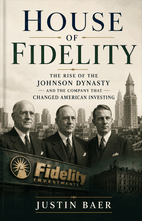
House of Fidelity by Justin Baer Book Cover

5 Main Takeaways from House of Fidelity

Stock picking is an art, not a formula

Ted Johnson rejected committees and algorithms, believing a single intuitive mind should pick stocks. This philosophy birthed the star fund manager model that defined Fidelity and drove its success for decades.

Mentorship shapes dynasties more than bloodlines

Gerry Tsai was treated as a surrogate son, Peter Lynch’s protégés became Fidelity’s next generation of leaders, and Ned Johnson’s patient guidance allowed his daughter Abby to find her own path. Long-term investment in people, not just stocks, built the firm’s resilience.

Family businesses must choose merit over entitlement

Ned Johnson insisted future CEOs would be chosen on merit, even as he groomed Abby. The tension between family control and professional management played out in succession battles, layoffs, and cultural overhauls that preserved the firm’s independence.

Adapt or stagnate: index funds are inevitable

Despite Fidelity’s profits from active management, Ned recognized the shift toward passive investing. The firm’s later embrace of index funds and cost-cutting reforms showed that even the best active managers must evolve or get left behind.

Accountability starts with culture, not just compliance

From the 'Reign of Terror' trading scandals to the MeToo reckoning, Fidelity learned that public crusades for fairness cannot hide internal rot. Abby Johnson’s decisive firings and cultural reforms proved that lasting change requires real-time feedback and flattened hierarchies.

Executive Analysis

These five takeaways weave a single narrative: Fidelity’s enduring success came from a unique blend of contrarian vision, intense mentorship, and family-business grit, but that very formula also bred blind spots—excessive reliance on star managers, resistance to market shifts, and cultural complacency. The book argues that the Johnson family’s willingness to adapt, even when it meant painful succession or public scandal, allowed Fidelity to survive and thrive across generations, while many peers crumbled.

This book matters because it demystifies the inner workings of one of the world’s most private financial giants, offering rare lessons on leadership, talent development, and the long game of building an independent dynasty. It stands apart from typical business biographies by focusing on the messy human dynamics—failed drugs, family rifts, and impulsive decision-making—that often determine long-term outcomes more than any strategy. For entrepreneurs, investors, and leaders, 'House of Fidelity' is a masterclass in balancing conviction with adaptability.

Chapter-by-Chapter Key Takeaways

Mister Johnson (Chapter 1)

  • Ted Johnson broke with his mentor Parker after secretly competing with Incorporated Investors, marking the start of his independent empire.

  • He built Fidelity’s three-pillar structure: the fund itself, the advisory firm (FMR Co.), and the distributor (Crosby Corp.), giving him full control.

  • Caleb Loring’s arrival signaled the creation of a devoted inner circle that would serve the Johnson family for decades.

  • Johnson’s investing philosophy rejected committees and formulas; he saw stock picking as an art best left to a single, intuitive mind.

  • This approach unwittingly set the stage for the star fund manager, a concept that would define Fidelity and 20th-century finance.

Try this: Break with mentors early if their constraints limit your vision, but do it secretly and cleanly to avoid burning bridges you might need later.

Number Two (Chapter 2)

  • Gerry Tsai’s immigrant story and his mother’s trading wisdom shaped a new investing style—momentum investing—that would later dominate parts of the industry.

  • Ted Johnson saw in Tsai not just a talented stock picker but a surrogate son, reflecting his own belief in meritocratic markets.

  • The postwar bull market, fueled by war bond habits and middle-class prosperity, created fertile ground for mutual funds and celebrity money managers.

  • Tsai’s launch of Fidelity Capital in 1957 marked the beginning of a new era: aggressive growth funds run by charismatic, larger-than-life investors.

Try this: Embrace momentum investing by following market trends, but remember it started as a risk-taking innovation from an immigrant who saw opportunity where others saw panic.

Ned Johnson (Chapter 3)

  • Ned's unconventional mind—likely shaped by undiagnosed dyslexia and ADHD—forced him to develop creative problem-solving skills that would prove invaluable in managing through market crises.

  • His father Ted exemplified patient mentorship, allowing Ned to discover his own path to the markets rather than forcing the family business upon him.

  • The early skepticism of Ned's colleagues at Fidelity, captured memorably by Gwen Shannon's bankruptcy prediction, would become the fuel for his later determination to prove them wrong.

  • Ned's fascination with how things worked, from grandfather clocks to telephone equipment to industrial processes, laid the groundwork for his eventual ability to see technological opportunities before his competitors.

Try this: Leverage your unique cognitive quirks—like dyslexia or ADHD—as creative problem-solving assets rather than liabilities, and give others the space to discover their own paths.

The Go-Go Years (Chapter 4)

  • Gerry Tsai’s sale to CNA earned him millions but forever tarnished his reputation as the “customers’ yachts” parable attached itself to his legacy.

  • Fidelity lost several key executives in the late 1960s (Tsai, Grimm, Shannon) but attracted fresh talent like Johnstone, Greenfield, and Dworsky.

  • Contrafund, launched in 1967, embodied the Johnsons’ contrarian philosophy and gave Leo Dworsky a prominent platform.

  • Ned Johnson emerged as the heir, applying his stock-picking instincts to the business itself, with a flair for spending and innovating that would reshape Fidelity after the market’s long winter.

Try this: Build a contrarian brand by launching products that go against the crowd (like Contrafund), and use market downturns as opportunities to attract fresh talent.

One Up, and One Down, on Wall Street (Chapter 6)

  • Fidelity's sector funds served a dual purpose: guaranteed relative outperformance in any market condition, and a proving ground for young talent.

  • Peter Lynch's mentorship extended beyond formal training—his evening chats with Ned Johnson and open-door policy shaped Fidelity's culture of hands-on learning.

  • Lynch's protégés went on to run major funds, including Magellan, Contrafund, and international venture capital, demonstrating the lasting impact of his approach.

  • The careers of Jeff Barmeyer and Joel Tillinghast show that Fidelity valued character and resilience as much as stock-picking skill.

  • Will Danoff's long tenure at Contrafund stands as the ultimate testament to Lynch's legacy: patience and persistence can yield extraordinary results.

Try this: Use sector funds as both a performance hedge and a training ground for young talent, then invest heavily in open-door mentorship that creates a pipeline of loyal leaders.

Big Money (Chapter 7)

  • Ted Johnson’s death from Alzheimer’s in 1984 marked the end of an era, with his granddaughter Abigail emerging as a future leader.

  • Black Monday 1987 tested Fidelity’s new operational scale; the firm’s early sell orders made it a target of the Brady Commission, but executives defended their actions as necessary to meet redemptions.

  • The crash prompted Fidelity to lay off 10% of its workforce, signaling a shift from rapid expansion to consolidation.

  • Internal tensions surfaced: key executives like Gould and Bodman exited (one by death, one by departure), clearing the path for the next generation—Abigail Johnson.

Try this: After a market crash, defend your firm's operational decisions publicly but also be ready to cut staff and consolidate—survival requires both backbone and flexibility.

Abigail Johnson (Chapter 8)

  • Abigail Johnson’s path to leadership was shaped by her father’s quiet, long-term planning—including funding academic research on family businesses and gender dynamics—even though he never explicitly told her she would run the company.

  • Growing up, Abby was drawn to the excitement of Fidelity but remained intensely private about her family, keeping her background hidden from college friends and business school classmates.

  • Her early career was deliberately unprivileged: she worked at a consulting firm first, then joined Fidelity as an analyst, staying in Motel 6s and avoiding special treatment.

  • Despite being added to the board and given a greater equity stake by 1995, Abby was not a confident or flashy manager; she was introverted, blunt, and more interested in picking stocks than managing people.

  • The chapter highlights the tension between Ned’s belief in Fidelity as a family business and his insistence that future CEOs would be chosen on merit—a balance Abby would have to navigate.

Try this: Start your career in the least privileged role possible, even if you're an heir, to earn credibility and learn the business from the ground up without expecting special treatment.

Retirement (Chapter 9)

  • Curvey's blunt critique led to the removal of Burkhead and Hondros, but the public airing of the "burned to a crisp" comment permanently fractured their relationship.

  • Bob Pozen, originally Fidelity's general counsel, was promoted to run the mutual-funds business—a move that surprised many but steadied the ship through morale-building stock grants and clearer investment mandates.

  • Fidelity's ownership structure was modernized: the Johnson family stake fell to 49%, Abby became the largest individual shareholder, and the company's private status was formally locked in.

  • Ned's refusal to sell to Sandy Weill—and his cheeky counter-question—underscored his commitment to keeping Fidelity independent.

Try this: When internal leadership fails, don't hesitate to bring in an outsider to stabilize the ship, but empower them with stock grants and clear mandates to rebuild morale.

Inheritance (Chapter 10)

  • Ned Johnson's father's Alzheimer's diagnosis drove him to personally fund brain disease research, leading to the Foundation for Neurologic Diseases and Alzforum.

  • Fidelity Capital was Ned's way to invest in his own ideas without constraints, producing successes like BostonCoach and COLT, but also failures like ProBuild.

  • Ned's real estate projects ranged from practical (Seaport Hotel) to purely aesthetic (Yin Yu Tang house), reflecting his hands-on approach.

  • His health-care bets were deeply personal, but the Alzheimer's drug he sole-backed failed in 2015, a quiet disappointment.

  • Ned refused to sell COLT at the market peak, a decision that frustrated some but turned the investment into a lasting asset.

Try this: Invest in personal passions (like real estate or health research) with your own capital, but accept that not every bet will pay off—the failures teach as much as the wins.

Next Gen (Chapter 11)

  • Ned Johnson’s in-law hiring policy proved flexible until divorce forced an uncomfortable separation, showing the limits of written family-business rules.

  • Iora Health’s rise and sale to Amazon underscored how Fidelity’s venture arm could incubate disruptive health-care models by betting on founder spouses like Chris McKown.

  • Daniel Auerbach’s early, patient investment in Alibaba became one of Fidelity’s most lucrative global moves, demonstrating the power of long-term conviction in emerging markets.

  • Edward Johnson IV found his niche outside the stock market, building Pembroke into a global real-estate firm that remains family-controlled.

  • The move from the historic Devonshire Street headquarters symbolized both the end of an old chapter and the family’s ability to adapt physically as well as strategically.

Try this: Create flexible in-law hiring policies that anticipate divorce, and let the next generation find their own niches (like real estate or venture) rather than forcing them into the core business.

The Bubble Bursts (Chapter 12)

  • The dot-com crash validated contrarian value investing but punished its practitioners in the short term; timing matters as much as conviction.

  • Regulation Fair Disclosure ended the era of informational privilege for active fund managers, accelerating the long-term shift toward index funds.

  • Fidelity’s internal leadership transition—from Curvey to Reynolds, and from Pozen to Abby Johnson—was shaped by the market downturn and personal vendettas.

  • Ned Johnson’s impulsive cancellation of AmEx cards revealed a defensive streak that would define the firm’s next decade.

  • The seeds of future scandal were planted in Fidelity’s aggressive push to cut trading costs, personified by Scott DeSano.

Try this: Time your value-investing conviction with patience, but recognize that regulatory changes (like Reg FD) can permanently shift the landscape—adapt your information edge accordingly.

Reign of Terror (Chapter 13)

  • Public crusades can’t shield a firm from its own internal vulnerabilities. DeSano’s victory over market unfairness was undercut by the very traders who had fought at his side.

  • The Jefferies investigation revealed a common but corrosive practice: quid-pro-quo entertainment between brokers and fund managers, often invisible until expense reports are audited.

  • For Fidelity, the timing couldn’t have been worse. Having demanded higher standards from everyone else, the firm now faced the same scrutiny—and the risk that its leadership’s moral authority would collapse alongside its own compliance.

Try this: Publicly call out industry misconduct only after securing your own compliance house, because one expense report audit can destroy your moral authority overnight.

Succession (Chapter 14)

  • The aftermath of the boardroom showdown saw key allies fired or reassigned, while the gift scandal lingered until 2008, ending with fines and new compliance oversight.

  • Scott Conroy transformed Fidelity's trading desk by rebuilding Wall Street relationships, opening the floor to portfolio managers, and modernizing broker evaluation.

  • Stephen Jonas's lack of investment experience made him an unpopular successor to Abby, and his tenure was short-lived.

  • Abby's assignment to the troubled Workplace Investing business became her proving ground, where she turned around operations and positioned herself for future leadership.

  • Family reconciliation—driven by Lillie Johnson and Abby's cancer diagnosis—gradually repaired the rift between Ned and his daughter.

  • Reynolds's failed NFL commissioner bid and Jonas's resignation opened the door for Rodger Lawson's return, setting up a new round of internal competition for the CEO role.

  • Despite Lawson grooming external candidates, Abby's growing responsibilities and the family's insistence that the business stay intact kept her in the picture.

  • The chapter closes with the world outside Fidelity darkening—a perfect storm of financial crisis looming while the succession question remained unanswered.

Try this: After a scandal, rebuild Wall Street relationships by opening your trading floor and modernizing broker evaluations, while grooming the next leader through a tough turnaround assignment.

Crisis Management (Chapter 15)

  • Abby Johnson was positioned to lead Fidelity’s future—overseeing 70% of employees in the direct-to-customer and workplace divisions—but her father remained unconvinced she was the right person for the top job.

  • Despite Fidelity’s enormous profits from active management, Ned Johnson recognized the shift toward index investing and grew restless with the status quo.

  • Ned’s pattern of courting outside successors continued, setting up a final confrontation between Abby and yet another rival for the CEO seat.

Try this: If you're the designated successor, take ownership of the most troubled division first—proving you can fix a mess is the fastest way to win over skeptics and the board.

Abdication (Chapter 17)

  • Baker’s success masked a toxic culture, and the MeToo movement forced an overdue reckoning at Fidelity.

  • Abby Johnson moved decisively: she fired Baker, overhauled the equities division’s culture, and elevated women and analysts to equal standing.

  • The changes—real-time feedback, flattened hierarchies, and immediate action on misconduct—represented a fundamental shift from the old Johnson-era playbook.

  • Fidelity’s willingness to reconcile with Baker, and its quick retreat under scrutiny, reveals the tension between business pragmatism and cultural accountability.

Try this: When a toxic culture surfaces, fire the top performer immediately to signal zero tolerance, then flatten hierarchies and elevate underrepresented voices to create lasting change.

A Twenty-Year Plan (Chapter 19)

  • Long-term success often requires contrarian vision and personal sacrifice, as seen in Ned Johnson’s Fidelity legacy.

  • Family business dynamics can either fuel or fracture a twenty-year plan—Mondavi’s coup is a stark warning.

  • Patience and reinvention, from rags to riches, are the true engines of dynasty building.

  • The best plans deserve to be fully understood before the final act unfolds.

Try this: Build your twenty-year plan on contrarian vision and personal sacrifice, but leave room for reinvention—the dynasty that adapts survives the dynasty that rigidly follows the script.

Continue Exploring