Good Writing Quotes
by Neal Allen
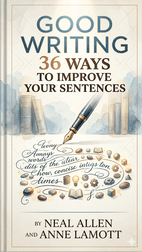
Looking for the best quotes from Good Writing by Neal Allen? Below are the lines that stand out most across the book.
The quotes are organized by chapter, each with a short note on where it appears and why it stands out.
Top Quotes from Good Writing
“The more specific the verb, the less likely you'll need an adverb.”
The author discussing a key benefit of strong verbs.
It's a concise, actionable insight that ties verb choice to concision, directly improving writing clarity.
“A STRONG VERB IN A sentence instantly improves your writing.”
Anne's take on the rule, presented in all caps for emphasis.
The emphatic capitalization and direct statement make it a powerful, quotable summary of the chapter's core advice.
“You see the old man—the noun—and what he is doing—the verb: carving something, holding it in one hand, slicing off thin layers of wood into a shape he has in his mind, to be revealed.”
The author illustrating how strong verbs create a vivid mental image.
This sentence demonstrates the principle in action, showing readers exactly what they gain by using strong, specific verbs.
“The verbs “to be” and “to have” are the weakest of all; by nature static, they slow a narrative.”
The author introduces the rule to question the use of these weak verbs.
It succinctly captures the core argument of the chapter and immediately makes the reader reconsider common writing habits.
“Most verbs move me along; “to be” keeps me in place.”
The author contrasts the dynamic quality of most verbs with the static nature of 'to be'.
This line uses a simple, relatable metaphor to explain why 'to be' fails to propel a narrative forward.
“If I think I own something, then I have stopped it in time as if it is neither in development nor in decay.”
The author describes the effect of using 'to have' in writing.
It poetically reveals how possession verbs freeze the subject, making the writing feel lifeless.
Quotes by Chapter
Rule 2: Question “Being” and “Having”
“Becoming is an activity; being is static.”
The author discusses the Sanskrit distinction between two verbs for 'to be' and contrasts it with English.
This aphoristic statement encapsulates the chapter's philosophy in a memorable, paradoxical form.
Rule 3: Keep It Active
“The story so far: In the beginning the Universe was created. This made a lot of people very angry and has been widely regarded as a bad move.”
Douglas Adams begins his sequel to The Hitchhiker's Guide to the Galaxy with this perfectly used passive voice.
This passage is memorable for its dry humor and shows how the passive voice can create mystery and wry tone, making it a classic example of intentional stylistic choice.
“Trust your ear. But also use pointers—rules—to find fault and improve.”
Neal advises writers to balance intuition with technical guidelines.
This line encapsulates the chapter's core philosophy: writing is both an art and a craft, and rules serve as tools for refinement, not straightjackets.
“Good writing is about taking each sentence and making it as strong and true as you can.”
Anne wraps up the discussion with a fundamental principle of writing.
It is a simple yet powerful mission statement that resonates with any writer striving for clarity and impact.
“Sometimes the passive voice is superior, and must be kept.”
Neal acknowledges exceptions to the active-voice rule.
This quote reveals the nuance in writing advice—rules are guidelines, not absolutes—and encourages thoughtful, context-aware decision-making.
Rule 4: Stick with “Said”
“By reducing all attributions to “said,” the rule removes subtle bias that invades synonyms such as “claimed” (which inserts the author's skepticism) or “argued” (which suggests a defensive stance).”
The author discusses how newspaper style uses "said" to maintain objectivity.
This passage reveals the hidden bias in seemingly innocent synonyms, giving writers a concrete reason to stick with the default.
“Chuckled” is the worst of all. Never, ever use “chuckled” in place of “said.”
Anne states her strong opinion about a particularly bad synonym for "said."
Its emphatic, humorous tone makes it unforgettable, serving as a cautionary warning against a common writing pitfall.
Rule 6: Prefer Anglo-Saxon Words
“For most people most of the time, attractive English isn't the art of choosing beautiful words. It is the art of arranging humble words beautifully.”
Anne Lamott recalls a quote from Ward Farnsworth's book on rhetoric.
It flips the common belief that good writing requires fancy vocabulary, emphasizing instead the power of simple words arranged well.
“Shirley Jackson said that a confused reader is an antagonistic reader.”
Anne Lamott quotes Shirley Jackson to warn against using obscure words.
This pithy warning directly links reader confusion to hostility, a memorable reminder to prioritize clarity.
“As readers, we prefer to come across the immediate and concrete over the learned and remote.”
From the main chapter text explaining why Anglo-Saxon words are preferable.
It succinctly captures a universal reader preference for clear, tangible language over abstract jargon.
Rule 7: Sound Natural
“I prefer absorption, as if I'm being guided through a jungle, not a zoo with glass cases and bars.”
The author contrasts two ways of experiencing a narrative.
The vivid metaphor captures the ideal of immersive storytelling versus detached observation, making the advice memorable and intuitive.
“Elizabethan English belongs to Shakespeare, not you or me.”
The author dismisses the use of archaic language in contemporary writing.
This punchy, humorous line reminds writers to avoid pretentiousness and stay in their own era's voice.
“Anyone can accidentally slip into formal, literary writing. It looks right, seems erudite, has a certain glow, but it’s flat-out wrong.”
The author warns against the common trap of writing that appears sophisticated but fails to connect.
It reassures struggling writers that this mistake is normal while clearly declaring why it must be avoided, making the lesson both forgiving and firm.
“If I feel the author is trying to impress me with their literariness, I'm going to put the book back on the shelf.”
Anne, the co-author, explains what drives her away as a reader.
This blunt, relatable statement puts the reader's perspective front and center, reinforcing that authenticity trumps showing off.
Rule 8: Trust Your Voice
“Your writing voice isn’t created, but discovered.”
The author states a core principle about voice emerging from practice.
This succinct aphorism relieves writers of the pressure to fabricate a style, emphasizing authenticity and patience.
“Trust your voice—the nexus of all the decisions you make as a writer: topic, point of view, diction, syntax, metaphor, imagery, even formatting—and go with it.”
The author elaborates on what it means to trust one's voice.
It redefines voice as the sum of every choice, giving writers a clear and empowering directive to own all aspects of their work.
“An ordinary or imperfect metaphor is worse than no metaphor, always.”
Advice on metaphor usage within the discussion of melody.
This bold, uncompromising rule challenges writers to strive for precision and avoid weak efforts that detract from their voice.
“After years of dogged reporting and roughly 10,000 hours of writing and rewriting, one day I sat down to write a short story, and it wrote itself for me in forty- five minutes.”
The author shares a personal breakthrough moment after extensive practice.
It vividly illustrates the reward of persistent effort and the eventual ease that comes from discovering one's natural voice, inspiring writers to persevere.
Rule 9: Question Transitions
“Word economy doesn’t just ease the reader, it often forces out blunders.”
From the author's explanation of Rule 9's principle.
This line succinctly captures the double benefit of concise writing: both readability and error detection.
“A reader is aware of time passing and assumes that what follows in text also follows in time.”
From the discussion on omitting the word 'then'.
It empowers readers by trusting their natural comprehension, a liberating idea for writers.
“They feel tentative to the reader, as if the author is backing into the picture.”
Regarding paragraphs that start with parenthetical clauses.
The vivid visual metaphor makes a common writing flaw instantly memorable.
“Seven hundred years-plus of recorded use, or cranky, wiseacre Neal?”
The author's playful rebuttal to Neal's criticism of 'meanwhile'.
It injects humor and personality into a stylistic debate, making the point stick.
Rule 10: Link Ideas with Semicolons
“It creates a sliding pause, as if the sentences on either side would be less without their partner.”
The author describes the semicolon as a rhetorical device.
This line beautifully captures the semicolon's unique ability to connect ideas with grace, making it a memorable and poetic image.
“The semicolon acts as a knowing gesture, tucking the second thought into the first.”
The author illustrates the effect of replacing a period with a semicolon.
The metaphor of a 'knowing gesture' humanizes punctuation, making the rule feel intuitive and elegant rather than technical.