Good Writing — Interactive Mindmaps

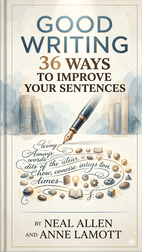
Good Writing by Neal Allen Book Cover

by Neal Allen

Neal Allen's Good Writing delivers 36 practical rules—from using strong verbs to trusting your reader—that sharpen prose through precision, energy, and natural voice. Designed for writers at any stage working on fiction, nonfiction, or journalism who want actionable techniques over abstract advice.

On Insta.page you also get an Apply This Book tool that lets you combine insights from up to 3 books to solve your specific situation.

Chapter mindmaps

Free preview: chapters 1–4 are fully interactive. Click any node to expand or collapse. Subscribe to unlock the rest.

Chapter 1: Rule 1: Use Strong Verbs

Key concepts: Rule 1: Use Strong Verbs

1. Rule 1: Use Strong Verbs

Why Strong Verbs Matter

  • Replace weak, imprecise verbs like 'walked' or 'got'
  • Add energy and clarity to writing
  • Pull reader into the scene structurally

Reshaping Sentence Structure

  • Strong verbs create momentum and consequences
  • Break monotony of subject-verb-object pattern
  • Force more complex, rhythmic sentences

Eliminating Adverbs

  • Specific verbs like 'raced' replace 'quickly'
  • Verbs carry full weight of action alone
  • Tightens prose and removes clutter

Avoiding Over-Glorification

  • Don't make every victory a 'massacre'
  • Strong verbs should clarify, not show off
  • Overdoing it makes readers roll their eyes

The Verb as the Picture

  • Verb choice creates the visual image
  • Precise verbs like 'hunker' or 'crave' are exact
  • Reader instantly sees and feels the action

Chapter 2: Rule 2: Question “Being” and “Having”

Key concepts: Rule 2: Question “Being” and “Having”

2. Rule 2: Question “Being” and “Having”

Why "To Be" and "To Have" Are Static

  • They freeze sentences instead of moving them forward
  • Create flat statements of identity or description
  • Describe past acquisition, not ongoing process
  • Rob the reader of propulsive energy

Exceptions and Nuances

  • Work well as auxiliary verbs in progressive tenses
  • Can lend authority to declarative statements
  • Hamlet's soliloquy moves away from static verbs
  • Language shift mirrors character's analytical arc

The Sanskrit Perspective on Becoming

  • Sanskrit has two verbs for "to be"
  • Second verb implies becoming, not fixed identity
  • Contrasts English's materialist, fixed view
  • Other languages offer fluid relationship to being

Practical Advice: Question and Replace

  • Find every "to be" and "to have" during revision
  • Replace with action verbs showing process
  • New sentences blossom with specificity and sensation
  • Active verbs evoke feeling, not just facts

Key Takeaways

  • Static verbs signal identity or possession
  • Replace with verbs showing change or sensory detail
  • Exceptions: auxiliary uses and authoritative statements
  • Transform static verbs into language that moves

Chapter 3: Rule 3: Keep It Active

Key concepts: Rule 3: Keep It Active

3. Rule 3: Keep It Active

Active vs. Passive Voice

  • Favor active voice as default
  • Passive can be superior for emphasis
  • Rule: pay attention every time you use passive

When Passive Works Best

  • Centers the recipient of action (victims)
  • Creates dramatic or wry tone
  • Roosevelt's speech: focused on attacked nation
  • Douglas Adams: detached, mysterious effect

The -ing Trap

  • -ing verbs create distance and flab
  • Compare 'was running' vs 'ran' for immediacy
  • Tighten -ing forms for tension
  • Use continuous aspect only when needed

Anne's Correction on -en Verbs

  • Subject receiving action weakens sentence
  • Examples: 'soufflé was eaten' vs 'dog ate'
  • Don't feel bad about passive choices
  • Question each sentence for strength

Key Takeaways for Writers

  • Watch for -ed, -en, -ing endings
  • Trust your ear, use rule as pointer
  • Passive works for centering recipients
  • Tighten prose for energy and immediacy

Chapter 4: Rule 4: Stick with “Said”

Key concepts: Rule 4: Stick with “Said”

4. Rule 4: Stick with “Said”

Core Rule: Use “Said” Almost Exclusively

  • “Said” is a mechanical function word, not a meaningful verb
  • Readers skip over it like prepositions
  • Synonyms like “chuckled” or “explained” add unnecessary drama
  • Trust the dialogue to carry emotion, not the attribution

Rationale from Journalism

  • Newspapers use “said” endlessly for objectivity
  • Words like “claimed” inject author skepticism
  • “Argued” implies a defensive stance
  • Strips away subtle editorializing from the text

The Anne–Neal Debate on Breaking the Rule

  • Anne defends synonyms like “whispered” and “mumbled”
  • “Whispered” does double duty: speech and secrecy
  • Neal calls her a Philistine for using alternatives
  • Avoid egregious synonyms like “chuckled” at all costs

Practical Guidelines for Attribution

  • Use “said” most of the time as default
  • Deviate only when the verb adds genuine clarity
  • Avoid adverbs after attributions; let dialogue show tone
  • A long stretch of “said” is better than a desperate synonym

Key Takeaways

  • “Said” is functional; readers register who spoke
  • Synonyms like “claimed” introduce bias—use deliberately
  • Reserve colorful attributions for moments with real meaning
  • Trust the reader to interpret tone from the words

Continue exploring Good Writing