F$ck Me Money, F$ck It Money, F$ck You Money Quotes
by Rex Bullard
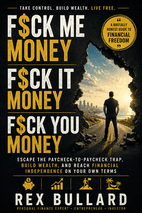
These are the lines people dog-ear, screenshot, and send to friends who still think a bigger paycheck will fix everything. They come from a book that treats money like a lever, not a life score. Some of them hit like a budget meeting, others like a breakup, but all of them are built to make you stop and check your own math.
Rex Bullard writes about earning, keeping, growing, and walking away. The book is quotable because it refuses to flatter the usual stories we tell about wealth. It does not romanticize rich people, and it does not fake sympathy for exhausted ones. It just names the tradeoffs, the fear, and the moment when enough becomes enough.
Top Quotes from F$ck Me Money, F$ck It Money, F$ck You Money
“Rich isn't a number. It's a permission slip.”
The author opens by redefining wealth before laying out the three levels.
It reframes wealth as freedom rather than a balance total. The phrase 'permission slip' is instantly memorable and sticks with the reader.
“The most expensive thing most people will ever buy is the appearance of being rich, and they buy it on a payment plan, every month, for thirty years.”
The author is explaining the trap of the F*ck Me Money rung.
It exposes the lie of looking wealthy while building nothing underneath. The image of renting a rich persona for decades is hard to shake.
“F*ck It Money buys your freedom, not your stupidity. You can be free, or you can buy the boat, but on this rung you usually can't do both.”
The author is describing Uncle Ray, who reached F*ck It Money by not spending like everyone else.
It distills the trade-off at the heart of financial freedom. The blunt wording makes the serious point unforgettable.
“It's the morning you wake up and realize you don't have to go in. You can. You might. But the "have to" is gone, and the "have to" was the whole prison.”
Defining what F*ck It Money actually feels like.
It turns an abstract net-worth target into an emotional release, and names the real enemy as obligation itself.
“The opposite of fear isn't courage. It's indifference. And indifference, real indifference, is something only abundance can buy.”
The narrator explains why the hot dog man can face any financial disaster in total calm.
It overturns the familiar courage-versus-fear frame and makes emotional peace a product of wealth.
“One more year is not patience. It's terror in a nice sweater.”
Hal, a financially free man, tells himself the same rationalization each December.
It names the real enemy behind over-saving: fear disguised as prudence. The image is hard to forget.
“Earn to feed it. Keep to hold it. Grow to multiply it. Free to actually use it.”
From the Free lever section, summing up how the four levers work together.
The short parallel structure makes the entire money philosophy memorable and easy to repeat.
Themes Behind the Quotes
The first big theme is that money is mostly an inside job. The numbers matter, but the real shift happens when a person stops chasing a moving target called more and starts deciding what enough looks like. Many of these lines are about the fear that keeps people working long after the paycheck matters, and the quiet freedom that arrives when that fear is gone.
The second theme is ownership versus spending. Earning a paycheck keeps the game going, but it does not change who benefits. The book keeps pointing to the difference between building wealth that works for you and simply showing up to make someone else rich. This is not about fancy living. It is about being honest, doing the unglamorous steps, and choosing a life you actually want to stay in.
Quotes by Chapter
Welcome to the Wealth Ladder
“Anyone selling you a shortcut is selling you a longer road with a tollbooth on it and their face on the sign.”
The author rejects get-rich-quick promises early in the book.
It turns the promise of a shortcut into a vivid warning. The tollbooth image exposes how most financial scams actually work.
F*ck Me Money: Comfortable-ish, Still on the Hamster Wheel
“The most expensive thing you can buy is the appearance of being rich.”
The opening line of the chapter.
It reframes wealth as a performance people pay for daily, and it becomes the lens for the whole rung.
“Carol wasn't rich. Carol was performing rich, full time, for an audience that fired her.”
After the author describes former coworker Carol's financial collapse when her division was cut.
It captures how easily a whole successful image can be built on nothing but the next paycheck, and the final phrase is withering.
“You can earn a doctor's salary and still be one bad Thursday from Carol.”
In a passage about high earners who live paycheck to paycheck.
It collapses the illusion that income equals safety and makes the danger feel personal and sudden.
“They built a whole identity on a two-month foundation and called it stability.”
Explaining how most people on this rung have under two months of runway.
The image of a two-month foundation is a devastating one-line summary of false financial security.
F*ck It Money: The First Real Escape Velocity
“Enough is a number. Most people never bother to find it.”
Opening the chapter on the F*ck It Money rung.
It reframes financial independence as a concrete math problem rather than a vague dream, which makes it feel attainable.
“When the paycheck becomes optional and you keep going anyway because you want to, you've arrived somewhere most people never even locate on the map.”
Describing Uncle Ray, who kept working after money stopped being necessary.
It captures the deepest signal of true freedom: continuing by choice, not by compulsion.
“Uncle Ray chose to keep fixing things and quietly owning his block and bringing his terrible cooler to work because he wanted to, which is the most luxurious sentence a human can say. Because he wanted to. That's F*ck It Money.”
Reflecting on why Ray kept his routine even after reaching financial independence.
The repetition of 'because he wanted to' lands like a hammer; it shows that the ultimate luxury is not idleness but chosen work.
F*ck You Money: Untouchable
“It isn't loud. It's just unreachable.”
The chapter's opening line and recurring refrain about what real F*ck You Money looks like.
It reframes wealth as silence and invulnerability rather than spectacle, which is more memorable than any yacht image.
“F*ck You Money is not a yacht with a helicopter on it. It can buy that, sure. But the people who actually have it almost never bother, and the reason why is the whole point of this chapter.”
The narrator is debunking the movie version of extreme wealth.
It separates money from its symbols and sets up the chapter's whole argument about quiet untouchability.
“He had spent thirty years climbing a mountain and then stood on the summit in the wind wondering why it was so quiet up there.”
The hot dog man reflects on the year after selling his company.
It captures the lonely anticlimax of reaching the top, when the struggle that gave life direction disappears.
The Head Game
“The last thing a person retires is the fear.”
The author describes how people retire only after they stop fearing.
It distills the entire chapter's message into one line: financial freedom is emotional before it is mathematical.
“Nothing is a prison with a nicer view.”
The author addresses early retirees who lose purpose after leaving work.
It reframes idleness as its own trap and makes the case for chosen meaningful work.
“The market didn't take that money from them. Their own nervous system did.”
The author explains why average investors underperform the market.
It shifts blame from external markets to internal panic, which is both devastating and empowering.
Your FU Number
“A goal without a number is just a wish you keep apologizing for.”
The chapter's opening line, repeated later as its thesis.
It reframes vague ambition as a measurable commitment and makes readers feel personally called out.
“Okay. Now we know what we're actually fighting for.”
Sam says this after calculating their real monthly expenses on the worst night of their financial life.
It turns a moment of crisis into clarity and reframes money as a concrete opponent.
“Most people spend their entire lives fighting for "more," which is not a number, which means it's not a target, which means they can never hit it and never stop.”
The author explaining why vague 'more' keeps people trapped.
It names the anxiety of endless wanting and shows why a specific number is liberating.
“Some of the freest people I know got free not by earning a mountain but by being honest about how small a happy life can actually be.”
The author explaining that 'enough' is partly chosen by how you design your life.
It subverts the assumption that freedom requires vast wealth and makes it about intentionality.
The Four Levers: Earn, Keep, Grow, Free
“The distance between skimming a dollar off your morning coffee and owning a thing that pays you while you sleep feels like a canyon, and nobody climbs a canyon.”
Appears when the author explains why most people freeze before starting to build wealth.
It names the exact feeling of being overwhelmed by the gap between small savings and real ownership, and turns it into something solvable.
“But it was never a canyon. It is a staircase, and every step is built out of the one beneath it.”
The narrator corrects the canyon metaphor with the staircase image.
It reframes a paralyzing gap as a buildable process, giving readers a concrete mental model for progress.
“You cannot out- earn the other three. I’m living proof. I earned a fortune in my big year and kept a leash, because earning more without the other levers just builds a fancier cage. Earn matters. Earn alone is a trap.”
From the Earn lever section, where the author shares a hard-won personal warning.
It warns that earning alone can create a bigger cage, and the rhythm makes the lesson stick.
Gear One. Kaizen: Small Moves Out of Level 1
“I was a loyal, daily, paying customer of my own financial irrelevance.”
The author admits he spent fifteen years buying coffee from a company he never owned shares in.
It turns a mundane habit into a stark account of how spending enriches others instead of yourself.
“When you spend, you make the owners richer. When you own, you become the one who gets richer while other people spend.”
The author lays out the core reversal behind the coffee-vs-stock napkin picture.
It distills the entire wealth-building shift into one memorable sentence: stop funding owners, become one.