F$ck Me Money, F$ck It Money, F$ck You Money Key Takeaways
by Rex Bullard
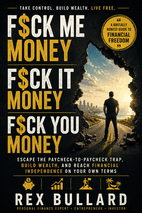
5 Main Takeaways from F$ck Me Money, F$ck It Money, F$ck You Money
Money buys time, not status; buy back your life.
The book organizes wealth into three buoys: Fck Me Money survives a surprise bill, Fck It Money survives years without a job, and F*ck You Money survives any catastrophe. The way to climb is to stop buying things that advertise prosperity — like Dave's financed boat — and put every dollar toward runway and freedom.
Your spending gap is the real lever, not your paycheck.
Saving 30% of income roughly halves the working time needed to hit 25 times annual spending. Every raise should be pre-committed to runway or savings before lifestyle absorbs it, because larger paychecks only enlarge the trap unless the gap between earning and spending widens.
Boring automated systems beat discipline, brilliant moves, and panic.
Automate monthly transfers into a broad index fund, don't check them, and cut fees; your absence is the strategy. Panic selling is the only serious adversary, and calm investors collect transfers from the fearful.
Own income-producing assets, because salary stops when you do.
Every paycheck is rented money. Build or buy an unglamorous business that runs without you, own your audience and IP, and combine independent income streams so a single failure can't end the whole arrangement.
Set your own enough and cross when the number covers expenses.
Based on real monthly spending, your number is 25 times annual expenses, and the 4% rule says you can cross when that portfolio pays the bills. Don't let the one-more-year fear win; the scoreboard is psychological, and meaning is your job afterward.
Executive Analysis
The five takeaways form a single ladder: wealth is measured by how much time and catastrophe survival it buys, not by appearances or net worth. The three buoys—Fck Me, Fck It, F*ck You—locate the reader, while twenty-five times annual spending creates a concrete target. Around that target, Rex Bullard wraps four levers—earn, keep, grow, free—and insists they be pulled together: income without holding capacity, idle cash without compounding, and money without life freedom all fail. The psychological layer is as central as the math: a visible 'enough' number, a witness, and automated systems exist to defeat panic and the one-more-year loop. The central thesis is that financial freedom is a boring engineering problem with an emotional finish line.
This book matters because it replaces status-signaling personal finance with a survival-based framework that anyone can diagnose and act on today. It gives high earners a way off the hamster wheel without pretending deprivation is the goal, and it bluntly separates the normal Fck It destination from the exceptional Fck You tier that requires ownership, not just saving. In a genre crowded with index-fund platitudes and get-rich hype, Bullard's voice is practical, profane, and psychologically honest: it treats panic, envy, and emptiness as real threats and gives the reader systems, not motivation. The book lands between The Simple Path to Wealth and the anti-FIRE critiques, offering a staged map that makes the climb feel possible, repeatable, and worth taking.
Chapter-by-Chapter Key Takeaways
Welcome to the Wealth Ladder (Chapter 1)
Buy nothing that advertises wealth; the boat Dave financed for a doomed promotion carried him straight to the repossessor, and financing the look of prosperity is precisely what keeps most people from ever owning anything.
Distinguish the three buoys by what they survive, not by how they look: one surprise bill ends Fck Me, two or three years without work ends Fck It, and no disaster that markets or bodies can throw reaches F*ck You.
Pull all four levers together, because extra income vanishes without the habit of holding it, idle cash decays without a plan to compound it, and none of it matters until it buys room in your actual life.
Test your own rung honestly before choosing moves: if a single unexpected invoice would topple you, you are at the first buoy, no matter what your paycheck says.
Drop a single recurring charge today and enlist someone else; the climb starts with one concrete step, is made with company, and pays out as permission to live as you want, not as a number.
Try this: Cancel one recurring charge that props up an image today, and tell a friend you're doing it; then test your true rung by imagining one surprise bill, not your paycheck, to see which buoy you're actually at.
F*ck Me Money: Comfortable-ish, Still on the Hamster Wheel (Chapter 2)
Count the price of appearing rich as a monthly payment, not a one-time splurge; that appearance is the first line item to delete.
Calculate your runway by dividing what you already own by your exact current monthly spending, then work to stretch it past the two-year mark that makes a bad boss survivable.
Treat every raise or bonus as pre-committed to either lengthening your runway or buying a higher standard of living, because the ratchet only moves upward.
Use the gap between what you earn and what you spend as your real lever; the moment you stop performing wealth is the moment you can start building it.
Try this: Calculate your runway by dividing your liquid savings by your current monthly spending, then assign every upcoming raise or bonus in advance to extending it rather than upgrading your life.
F*ck It Money: The First Real Escape Velocity (Chapter 3)
Aim for twenty-five times your annual spending in invested assets, because the income from that principal, not the principal itself, is what should cover your life.
Treat your savings rate, not your income, as the primary lever: saving 30% of what you earn can roughly halve the time you need to work.
Preserve the principal as a hard boundary: spending the capital to buy a boat or other indulgence destroys the very freedom the money was meant to secure.
Redefine the goal as being work-optional rather than work-forbidden, since the real prize is the ability to choose to work, as Uncle Ray did.
Plan for the demand of purpose: the money buys the freedom to discover what to do next, but that question will come due.
Try this: Aim to accumulate 25 times your annual spending in invested assets, then protect the principal as a hard boundary and plan for what you'll do with your optional work before you get there.
F*ck You Money: Untouchable (Chapter 4)
Measure F*ck You Money by the catastrophes it survives, not by the yacht and helicopter it could buy: the threshold is tens of millions, a number no crash or lawsuit can drag you back from.
Learn the difference between Fck It and Fck You: the first lets you quit one bad job, the second makes you unreachable, and only the second buys indifference.
To get from six to eight figures, stop trying to save or index-fund your way there; build an unglamorous local business that runs itself and then sell it.
Expect the money to bring a strange emptiness: once no alarm dictates your day, the year after selling everything can feel like the worst of your life, and the hangers-on are just mosquitoes.
The scoreboard lives in your head: climb every rung and you can still feel broke, because the real game is psychological, not numerical.
Try this: Stop trying to save your way to eight figures: build one unglamorous, self-running local business that you can sell, and expect the year after the sale to feel empty unless you design purpose beforehand.
The Head Game (Chapter 5)
Put a concrete number on “enough” and treat it as fixed, because your brain is wired to keep raising the bar and calling you not wealthy.
Get someone who can see your actual finances to say your number out loud; that witness is what breaks the one-more-year loop.
Accept that your main threat is panic, not ignorance, and build a decision system that stops you from buying euphoric highs and selling crash lows.
Design a life that is work optional, not work forbidden; the emptiness after early retirement comes from losing a chosen something, not from having enough money.
Replace “try harder” with boring, repeatable systems; the head game is standard human wiring, not a character flaw to overcome.
Try this: Write down a concrete 'enough' number, read it to someone who can see your finances, and automate a no-panic decision rule so euphoria and fear can't move your buys or sells.
Your FU Number (Chapter 6)
Start with your real monthly outflow, not the budget you wish for; a wish has no target, while a figure gives you a distance to close.
Set three separate figures: a cash buffer covering a few months, a freedom number equal to twenty-five times your yearly spending, and an immunity stake in the tens of millions.
Treat location as a lever on “enough”; a good life that costs a hundred thousand in one city can cost forty thousand in another, and shrinking the cost shrinks every rung above it.
Watch your numbers evolve and record their movement, because a visible, approaching line earns loyalty that an invisible plan never does.
Try this: List your real monthly outflow, then set three targets: a cash buffer, a freedom number of 25 times annual spending, and an immunity stake in the tens of millions, and track them as they move.
The Four Levers: Earn, Keep, Grow, Free (Chapter 7)
Work all four levers at once; earning, keeping, growing, and freeing money each feed the others, and pulling only one will stall you on the same rung.
Treat your income as a skill you can sharpen, but do not expect money to solve money; a larger paycheck only enlarges the trap unless you also widen the gap between what comes in and what stays.
Invest consistently and then leave the money alone; given decades, compounding needs only patience, while the panic-selling and herd-buying that gut returns comes from you, not from the market.
Set a runway number that ends a bad job and a freedom number that lets you walk away, and spend your pile on that time while your body can still enjoy it.
Try this: Pull all four levers each month: earn more, keep the gap wide, invest automatically and leave it alone, and set a runway number that lets you walk away from a bad job.
Gear One. Kaizen: Small Moves Out of Level 1 (Chapter 8)
Skim a token amount from every purchase into fractional shares of the company you're already paying, because ownership compounds while spending only disappears.
Plug every recurring hole you no longer really use: Fine calculates the average $198 monthly leak costs over $100,000 across two decades, so closing leaks funds investment without changing your lifestyle.
Treat the first hundred thousand as a fortress to build and hold, since before that milestone your own contributions outweigh anything the market returns.
Don't trust self-discipline to last; set up automatic round-ups and skim raises before your budget expands to meet them.
Involve a few people in your savings goal, because a financial habit hidden from others tends to collapse in secret.
Try this: Round up every purchase into fractional shares and plug one recurring subscription today; automate both before your budget can absorb the money, and tell a few people you're doing it.
The Crew (Chapter 9)
Give your time-buying plan witnesses; a first hundred dollars or first month of runway becomes real only when someone hears about it, because a habit kept invisible dies on schedule.
Report one concrete win to the Crew each week; having a pack to tell is what carried Theo from knowing every finance fact cold to actually saving a dollar.
Welcome a slipped member back with no mention of the gap; a pack that shames is just a worse version of being alone.
Make your first crossing a witnessed event, through the Crew's code or your own arrangement, so the applause arrives when the spreadsheet stays silent.
Try this: Give one specific savings win to a small crew every week, and if someone slips, welcome them back without mentioning the gap; make the first milestone witnessed by a ritual or code.
Proof the Boring Way Works (Chapter 10)
Check what money is for. If every raise disappears into a slightly nicer car or a bigger place, your baseline rises and the finish line sprints away, no matter how large the paycheck gets.
Set your own number. Because the target is twenty-five times annual spending, lean, fat, and coast are the same math with different inputs, so pick the flavor that fits the life you actually want, not the one you are supposed to want.
Expect the second problem. A bank balance buys your days back but cannot tell you what to do with them, so people who hit their number often go back to work, and the harder question arrives only after the money problem is solved.
Handle the two asterisks before you quit. If your month ends before your money does, plug one hole and widen the gap a dollar at a time, and treat health insurance as a line item planned on purpose, because it is the thing that drags people back to a desk.
Move from the things that bill you forever, like timeshares and financed cars, to the boring purchases that pay you back: owning the roof over your head, a reliable used car bought in cash, tools, a library card, and the checkup you did not skip. Nobody can guarantee the return, but buying time instead of appearances changes which side of the counter you stand on.
Try this: Check what your raises do: if they lift your lifestyle, redirect the next one into paying off a financed car or mortgage, and treat health insurance as a planned line item before you quit.
The Ten Paths (Chapter 11)
Treat any money-making promise as suspect until you have tested it yourself, because the dependable earnings in get-rich pitches come from teaching the scheme, and the ten real paths have worked since your great-grandparents.
Draw the line that matters between owning an asset and renting out your hours: every paycheck is rented money, so buy things that earn while you are absent, and make peace with the slow path's honest ceiling of Fck It, not Fck You.
Rex's ground-level numbers put half of new businesses gone in five years and two-thirds in ten, which makes the grown-up move a path you can survive, not the best video.
The careers of Reinberg, Koum and Blakely share one spine: hold the ownership undiluted, repeat the unglamorous move for decades, and let a rare skill open a door that ownership then turns into a fortune.
Pick one, maybe two paths that fit your actual age, cash, risk tolerance and the life you are buying, try them on like coats, and start with the slow bulletproof one that nobody films.
Try this: Test any money-making claim yourself before trusting it, then pick one real path that fits your age and risk tolerance and start with the boring, asset-owning version nobody films.
Getting to F*ck It Money: The Slow, Bulletproof Path (Chapter 12)
Automate a monthly transfer into a broad market fund, then deliberately fail to check it; your absence is the whole strategy.
Treat your own panic as the only serious adversary; selling at the bottom and creeping back at the top is a reflex you can choose not to have.
Aim for Fck It Money, not Fck You; the first is the reward of a normal lifetime with a clear mortgage and a seven-figure cushion, and the second is an exception that demands the boring base first.
Start late? Buy time with a higher savings rate and a more modest landing; the market's whole game is paying the patient from the pockets of the impatient.
Try this: Automate a monthly transfer into a broad market fund, vow not to check it, and if you're starting late, raise the savings rate and shrink the landing rather than chase a higher return.
The Quiet Engine (Chapter 13)
Own the whole market through a low-cost index fund and stay in it, because patient index investors beat most professional stock pickers over the long run.
Treat every panic sell as a transfer payment to you: the calm buyer collects the money the fearful leave behind.
As Morgan Housel notes, a 1% annual fee swallows roughly a third of a 40-year retirement, and since fees and time are the only levers you control, cut costs and extend your horizon.
Abandon both stock-picking and market-timing; picking demands luck and timing demands two correct guesses, while a diversified index requires only patience.
Sit still when markets are crumbling; the investor who does nothing through the fire earns what the active trader forfeits.
Try this: Own a low-cost total market index fund and sit through crashes on purpose; treat every panic seller's loss as your transfer payment, and cut fees rather than chase stock picks or timing.
High-Value Skills and Careers (Chapter 14)
Aim to be very good, not perfect, at two or three scarce, in-demand skills that rarely appear together; the unusual combination is what makes you irreplaceable.
Expect the climb to take years of deliberate repetition and blunt feedback; the skill you end up with is the one asset no one can take from you.
Protect the gap between what you earn and what you spend, and move raises into savings before your lifestyle can absorb them; a large paycheck by itself is not wealth.
Know that trading your skill for wages has a ceiling: true top-tier wealth comes from owning the practice, the product, or the firm around that skill.
When you are ready to move past delivery, turn to sales: it is the one arena where results replace credentials.
Try this: Combine two or three scarce skills into one rare profile, protect the gap between your income and spending by moving raises to savings first, and let ownership of a practice or product be your future ceiling.
Sales and Deal-Making (Chapter 15)
Treat sales as the one career door with no credential check, and let listening and diagnosing outrank talking.
Accept rejection as the tuition that hardens you and builds your first stack of capital, since the commission structure offers neither a safety net nor an earnings cap.
Bank your commission years into an ownership stake, because selling alone stops well short of money that lets you refuse anyone.
Set your lifestyle from your worst month, not your best, so feast spending never eats the seed pile.
Anchor your career on persuasion and trust, since those are exactly the skills an automated economy still cannot imitate.
Try this: Lead with listening and diagnosing, not pitching, and set your lifestyle to your worst commission month so feast months always build an ownership stake that eventually lets you refuse anyone.
Owning the Thing (Chapter 16)
Reframe your definition of income: aim for a stream that keeps flowing while you're absent, since a salary stops the moment you do.
Pursue boring, problem-solving businesses like HVAC fleets and commercial laundries rather than chasing novelty.
Rex cites BLS data that half of new ventures fail within five years, so buy an existing business at two to three times seller's discretionary earnings instead of starting one.
Before purchasing, confirm the operation is an asset that runs without you, and build it to pay you twice: cash flow now, a sale price later.
Try this: Buy an existing boring business at two to three times seller's discretionary earnings only if it runs without you, and aim to get paid twice: current cash flow and a later sale price.
Personal Brand, Media, and IP (Chapter 17)
Own the means of distribution: your audience list and your intellectual property are assets that keep paying while you are away, not rentals from a platform.
Test your idea on the side before committing full time, and ignore anyone selling a quick exit; the only honest proof is the market, not a course.
Define your niche as a single person with a single pain point; that specificity is what makes your media worth following.
Price your downside so you risk little to chase an unbounded upside, because even though AI has lowered the cost of creating, it has not flattened the winner-take-most curve.
Try this: Test your niche on the side by aiming at one person with one pain point, build your own audience list and IP, and risk little on the downside while keeping the upside unbounded.
The Startup Lottery (Chapter 18)
Judge a startup job by its salary and what it teaches you; accept the stock as a free maybe, and never let the equity carry the decision.
Treat any offer that trades away salary for equity as a request to fund a gamble with the household money, since the gamble almost never pays.
Assume the stock is worth zero until the money actually lands in your account, and never build a budget on an unvested maybe.
Play this game mostly while young and with little to lose; once you have dependents, only risk what the household can do without.
Tilt the odds by joining a company that already has customers and revenue, and plan to stack several such chances rather than stake everything on a single draw.
Try this: Judge a startup job by cash salary and skills, treat equity as worth zero until it lands in your bank, and only gamble with money the household can lose — ideally when you're young.
Combining Paths (Chapter 19)
Give yourself at least two or three income lines that move independently, since any single line is a risk to the whole arrangement.
Add streams sequentially and let each one fuel the next: regular pay builds the reserve, the reserve buys income property, and property income pays for the following stream.
A resilient setup combines sources on purpose, so that in a rough stretch one stream can rest while another takes the weight.
Getting to financial freedom and staying there call for different skills; what keeps you at the top is relational trust rather than another income line.
Try this: Build at least three independent income lines sequentially — paycheck funds reserves, reserves buy property, property income fuels the next stream — and use relational trust, not just income, to stay free.
Surviving the Climb (Chapter 20)
Assign every raise to savings or investments the moment it arrives, so your pre-raise spending never learns to expect it.
Keep your monthly outgoings roughly flat as income climbs, and direct any visible increases only toward the few pleasures you value most.
Beware the accumulated weight of many small upgrades: each one feels reasonable in isolation, but together they quietly move the finish line.
Once wealth is built, trade the scarcity habits that got you there for a deliberate spending plan that funds your chosen joys without guilt.
Try this: Assign every raise to savings or investment the moment it arrives, keep monthly outgoings flat except for a few chosen joys, and trade scarcity habits for a deliberate spending plan once you're wealthy.
Staying Rich (Chapter 21)
The boldness that builds a fortune is the same trait that destroys it, so the temperament needed to make money is almost the opposite of the one needed to keep it.
Staying rich is a survival game: compounding only works if you never suffer the fatal blow, which makes avoiding the catastrophic move more important than making a brilliant one.
Room for error is not wasted capacity but the cushion that lets you endure bad years without being forced to sell, and that cushion is the price of staying in the game.
Enough is the finish line: once you have what you need, risking it for more turns gain into loss, and the enduring task is trading nerve for humility.
Try this: Switch your mindset from bold fortune-building to survival mode after the pile is built: avoid the catastrophic move, keep room for error, and treat enough as the finish line so you never risk real wealth for more.
Your Map (Chapter 22)
Put a specific number and a date on a sticky note so freedom becomes a scheduled target you can measure progress against, not a vague someday.
Answer three questions in hard numbers: where you actually stand today, what the next buoy is, and which road genuinely fits your current season of life.
Build your approach by stage: in youth, trade time for a marketable skill and one speculative bet; later, protect the accumulated pile and own one core asset; in the middle, mix both.
Break your number into five-, ten-, and twenty-year targets, seal one recurring leak, and put a fixed contribution on autopilot; the bank's supercharging money is a later lever, not a starting move.
Try this: Write your freedom number and a date on a sticky note, answer where you stand and which road fits your season, and automate one recurring leak fix plus a fixed contribution today.
F*ck Off Money (Chapter 23)
Use borrowed real estate only as a finishing move: leverage is a gear bolted onto the Grow lever, and it lifts you faster only after the boring foundations are already poured.
Underwrite the deal, not yourself: seek properties whose rent covers the payment, because the bank is betting on bricks it can repossess, not on your job or salary.
Treat the loan's math as an ejector seat: the same multiplier that builds your gains will strip your equity when the cycle turns, so keep a margin of safety in every purchase.
Earn the gear in order: close the gap, build the pile, and learn the skills, since a beginner handed five buildings on borrowed money gets a machine they cannot control.
Fine watched a friend ride the supercharger up, lose the buildings to the bank, and take twenty-two years to recover, which is why this door stays closed until a bad year cannot end you.
Try this: Use borrowed real estate only as a finishing move: underwrite the property's rent, not your salary, keep a margin of safety, and delay this door until a bad year cannot end you.
The Crossing (Chapter 24)
Anchor your number in Bengen's 4 percent rule, and cross when that number pays your expenses; no larger round number is required.
Read the quiet tears as a sign you have arrived, not a problem: the arithmetic that used to run in the dark has finally gone quiet.
When the threshold appears, the urge to work one more year is old fear wearing a sensible coat; put it down and take your Wednesday.
Spend the first optional weekday on a small ritual with someone you love, and treat what you no longer need as time, choices, and the ability to give.
Wanting to be free from a paycheck is a legitimate aim, but never expect the money to supply meaning; that work belongs to you.
Try this: Cross the moment your 4% number covers your expenses, say no to 'one more year' fear, and spend your first optional Wednesday on a small ritual with someone you love rather than hunting for meaning.