Entrepreneurship Mindmap: Visual Summary of All Chapters | Insta.Page

Entrepreneurship — Interactive Mindmaps

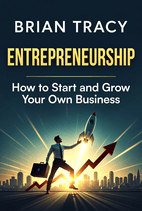
Entrepreneurship by Brian Tracy Book Cover

by Brian Tracy

Brian Tracy's Entrepreneurship provides a practical, systemic framework for starting a business, covering market validation, bootstrapping, sales systems, and mindset shifts. Written for aspiring entrepreneurs who want a realistic guide to navigating the first few critical years without romantic fluff.

On Insta.page you also get an Apply This Book tool that lets you combine insights from up to 3 books to solve your specific situation.

Chapter mindmaps

Free preview: chapters 1–4 are fully interactive. Click any node to expand or collapse. Subscribe to unlock the rest.

Chapter 1: One Welcome to the Entrepreneurial Age!

Key concepts: One Welcome to the Entrepreneurial Age!

1. One Welcome to the Entrepreneurial Age!

The Entrepreneurial Mindset

  • Entrepreneurs spot opportunities to serve others
  • Human desires are unlimited, driving the ER factor
  • Entrepreneurship is a learnable skill like driving
  • Success formulas exist and can be learned

The Power of Systems

  • Top performers use proven systems, not just hard work
  • Sales system: build trust, ask questions, help decisions
  • Adopting a recipe can multiply results tenfold
  • Trial and error reveals success formulas

Long-Term Thinking and Security

  • Thinking is the most important work
  • Long-term thinking predicts economic success
  • Security is the foundational human need
  • Avoid getting stuck in the comfort zone of wages

Service as the Core of Success

  • Serve customers better than anyone else
  • Deserve comes from Latin deservire - to serve zealously
  • Steve Jobs and iPhone exemplify service-driven success
  • Complacency leads to failure like BlackBerry

Choosing Your Path: Corporate or Entrepreneurial

  • 80% of businesses fail without experience
  • Work first to learn marketing, selling, customer care
  • Be an intrapreneur within corporations
  • Organizations emphasize strengths, make weaknesses irrelevant

Taking Personal Responsibility

  • You are responsible for your own life
  • Accepting responsibility gives you power to change
  • Your earning ability is your most valuable asset
  • 80% of people blame others and drift

Ambition and Goal Setting

  • Ambition accounts for at least 80% of success
  • Written goals make you ten times more likely to succeed
  • Only 3% of adults have written goals
  • Wealthy people decide to become wealthy

Chapter 2: Two Myths of Modern Entrepreneurship

Key concepts: Two Myths of Modern Entrepreneurship

2. Two Myths of Modern Entrepreneurship

Myth 1: 95% Failure Rate

  • Real cause is lack of preparation, not failure
  • Answer three questions: market, size, concentration
  • Get proof of concept before product exists
  • Everything takes 3x longer and costs 2x more

Myth 2: Need Venture Capital

  • 99% of VC applications are rejected
  • Bootstrapping: sell, profit, reinvest, repeat
  • Start-up is a race against running out of money
  • 80% of success comes in final 20% of effort

Myth 3: Good Product Guarantees Success

  • Customers only care about 'What's in it for me?'
  • Product must excel in one key customer attribute
  • 'Let me think about it' really means no
  • Customer perception of value can vanish overnight

Myth 4: Need Groundbreaking Invention

  • Most businesses solve existing problems better
  • Market fit matters more than novelty
  • Improve on cheaper, faster, or better options

Myth 5: Entrepreneurs Are Risk Takers

  • Successful entrepreneurs are risk avoiders
  • Test ideas on tiny scale to minimize losses
  • Cut losses quickly based on real feedback

Myth 6: Entrepreneurs Are Born

  • Entrepreneurship is natural human instinct
  • Must develop through study and practice
  • Learn sales, marketing, and customer behavior

Myth 7: All Want to Be Rich

  • Real drive is freedom from a bad boss
  • Decide to make money, learn from successful people
  • Keep asking for advice and take notes

Chapter 3: Three What Type of Business Should I Start?

Key concepts: Three What Type of Business Should I Start?

3. Three What Type of Business Should I Start?

The Emotional Core of Business Choice

  • Decision is fundamentally emotional, not logical
  • Find something that genuinely 'grabs' you
  • Emotional pull sustains through inevitable obstacles

Loving the Product Enough to Persevere

  • 95% of Inc. 500 founders loved their product first
  • They wanted the product for themselves initially
  • Personal love for product fuels persistence through difficulties

Loving Your Customers

  • Success requires love for both product and customers
  • Real joy comes from improving customers' lives
  • Most important question: Does it work?

Right Fit for Your Personality and Values

  • Sales method must match who you are
  • Legendary companies hire nice people, not train them
  • Employees genuinely love going to work

Protecting Integrity at All Costs

  • Never compromise product quality or customer care
  • Steakhouse chain failed after cutting corners
  • Profit focus destroys what made business work

Business Structures and Legal Advice

  • Sole proprietorship, LLC, S corp, C corp serve different stages
  • Good lawyer and accountant save more than they cost
  • Skimping on legal advice is false economy

Selling as the Engine of Success

  • Every business depends on selling more stuff
  • Income reflects number of conversations had
  • High sales solve problems; low sales cause them

Chapter 4: Four How Should I Finance My Business?

Key concepts: Four How Should I Finance My Business?

4. Four How Should I Finance My Business?

Cash Flow and Sales Are Everything

  • Running out of cash is the #1 business failure cause
  • Lack of sales traces to poor core business thinking
  • First 2-4 years are a race against time
  • Manage money to accumulate, save, and deploy it

Bootstrapping Forces Smart Discipline

  • Bootstrapping forces you to become smart fast
  • Business planning acts as an insurance policy
  • Discover if you 'can't get there from here' early
  • Exchange sweat equity for financial equity

Obsession with Customers and Sales

  • Successful companies obsess over customers daily
  • Failed companies stop selling and get distracted
  • Reputation is your most valuable asset
  • Every customer interaction should increase goodwill

Four Key Questions for Investors

  • How much in? What do you want me to put in?
  • How much out? What will I get back?
  • How quick? When will I see my money?
  • How sure? What guarantees exist?

Cost Consciousness Drives High Profits

  • Small expenses mean high profits
  • Buy used, borrow, rent, or lease instead of new
  • Keep costs down and focus entirely on sales
  • Prove you can handle money by not wasting it

Chapter 5: Five Shifting from an Employee Mindset to an Entrepreneurial Mindset

Mindmap locked. Subscribe to unlock all chapters of Entrepreneurship.

Subscribe to unlock

Chapter 6: Six Creating a Realistic Business Plan

Mindmap locked. Subscribe to unlock all chapters of Entrepreneurship.

Subscribe to unlock

Chapter 7: Seven Hiring Top Talent and Managing for Success

Mindmap locked. Subscribe to unlock all chapters of Entrepreneurship.

Subscribe to unlock

Chapter 8: Eight Sales and Marketing: The Fuel of Your Business Growth

Mindmap locked. Subscribe to unlock all chapters of Entrepreneurship.

Subscribe to unlock

Continue exploring Entrepreneurship