Entrepreneurship Quotes
by Brian Tracy
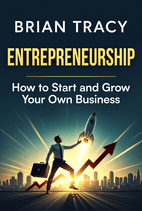
This collection brings together some of the most memorable lines from Brian Tracy's classic on entrepreneurship. You'll find short, punchy truths that cut straight to the heart of building a business. Tracy writes with a no-nonsense style, drawing on decades of research and real-world experience.
The lines here are the kind you underline, share with a co-founder, and come back to when things get tough. They cover everything from why sales matter above all else to the simple test of offering something you'd sell your own mother. This book is quotable because it turns complex ideas into unforgettable one-liners.
Top Quotes from Entrepreneurship
“The entrepreneur is a person who sees an opportunity to serve people in some way with a product or service that they want and need, and then is able to bring this product or service to the customer at a cost that is lower than the customer is willing to pay.”
The author defines the entrepreneur based on his study of entrepreneurial economics.
This definition captures the essence of entrepreneurship as service-oriented value creation, making it a foundational concept for readers.
“The fastest way for you to become financially independent and to have a wonderful life and a wonderful standard of living is to find a way to offer something that people want and need that's faster, better, cheaper, easier, and more convenient.”
The author explains the ER factor as the key to financial independence.
It provides a clear, actionable directive that resonates with anyone seeking success by focusing on customer value.
“The number-one reason businesses get into trouble is low sales. The number-one reason businesses succeed is high sales. Everything else is commentary.”
The author emphasizes the critical role of sales in business success.
Its blunt simplicity cuts through complexity, reminding readers that sales drive all business solutions and results.
“There's 100 years of research that shows that no one will buy from you until they like you and trust you.”
The author recounts advice from a top salesperson about building trust with prospects.
This timeless principle underscores the importance of relationships over transactions, a core lesson for entrepreneurs and salespeople alike.
“This is the only proof that there is a market: people give you money for it.”
The author stresses that genuine market validation requires actual purchases, not just praise.
It cuts through wishful thinking and gives entrepreneurs a clear, objective standard for testing their idea.
“Would you sell this product to your mother?”
The author poses this as a litmus test for whether an entrepreneur truly believes in their product.
It is a simple, visceral question that cuts through marketing hype and forces honest self-evaluation. Readers remember it because it ties business integrity directly to personal relationships.
“Nobody cares about what you sell. To them, it's completely irrelevant. They only care about one thing: What does the product or service do? How does the product or service change my life or my work or my family in some way?”
The author addresses an audience about customer psychology.
It powerfully reframes the entrepreneur's focus from product features to customer outcomes, a core lesson for any business.
Themes Behind the Quotes
A major theme running through these quotes is the absolute primacy of the customer and the sales process. Tracy repeatedly emphasizes that nothing else matters if you aren't generating revenue. Every problem in a business can be traced back to low sales, and every success starts with understanding what people truly want and need. Customer obsession, not product perfection, is the real engine of growth.
Another strong thread is personal responsibility. Tracy insists that entrepreneurs must own their outcomes completely, from hiring decisions to daily focus. There is also a clear call to protect your integrity and never compromise on quality, even as you hustle. Finally, the quotes hammer home the need for competitive advantage and the willingness to delegate or outsource anything that doesn't require your highest skill level.
Quotes by Chapter
Two Myths of Modern Entrepreneurship
“The role of the entrepreneur is to mitigate risk, to alleviate risk, to eliminate risk.”
The author explains that entrepreneurs are not risk-takers but risk-managers.
This reframes a common myth and offers a powerful, actionable mindset for anyone starting a business.
“Foolish in small things, foolish in big things.”
Warren Buffett declines a $1,000 golf bet, explaining his discipline.
This short, memorable line encapsulates the importance of consistent prudence and integrity in decision-making.
“Customers are heartless. They have ice water in their veins, and they only want to know what a child wants to know—what's in it for me, me, me, and double me.”
The author debunks the myth that a good product alone guarantees success.
This vivid, blunt imagery forces entrepreneurs to focus relentlessly on customer value and superiority over alternatives.
Three What Type of Business Should I Start?
“Successful entrepreneurs are producing and selling and making available something that grabbed them.”
The author explains that entrepreneurs are driven by a product or service that emotionally 'grabs' them.
It captures the emotional, almost magnetic pull that distinguishes successful ventures from ordinary ones. This line resonates because it reframes entrepreneurship as a heartfelt connection rather than a purely rational decision.
“The most important question in all of business is, does it work?”
The author emphasizes that efficacy—whether the product or process actually delivers—is paramount.
This line strips away all complexity and reminds readers that results matter above all else. It is a rallying cry for practical, reality-based entrepreneurship.
“Never compromise your integrity. Your integrity is the quality with which you do your work, the quality with which you provide your product or service, the quality with which you treat your customers.”
The author warns against sacrificing quality for short-term profit, using an example of a ruined restaurant chain.
It crystallizes the non-negotiable value of integrity in business. The repetition of 'quality' makes the definition of integrity concrete and memorable.
Four How Should I Finance My Business?
“The number-one reason companies have trouble is they run out of cash, and the reason they run out of cash is that they don’t have enough sales.”
The author explains the primary cause of business failure based on his experience and observations.
This stark cause-and-effect chain cuts through complexity, reminding entrepreneurs that cash flow is ultimately driven by sales, not by fundraising or cost-cutting alone.
“Your job as a business owner, as an entrepreneur is to think about customers and talk about customers and talk to customers. You become obsessed with customer service. That'll be about 90 percent of your success.”
The author distills the entrepreneur's role after citing Tom Peters' principle of obsession with customer service.
It delivers a memorable, almost mantra-like directive that simplifies success into a single, relentless focus—something every entrepreneur can immediately act on.
“If you build a better mousetrap, you're going to have to beat a path to the customer's door, and you're going to have to line up, and you're going to have to go back and see them over and over again.”
The author refutes the classic American business phrase 'If you build a better mousetrap, the world will beat a path to your door.'
It shatters a romanticized myth with the gritty truth that selling requires persistent, repeated effort—a wake-up call for over-optimistic founders.
Five Shifting from an Employee Mindset to an Entrepreneurial Mindset
“You and I are different from most people. We can only eat what we kill. If we don't make a sale, if we don’t generate revenue, then we don’t eat.”
The author says this to his audiences when contrasting the employee mindset with the entrepreneurial mindset.
This line captures the raw, high-stakes reality of entrepreneurship, emphasizing self-reliance and the direct link between effort and survival.
“I am responsible. I am responsible. Like a drumbeat: I am responsible.”
The author repeats this mantra while explaining the power of self-responsibility as a core entrepreneurial attitude.
The repetitive, rhythmic phrasing makes the principle of taking full ownership unforgettable, reinforcing that blame is replaced by personal agency.
“Self-responsibility is the starting point of successful entrepreneurship. Without it, nothing is possible.”
The author concludes his discussion on the importance of self-responsibility in business.
It is a clear, foundational statement that distills the entire chapter's message into one essential truth: everything else builds on accountability.
“Whatsoever a man soweth, that shall he reap.”
The author cites the biblical law of sowing and reaping to explain the relationship between effort and reward.
This timeless wisdom resonates because it connects the principle of cause and effect directly to income and success, encouraging proactive behavior.
Six Creating a Realistic Business Plan
“The customer is always right. If the customer says no, or if the customer hesitates, or the customer delays purchasing your product, they are telling you that you have come to the market with a wrong product.”
The author discusses the importance of listening to customer feedback.
It reinforces the hard truth that market rejection is a signal to adapt, not to persist with a flawed offering.
“The ability to focus on one thing at a time is the absolutely essential skill for success, especially to focus on improving the life or work of your customers in some way.”
The author explains the focal point concept from his coaching program.
It succinctly captures the double-edged necessity of focus and customer-centricity, a foundational entrepreneurial mindset.
“A good salesperson is free plus a profit.”
The author advises on hiring top sales talent.
This memorable phrase challenges the instinct to minimize sales costs, highlighting the outsized return a great salesperson brings.
Seven Hiring Top Talent and Managing for Success
“The rule is that 95 percent of your success is going to be determined by the people that you hire to do the critical jobs.”
The author introduces a key principle in his entrepreneurial coaching program about hiring.
It highlights the disproportionate impact hiring has on business outcomes, making readers prioritize who they bring on board.
“Hire, outsource, downsize, delegate every single task that somebody else can do who works at a lower rate than that.”
The author explains the life-changing rule based on calculating your hourly income.
This actionable advice empowers entrepreneurs to free up time for high-value work by leveraging others at lower cost.
“Do fewer things, but do more important things, and do them more of the time and get better at each one.”
The author describes the Law of Three and focusing on the activities that contribute the most value.
It cuts through the busywork trap, urging readers to concentrate on what truly moves the needle.
“Never cheap out on hiring good people, because, as I’ve said before, they'll always pay you back far, far more than you pay them.”
After sharing a story about hiring a competent accountant, the author concludes with this advice.
It reinforces that investing in top talent yields exponential returns, countering the temptation to save money on salaries.
Eight Sales and Marketing: The Fuel of Your Business Growth
“Whatever business you are in, you are in the marketing business.”
The author cites Dan Kennedy's perspective on the role of marketing in any business.
It distills the essence of entrepreneurship into a single, undeniable truth: every venture is fundamentally a marketing endeavor.
“If you do that, you succeed; if you don’t do that, you fail, and everything else is secondary.”
Directly following the Dan Kennedy quote, explaining the consequence of embracing or ignoring marketing.
This stark binary forces readers to confront the make-or-break nature of sales and marketing, cutting through all other distractions.
“If you don’t have competitive advantage, you don’t compete, or if you don't have competitive advantage, develop a competitive advantage.”
The author paraphrases Peter Drucker's advice on the necessity of competitive differentiation.
It delivers a blunt, actionable imperative: without a unique edge, a business cannot survive, so creating one is not optional.