Entrepreneurial Leap, Updated and Expanded Edition Quotes
by Gino Wickman
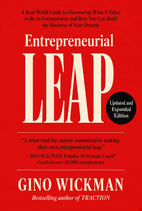
This page gathers some of the sharpest lines from Entrepreneurial Leap, Updated and Expanded Edition. You will find blunt advice about traits, risk, passion, hiring, pricing, and the reality of building something on your own. Some quotes are short kicks. Others are hard-won reminders.
The book is quotable because it does not dress up entrepreneurship as a glamorous shortcut. It speaks plainly about discomfort, failure, ambition, and the choices that separate real operators from people who just like the idea of business. These lines are easy to remember and easy to argue with, which is probably why they stick.
Top Quotes from Entrepreneurial Leap, Updated and Expanded Edition
“You're more comfortable with the discomfort of stretching than the contentment of the status quo.”
This appears in the chapter’s list of characteristics common to entrepreneurs.
It contrasts a growth-oriented mindset with comfort and complacency, capturing the entrepreneur’s drive to stretch.
“Skills can be learned; traits can’t. You're either born with certain traits, or you aren't.”
Gough introduces the distinction between learnable skills and innate traits.
It crystallizes the chapter’s all-or-nothing premise that traits are natural wiring, not skills. It pushes readers toward honest self-assessment.
“In case I haven't mentioned it before, entrepreneurship is hard.”
This line lands at the end of the section on lacking the Driven trait.
It cuts through any romanticized view of starting a business. Its bluntness makes it memorable and grounding.
“The greatest company in America we'll never know, because it's some $10 million company in middle America that doesn't want to be known.”
The author quotes Jim Collins while explaining that excellent companies can succeed quietly and out of the spotlight.
It honors quiet, excellent businesses and suggests fulfillment does not require fame. It makes ordinary-scale success feel aspirational rather than lesser.
“Hire slowly. If, unfortunately, you hire the wrong person, you have to be willing to fire quickly. Whenever you hire, always think long term. Don't hire to solve a short-term problem.”
This is from the second critical mistake, Hiring the Wrong People.
It distills a disciplined hiring rule: be slow to hire, quick to fire, and always think long term.
“Dan Sullivan has a great rule of thumb when choosing your pricing. He suggests that you think about the number that scares you and then add 20 percent.”
This is from the fifth critical mistake, Not Charging Enough.
It offers a concrete pricing heuristic that helps entrepreneurs overcome fear and charge what they are worth.
“Know why you're going and don't just follow the herd.”
Wickman gives this blunt guidance about choosing college.
It captures the chapter’s central warning: college is a choice, not a default. The line is short enough to stick with readers.
Themes Behind the Quotes
A major theme is self-awareness. The book keeps returning to the idea that entrepreneurship is not inherited or borrowed. It comes from a mix of internal traits and choices. Passion, risk tolerance, problem solving, drive, vision, and responsibility show up again and again. Readers are pushed to ask whether they actually have the wiring and the appetite for the work.
Another theme is realism. Building a company is hard, failure is normal, and not every business or founder is meant to scale to the moon. The quotes celebrate profitable, durable companies, careful hiring, honest numbers, and knowing your own reasons. They also warn against following the crowd, chasing status, or assuming a degree or family legacy will make someone an entrepreneur.
Quotes by Chapter
1. Know Thyself
“As the words inscribed above the entrance to the Temple of Apollo at Delphi in ancient Greece put it: “Know thyself.””
The chapter invokes ancient wisdom while urging readers to assess whether they are entrepreneurs at heart.
Self-knowledge is framed as the essential starting point before taking any entrepreneurial leap.
“As marketing guru Joe Polish says, “Entrepreneurs solve problems for a profit.””
The author cites marketing guru Joe Polish while describing entrepreneurs’ financial motivation.
It distills entrepreneurship into solving problems, connecting profit with contribution.
“An entrepreneur is a risk taker, which means that once you see the opportunity, you'll take the leap, knowing there are no guarantees.”
This describes how entrepreneurs approach risk after spotting an opportunity.
It defines the leap as action without guarantees, a central theme of the book.
2. 6 Essential Traits of an Entrepreneur
“Passion is an essential trait because it gets an entrepreneur through tough times. You cannot survive failure without passion.”
Gough explains why passion is one of the six essential traits.
It frames passion as the fuel that makes failure survivable, not just enthusiasm. The line is memorable because it ties belief directly to persistence.
“A problem solver is someone who leans into problems, obsesses about them, and genuinely gets a high from solving them.”
Gough describes the mindset behind the third essential trait.
It separates true problem solvers from people who merely tolerate problems. The phrase “leans into problems” makes the trait feel active and visceral.
“A risk taker is someone willing both to take a leap and to fail. A risk taker is a rule breaker, change maker, disrupter. The status quo is not good enough.”
Gough introduces the fifth essential trait, being a risk taker.
It compresses the boldness and dissatisfaction with the status quo that entrepreneurial risk-taking requires. It makes risk-taking sound identity-defining rather than reckless.
3. What If You’re Missing an Essential Trait?
“Just as a gas-powered car needs an engine, transmission, wheels, a steering wheel, gas, and oil to function, the entrepreneur needs to be visionary, passionate, a problem solver, driven, a risk taker, and responsible.”
The chapter introduces the six Essential Traits by comparing a missing trait to a car missing a vital component.
This analogy makes the traits feel interdependent rather than optional. It sticks because one missing part can stop the entire venture.
“If you aren't passionate about the void you're going to fill in the world with your product or service, you'll never survive the many setbacks and failures that will occur, especially in the first few years.”
From the section explaining what happens when the Passionate trait is missing.
It frames passion as emotional fuel for surviving early failure. Readers remember it because it describes entrepreneurial endurance, not just enthusiasm.
“Like the great boxer Mike Tyson said, “Everybody has a plan until they get punched in the mouth.””
The author quotes Mike Tyson while explaining why problem solvers must adapt after setbacks.
It captures the gap between planning and real-world adversity in one vivid line. It resonates because every founder eventually gets punched by reality.
4. Second-Generation Entrepreneurs
“Being an entrepreneur is not something you can inherit. It has to be inside you no matter who your parents are.”
The author explains what parents must understand about the entrepreneurial traits of the next generation.
It cuts to the core of the chapter: entrepreneurship cannot be passed down like a family heirloom. The line is direct and memorable.
“If you want the company to evolve with the times and last for decades, you'll need to fill that role with another entrepreneur—someone with the 6 Essential Traits, no matter who.”
The author advises a founder on choosing the right successor for a business that must keep evolving.
It prioritizes entrepreneurial ability over family succession. Readers remember that preserving a company may require looking beyond kin.
“Research on the subject shows that about 32 percent of second-generation businesses survive, only about 13 percent of third-generation ones, and only about 3 percent of fourth-generation ones and beyond survive.”
The author cites survival rates to show how rare successful multigenerational transitions are.
The steep decline makes the danger concrete. It reinforces why inherited ownership is not the same as inherited entrepreneurship.
“We've seen family-owned businesses survive economic losses, fires, tornadoes, threats, and deaths. We have never seen a family-owned business survive heirs who lack ambition.”
Kathy Kolbe and Amy Bruske state this in their handbook on family-owned companies.
The contrast is powerful: external disasters are survivable, but disengaged heirs are not. It underscores ambition as a nonnegotiable ingredient.
6. Real-Life Entrepreneurial Stories
“The billion-dollar tech companies are the one-in-a-million stories, and besides, they aren't all they're cracked up to be. In most cases, they aren't for you.”
In introducing Part II, the author cautions against chasing the kind of tech-company success that dominates the press.
It reframes success away from hype and toward a business that actually fits your life. It reassures readers that they do not need a one-in-a-million outcome to win.
“There's no right or wrong answer, only the answer that's best for you.”
The author has just listed possible business sizes and outcomes and says entrepreneurs can choose what matters most to them.
It reminds readers that success is personal, not a single template. It gives permission to define ambition on your own terms.
“True entrepreneurs don’t follow the herd or care about what everyone else thinks.”
The author describes the mindset of true entrepreneurs while framing the real-life stories that follow.
It captures the independence and self-trust required to take the leap. It pushes readers to stop measuring themselves by others’ expectations.
7. Avoiding the 8 Critical Mistakes
“First off, you have to assume that you'll make mistakes. Everyone does.”
It appears at the start of the chapter's list of eight mistakes.
It normalizes mistakes while urging readers to internalize the most common ones so they can avoid them.
“The numbers and data never lie. If you're not good at this, pay someone for a few hours per month to generate these reports for you.”
This is from the seventh critical mistake, Not Knowing Your Numbers.
It reminds entrepreneurs that financial data reveals the truth and that regular reporting is non-negotiable.
8. Discover the Ideal Business for You
“Not every entrepreneur is cut out to build every business.”
The author introduces the chapter by explaining that business ownership is not a one-size-fits-all path.
It relieves readers from the pressure to chase every opportunity and points them toward self-awareness instead.
“Please suspend any disbelief, because I've learned that if you can begin your entrepreneurial journey with the end in mind, you'll get there faster and avoid a lot of frustration.”
The author explains why entrepreneurs should think about company size before they even start.
It reframes planning as choosing a destination first, which helps founders make better decisions and avoid wasted effort.
“You can make a huge impact, become very wealthy, and help a lot of people by building $10 million companies.”
The author pushes back on the media obsession with billion-dollar companies.
It validates ambitious but scaled goals, showing that meaningful wealth and impact do not require becoming a unicorn.
“Some $10 million companies generate a 20 percent profit. That's $2 million. Some $100 million companies generate a 2 percent profit. That's also $2 million.”
The author compares revenue size with actual profit to show that bigger is not always better.
It makes the case that profit and simplicity can matter more than top-line revenue and ego.
9. College or Not?
“For the last twenty years, I've asked every successful entrepreneur who has a college degree the following question: “As an entrepreneur, do you use anything you learned from your degree?” The answer is no almost 100 percent of the time.”
Wickman shares what he learned after asking successful entrepreneurs whether they use their college degree.
It reframes the value of college around what it does not teach. The near-universal answer is surprising and memorable.