Entrepreneurial Leap, Updated and Expanded Edition Key Takeaways
by Gino Wickman
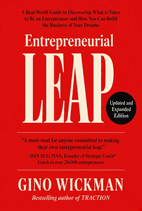
5 Main Takeaways from Entrepreneurial Leap, Updated and Expanded Edition
Assess All Six Entrepreneurial Traits Before You Leap
Wickman argues vision, passion, problem solving, drive, risk taking, and responsibility are largely fixed, so strength in a few cannot cover for one missing trait. Use the assessment to treat a failed fit as information, not a verdict on your worth.
Fill Missing Traits With Partners, Hires, or Systems
If you lack a founder trait, don't assume you can fix it later. Restructure by filling production, management, and ownership seats, hiring an Integrator, buying an operating model, or choosing a role that supplies the missing momentum.
Design the Ideal Business Around Customer, Price, and Profit
Choose product or service, business or consumer customers, and premium or low-cost, then pick one rung on the price-quality ladder. Size by profit rather than revenue, and serve customers you'd be proud to champion.
Avoid Critical Mistakes by Leading With Vision and Numbers
Decide the ten-year picture, hire owners, know your numbers, and write down who owns what. Let that vision veto incompatible hires, customers, and prices before they pull the business off course.
Manage Energy and Commit to a Ten-Year Founder Journey
Write the exact ten-year date, protect rest, silence, and a weekly work container, and pace yourself through idea, selling, struggle, and seasoned operator stages. Define success across work, people, impact, fair pay, and time for other passions.
Executive Analysis
The five takeaways form a single argument: the entrepreneurial leap is not an act of faith but a disciplined fit decision. Wickman first forces readers to measure their six essential traits, accept that missing one changes the plan, and fill gaps with partners, hires, or systems. From there, the book narrows to the right business—customer, price-quality position, profit-based size—and the critical mistakes and must-dos that determine survival. The final layer is stamina: ten-year goals, stage awareness, mentors, and energy disciplines keep the founder moving from idea to seasoned operator.
Its practical impact is that it gives aspiring founders a diagnostic and an operating path before they quit a job or raise money. Instead of romanticizing startup success, it treats traits, market fit, systems, and personal sustainability as filters that can save years of misdirected effort. In the startup and small-business genre, it sits alongside Lean Startup and EOS-style operating guides, but its distinctive value is helping readers decide whether and how to leap—not just how to scale.
Chapter-by-Chapter Key Takeaways
2. 6 Essential Traits of an Entrepreneur (Chapter 2)
Accept that these six qualities are fixed at birth. Energy spent trying to acquire a missing one is energy wasted.
Judge yourself on all six at once. Strength in a few does not cover for a single absence.
Treat a failed result as information about fit, not a verdict on your worth. Let it point you toward work that matches the person you already are.
Expect the bar to exclude most people. Douglas Brackmann estimates that only about 10 percent are born with the gene behind drive.
Try this: Assess yourself against all six essential traits at once and treat any missing trait as fit information; don't spend years trying to acquire what wasn't there at birth.
3. What If You’re Missing an Essential Trait? (Chapter 3)
Check yourself against every trait a founder needs before you commit. If one is missing, delay or restructure. Don't treat it as a small weakness to fix later.
If you're a technician and you suddenly want to start a business, that might be an entrepreneurial seizure, not proof you're ready. Fill the three seats every company needs, production, management, and ownership, with people who actually fit them.
If you're great at selling and talking to customers but not at setting direction, take the sales role and let someone else carry the vision.
If your enthusiasm fades at the first setback, or you know others will outwork you because you lack drive and appetite for risk, bring in a partner, work as an entrepreneur inside a company, or pick a structure that supplies momentum.
If systems thinking or personal accountability is your weak spot, buy into an established operating model, or stay a solo operator until you can own results without employees to blame.
Try this: Check every founder trait before committing, and if one is missing, fill production, management, and ownership seats with people who fit rather than trying to fix yourself later.
4. Second-Generation Entrepreneurs (Chapter 4)
Send the next generation out to build a career and a reputation elsewhere first. Inside the family firm, they will have to earn twice over what the founder was granted on arrival.
Figure out whether the business you're passing on needs growth or just steady hands. A child who's better at keeping things running can hold a role in the firm, but can't be trusted with a company whose survival depends on an entrepreneur's drive.
Treat each handover as the decision that determines whether the company outlives you. Assume survival into the later generations is the exception, not the rule.
Try this: Send the next generation out to build an independent career first, match successors to whether the business needs growth or steady hands, and treat each handover as a survival decision.
5. The Entrepreneur-in-the-Making Assessment (Chapter 5)
Take the 24-statement assessment on your own. If you score below 90, treat it as something to work on, not a final answer about what you can do.
Use the six key traits to figure out whether you're still the one doing all the work. If you are, you have a job, not a company.
Use the Kolbe A Index and the Culture Index to see if your natural work style and drive match what founders typically have. If they don't, decide what to hire for or who to partner with.
Try this: Take the 24-statement assessment alone, use a score below 90 as a development prompt, and compare your Kolbe A and Culture Index patterns with founder traits to decide what to hire or partner for.
6. Real-Life Entrepreneurial Stories (Chapter 6)
Success looks different for everyone — a $10 million firm in middle America can be just as successful as a trillion-dollar tech company.
Famous success stories leave out the setbacks, course corrections, and small decisions that made them possible.
There is no universal playbook, because every product, service, competitor, and customer is different.
Define success on your own terms instead of measuring yourself against billion-dollar valuations.
Once your idea is settled, hold yourself against six traits: vision, passion, problem solving, drive, risk taking, and responsibility.
Try this: Define success on your own terms, ignore the highlight-reel version of famous founders, and test your settled idea against vision, passion, problem solving, drive, risk taking, and responsibility.
7. Avoiding the 8 Critical Mistakes (Chapter 7)
Decide what the business should look like a decade from now. Then let that picture veto the hires, customers, and prices that don't fit.
Hire people who take ownership, not people who just fill a slot. Put time with them on the calendar now: a weekly leadership meeting, a quarterly planning day, an annual retreat.
Know exactly who your customer is, and price for that customer. Don't chase whoever is shopping on price.
Learn your numbers well enough to spot trouble early. A founder working nights and weekends while profit and distributions sit at zero is usually flying blind.
Write down who owns what. Keep the business anchored to its core when an opportunity tries to pull it somewhere else.
Try this: Decide the ten-year picture first, then let it veto incompatible hires, customers, and prices while you hire owners, know your numbers, and protect the core.
8. Discover the Ideal Business for You (Chapter 8)
Settle product or service, business or consumer customer, and premium or low-cost. Hybrids rarely survive on both sides.
Pick one spot on the price-quality ladder. Chase the discount shopper and the premium buyer at the same time and you have no position at all.
Weigh size by profit, not revenue. The same take-home pay at a lower revenue figure spares you the added complexity that arrives at ten, fifty, two hundred, and a thousand employees.
Name the customers you'd be proud to champion. If no group comes to mind right away, run a few experiments until one does.
Try this: Choose product or service, business or consumer customer, and premium or low-cost position, then pick one price-quality rung and size by profit while naming customers you'd be proud to champion.
9. College or Not? (Chapter 9)
Choose college for the people you will meet and the customers you can reach while you are still a student. Judge your time there by the relationships and ventures you build, not by your transcript.
If you enroll, fill your schedule with sales, negotiation, storytelling, programming, and financial literacy instead of a conventional major.
If you skip, keep paying for your own learning and know that a failed venture leaves you with fewer fallbacks.
Weigh your own tolerance for risk and your ability to learn on your own, because a degree has not been required to build a major company.
Try this: Choose college for relationships and customer access if you go, fill your schedule with sales, negotiation, storytelling, programming, and financial literacy, or keep paying for learning independently if you skip.
11. Find a Mentor (Chapter 11)
Line up several prospective mentors at once and ask each for a single meeting, then agree on clear terms before things get vague: how you meet, how often, and for how long.
Close the loop after every piece of advice by showing what you did differently and thanking them, since visible progress is what keeps a mentor engaged.
Plan to trade up as you grow: the person who fits this stage will not fit the next, and while some mentorships run a year, others last a lifetime.
Try this: Recruit several prospective mentors at once, set clear terms for meeting cadence and duration, close the loop with visible progress, and trade up as your stage changes.
13. 8 “Must Do’s” to Increase Your Odds of Success (Chapter 13)
Answer the eight vision questions in order. Start with passion and customer need. Work down to the next ninety days. Then keep upgrading the document as the company grows. Don't treat it as a one-time exercise.
Decide early whether you want a partner. If you do, treat it like a long-term marriage. Settle your core values. Imagine a decade together. And get the terms in writing with a lawyer before anything begins.
Choose the largest problem you can genuinely solve. The value you capture scales with the size of the problem, not with how hard you labor.
Get paying customers in front of the product as early as possible. Keep plans B, C, and D alive. Amar Bhidé found that most ultimately successful companies abandoned their original strategy.
Expect the work to be grueling and the doubt to be constant. Rehearse the ten-year picture nightly. That way, rejection and setbacks register as data, not as a verdict on your idea.
Try this: Answer the eight vision questions in order, decide partner terms in writing early, choose the largest solvable problem, get paying customers early, and rehearse the ten-year picture through constant doubt.
14. 9 Stages of Building Your Business (Chapter 14)
A business that works at one size rarely works at the next, so owners need to know which stage they're in and what comes after.
Nothing is proven until a customer pays, which makes generating cash the first obsession.
Entrepreneurs need an Integrator to run daily operations and hold people accountable so the founder can focus on the big picture.
Core values are discovered, not created, and naming your one thing keeps the business from chasing every opportunity.
A clear brand promise, a dashboard of key numbers, real accountability, and leaders at every level are what let a company scale.
The final stage is giving back, because purpose beyond profit is what keeps a business lasting.
Try this: Identify your current stage and build the next one: generate cash first, add an Integrator, name core values and your one thing, then scale with brand promise, dashboard, accountability, leaders, and giving back.
15. Top 30 Lessons: A Lifetime of Growth, Learning, and Motivation (Chapter 15)
Sort the advice you take in: keep what fits your business and your gut, and discard the rest rather than trying to act on all of it.
Start before you feel ready, build around work that genuinely interests you, and ask for help early.
Choose a business partner the way you would choose a spouse, and bring strong hires in sooner than feels comfortable.
Read one nonfiction book a month, add founder biographies, and keep learning through podcasts, business blogs, and a peer group.
Set aside weekly time away from the desk to think, and figure out how you work best.
Try this: Filter advice to what fits your business and gut, start before you feel ready, partner like a marriage, hire strong sooner, and protect weekly thinking plus monthly learning.
16. 10 Disciplines for Managing and Maximizing Your Energy (Chapter 16)
Set a ten-year horizon by writing down the exact date, how old you will be on it, and the one thing you most want done by then. Decisions measured against that span won't be thrown off by one bad quarter.
Book extended time away and a daily stretch of silence as fixed commitments, not rewards. Rest is what generates the ideas and output that crowded hours cannot.
Define your work container in hours per week and weeks per year before anyone else defines it for you. Treat everything past that line as a no unless it's a clear yes.
Hand off low-value work like email, scheduling and travel. Keep every promise and idea in one place, and plan tomorrow on paper before bed so your mind can keep working on it overnight.
Ask the five most important people in your life where you sit between arrogance and humility. Thinking of yourself less gives you energy and allies; it doesn't cost you respect.
Try this: Set a ten-year horizon, book rest and silence as fixed commitments, define your work container, hand off low-value tasks, centralize commitments, plan tomorrow on paper, and ask five people about arrogance versus humility.
17. 1-2-3 Roadmap—All the Tools at a Glance (Chapter 17)
Do the three-tool sequence first. Each one sharpens what the next can do.
Set aside about an hour for all three. That hour is not optional. It's where you start.
Use the other tools as needed, depending on what you're dealing with. Traits and mistakes before you commit. MentorTrack and the must-do's during the early push. The stages and lessons while you build. The energy disciplines once the pace picks up.
Use the online roadmap and the collaborator network. Don't grind through the tools alone.
Try this: Run the three-tool sequence first, spend the non-optional hour, then deploy other tools by stage and use the online roadmap and collaborator network instead of grinding alone.
18. Summary (Chapter 18)
Build the 6 Essential Traits. Don't wait on a plan or funding.
Expect the path to run from an idea, to selling it, to years of open struggle, and finally to becoming a seasoned operator. Pace yourself for that whole arc, not just the launch.
Define the life you want across five things: work you love, people you love, the difference you make, fair pay, and time for other passions. If a win fails any one of those five tests, it's incomplete.
Set aside a share of every dollar you earn before you spend it on your lifestyle. That way, your ideal life is funded by your own discipline, not by a windfall.
Commit to a ten-year goal. Then the setbacks along the way become stages of a long campaign, not verdicts on whether you were meant to do this.
Try this: Build the six traits without waiting for a perfect plan, pace yourself for the full idea-to-operator arc, define your ideal life across five tests, save before lifestyle spending, and commit to a ten-year goal.