Do Hard Things Quotes
by Steve Magness
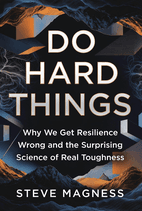
Here you'll find a collection of quotes from Steve Magness's Do Hard Things, a book that flips the script on toughness. Instead of gritting your teeth and ignoring pain, it shows a smarter way to handle challenges.
These quotes zero in on real resilience: listening to your emotions, staying honest about difficulty, and building confidence from the ground up. They're the kind of lines you'll want to save, share, and come back to when you need a new perspective on pushing through.
Top Quotes from Do Hard Things
“Real toughness is experiencing discomfort or distress, leaning in, paying attention, and creating space to take thoughtful action.”
The author offers a new definition of toughness after critiquing the old-school model.
This line reframes toughness as a mindful, adaptive process rather than mere stoicism, empowering readers to handle challenges with clarity rather than brute force.
“Fake toughness creates fragility, responding out of fear, suppressing what we feel, and attempting to press onward no matter the situation or demands.”
The author contrasts fake toughness with real toughness, summarizing the harmful effects of the traditional approach.
It exposes the paradox that the very methods meant to make people tough actually make them brittle, which resonates with anyone who has experienced burnout or learned helplessness.
“A tougher runner isn’t one who is blind with ambition or confidence, but one who can accurately assess the demands and the situation.”
The author explains how experienced runners pace themselves by aligning expectations with reality.
This line redefines toughness as accurate self-assessment rather than reckless confidence, a counterintuitive insight that resonates with anyone striving for sustainable performance.
“Toughness is about embracing the reality of where we are and what we have to do. Not deluding ourselves, filling ourselves with a false confidence, or living in denial.”
The author summarizes the chapter's core message on facing challenges honestly.
This powerful, concise statement distills the chapter's theme into an actionable mantra, encouraging readers to ground their efforts in truth rather than illusion.
“A key component of real toughness is acknowledging when something is hard, not pretending it isn’t.”
The author introduces the strategy of setting realistic expectations in the section 'Setting Your Mind on Reality'.
Simple and direct, this line validates the difficulty of hard tasks while showing that honesty is a strength, not a weakness.
“Pain isn’t something to fear or push our way through; it’s a message that needs interpretation.”
The author discusses how to approach pain and discomfort.
This reframes pain as valuable information rather than a barrier, encouraging a more mindful and effective response to hardship.
“Human freedom involves our capacity to pause between stimulus and response and, in that pause, to choose the one response toward which we wish to throw our weight.”
Existential psychologist Rollo May stated this in The Courage to Create.
It captures the core idea of creating space between feeling and reaction, which is the chapter's central theme of staying steady.
Themes Behind the Quotes
One major theme is the difference between genuine toughness and a brittle, fake version. Real strength means acknowledging discomfort and doubt rather than suppressing them. It involves pausing, assessing reality, and choosing a thoughtful response instead of blindly charging ahead.
Another thread is the importance of control and inner confidence. When people lose agency, they resign themselves to hopelessness, but maintaining a sense of control quiets the alarm system in our brains. Lasting self esteem comes from actual work and honest self appraisal, not from hollow praise or false bravado.
Quotes by Chapter
Chapter 1: From Tough Coaches, Tough Parents, and Tough Guys to Finding Real Inner Strength
“The old view of toughness gives him a hammer and expects him to bash his way through any problem.”
The author illustrates the limited, one-size-fits-all nature of the callous model of toughness.
The memorable metaphor of a hammer highlights the inadequacy of a single rigid strategy, encouraging readers to develop a flexible toolkit for adversity.
“Somewhat ironically, teaching, parenting, or coaching for this version of “toughness” creates fragile and dependent individuals.”
The author discusses the failure of authoritarian styles in producing genuine resilience.
This ironic truth challenges widely held beliefs about harsh discipline and offers a compelling reason to rethink how we build strength in others.
Chapter 2: Sink or Swim: How We Took the Wrong Lesson from the Military
“You go through ten days of hell, and you go in as a boy and you come out a man.”
Bob Easley, a fullback on the 1954 Texas A&M team, describes the Junction Boys training camp.
This line captures the classic myth of toughness as a transformative rite of passage, making it memorable and widely quoted, yet the chapter later challenges its accuracy.
“We went out there in two buses and came back in one.”
Gene Stallings summarizes the massive attrition during the Junction Boys camp in Jim Dent's book.
The stark, almost gallows-humor imagery of losing an entire busload of players makes this quote instantly vivid and a perfect symbol of the sink-or-swim mindset.
“A lot has been made about the ones who stuck it out being stronger or whatever. But I think most of us survived because football was important to us for whatever reason, and it was in our nature to do whatever we had to do to stay on the team and stay in school. Our instinct was survival.”
Running back Bobby Drake Keith offers a grounded explanation for why players endured the brutal camp.
This quote dismantles the heroic narrative by revealing that survival often stems from practical constraints and personal priorities, not extraordinary toughness.
“If it had been me, I'd have quit a dozen times, but they never quit. I didn’t know if I was doing it right or not, but it was the only way I knew how to do it.”
Bear Bryant reflects on his own methods at a twenty-five-year reunion of the Junction Boys survivors.
Bryant's own admission of doubt and regret humanizes him and underscores the chapter's central argument: that the old model of toughness was flawed, even by its creator.
Chapter 3: Accept What You Are Capable Of
“Contrary to old-school toughness wisdom, a touch of realistic doubt keeps us on track and makes it more likely that we will persist.”
The author challenges traditional notions of toughness while discussing the role of expectations in performance.
It reframes doubt as a constructive tool for persistence, freeing readers from the pressure of unwavering positivity and inviting a more honest approach to challenges.
Chapter 4: True Confidence Is Quiet; Insecurity Is Loud
“True confidence has to be founded in reality, and it comes from the inside. It's not in ignoring the human condition of experiencing doubt and insecurity, but coming to terms with them and what you're capable of.”
The author contrasts the old model of confidence (faking it) with a new, inside-out approach.
This passage reframes confidence as acceptance rather than denial, making it accessible and grounded. It resonates because it validates the natural experience of doubt while offering a realistic path to self-assurance.
“Confidence is a filter, tinting how we see the challenges before us and our ability to handle them.”
This is the TOUGHNESS MAXIM presented in the chapter.
The metaphor of a filter is simple yet powerful, capturing how confidence shapes perception and performance. It sticks with readers because it makes an abstract concept instantly visual and relatable.
“Lasting self-esteem doesn’t come from being told that we are great. It comes from doing the actual work and making real connections.”
The author critiques the self-esteem movement's focus on empty praise and rewards.
This sentence cuts through the culture of easy affirmation, reminding readers that genuine worth is earned through effort and relationships. It's memorable for its direct, no-nonsense challenge to common parenting and educational practices.
“When your bite can’t back up your bark, your brain is already aware.”
The author explains that overconfidence leads to failure because the brain recognizes the mismatch between expectation and reality.
This vivid metaphor illustrates how internal self-awareness undermines false confidence, resonating with anyone who has experienced the gap between talk and ability.
Chapter 5: Know When to Hold ’Em and When to Fold ’Em
“Take away control, and animals resign themselves to their fate. They give up. Even if the path to avoiding despair is right in front of them.”
Summarizing the learned helplessness experiments with dogs and rats.
This captures the core insight of the chapter in a stark, memorable way, showing how lack of control leads to giving up even when escape is possible.
“We have spent years training hopelessness in the misguided name of discipline.”
Critique of modern workplaces, sport leagues, and schools that rely on control and constraint.
It provocatively reframes traditional toughness as counterproductive, challenging readers to rethink common practices.
“When we have a sense of control, our alarm is quieter and easier to shut off.”
The TOUGHNESS MAXIM summarizing the relationship between control and stress response.
This succinct, actionable insight directly links perceived control to a calmer physiological state, making the science practical.
“When we lack control, when we feel like no matter what we do, it doesn’t make any difference, our brain is getting the message “What's the point?””
Describing how learned helplessness manifests in humans in modern life.
It vividly articulates a familiar feeling of apathy, helping readers recognize the mechanism behind their own demotivation.
Chapter 6: Your Emotions Are Messengers, Not Dictators
“If feelings are meant to inform and nudge, emotions are the alarm bells, screaming at you that something changed and that you need to do something about it.”
The author explains the distinction between feelings and emotions.
This vivid metaphor transforms emotions from obstacles into necessary alerts, empowering readers to see them as helpful guides rather than enemies.
“When we ignore our feelings in the name of bulldozing through a hurdle and calling it “being tough,” we risk not understanding our needs and even our capabilities.”
The author critiques the traditional model of toughness that suppresses emotions.
It challenges the common misconception that toughness requires emotional suppression, revealing the hidden costs of ignoring inner signals.
“Feelings send a message, conveying information and nudging us toward a behavior.”
The chapter opens with this Toughness Maxim, setting up the core idea about emotions.
It succinctly frames the entire chapter's premise that emotions are informational rather than commands, giving readers a memorable takeaway.
Chapter 7: Own the Voice in Your Head
“My emotional self feels fear and my physical self feels pain. I instinctively rely on my rational self to take command over the fear and pain.”
Steven Callahan, sole survivor of 76 days adrift at sea, describing his inner division to stay alive.
This line powerfully illustrates how to use rationality to manage emotions and pain, embodying the core theme of owning one's inner voice.
“Neither is good or bad; they are conveying information that sometimes we want to listen to, other times we let float by.”
The author discussing a new model of toughness that reframes inner voices as neutral data.
It liberates readers from judging their thoughts, instead treating them as useful signals that can be selectively engaged or dismissed.
“Our inner voice acts as a safety mechanism, translating our inner world into something we can process and deal with.”
Explanation of the role of inner speech according to Charles Fernyhough and the Hearing Voices Movement.
This insight reframes inner dialogue as a constructive tool for resilience, turning abstract feelings into manageable thoughts.
“If the messenger (feeling) shouts loud enough, a corresponding thought will enter our awareness to motivate us toward a behavioral response or action.”
The chapter's 'Toughness Maxim' summarizing the sequence from feeling to thought to action.
It succinctly captures the mechanistic link between emotions and thoughts, helping readers understand why certain voices arise under stress.
Chapter 8: Keep Your Mind Steady
“In some sense, the average person is getting a triple dose of pain (before, during, and after). Whereas the long-term meditator is simply responding when the painful stimulus is delivered.”
Richard Davidson's observation comparing the pain experience of ordinary people versus expert meditators.
It vividly illustrates how anticipation and lingering emotions amplify suffering, and why learning to respond only to the present moment is a key skill.