Ding Dong Quotes
by Jamie Siminoff
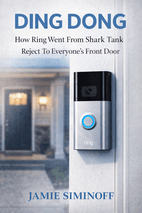
In this collection, you will find the unfiltered thoughts of an entrepreneur in the trenches. Some lines are brutally honest about failure and doubt. Others offer surprising wisdom about saying no and staying scrappy. There are moments of dark humor, fierce determination, and hard won lessons. What makes Ding Dong so quotable is its refusal to sugarcoat. Every line feels earned, not manufactured. These are the kind of sayings you underline, screenshot, and send to a friend who needs a kick in the pants.
The quotes range from one line zingers to longer reflections. They capture a startup's chaotic energy, like a pirate ship. You see the fear, grit, and stubborn optimism. It gives you permission to fail, be embarrassed, and keep going.
Top Quotes from Ding Dong
“It was going to fail. / was going to fail. In front of eight million people. Fuck.”
The narrator, Jamie Siminoff, realizes moments before taping his Shark Tank segment that his product is malfunctioning.
This visceral opening line captures the raw panic and high stakes of a live pitch, instantly drawing readers into the tension of the moment.
“You never want to own the whole thing. You don’t want to be the guy. You want to be the guy behind the guy.”
Siminoff recalls his father’s conservative business advice from when he was 16 years old.
The line perfectly contrasts the father’s cautious worldview with Jamie’s burning ambition, making it a memorable and poignant commentary on risk-taking and generational differences in entrepreneurship.
“The harder you work, the more lottery tickets you get.”
Jamie reflects on the grind of startup life and the odds of success.
This simple metaphor encapsulates the relentless effort required in entrepreneurship. It inspires readers to keep pushing despite uncertainty.
“If you aren't embarrassed by the first version of your product, you shipped too late.”
The author recalls the warning from Reid Hoffman as he considers product timing.
This quote is a mantra for entrepreneurs, validating the practice of launching imperfect products and iterating quickly.
“The things you say no to can be more important than the ones you say yes to.”
The author decides to decline a partnership offer from a lock company.
It underscores the importance of strategic focus and the power of saying no to preserve a company's vision.
“Failure sucks. But failure is better than regret, so long as it's an honest failure.”
Jamie reflects on his entrepreneurial philosophy about owning decisions and outcomes.
This succinct, powerful aphorism distills a universal truth about risk and integrity, encouraging readers to embrace honest failure rather than live with the pain of regret.
“It was not a lie. I had a board. The only detail I left out was that the board was just me.”
The founder tells the domain owner that his board won't let him pay the full price, omitting that he is the sole board member.
The humor and cunning of this line reveal the founder's resourcefulness and willingness to bend the truth to survive, making it memorable.
Themes Behind the Quotes
A central thread is relentless perseverance. The quotes hammer home that giving up is not an option, even when failure seems certain. Another major theme is the power of saying no. Turning down easy money or short term gains protects long term vision. Honesty and self criticism also run deep, with the author openly questioning his own habits and celebrating honest failure over regret.
A second theme is scrappy, mission driven creation. The book highlights building with limited resources, releasing imperfect products, and staying humble. It emphasizes empathy for customers as the core of product development. There is also a human side, balancing the grind with gratitude for family and recognizing that personal relationships matter more than business victories. These themes combine to paint a portrait of an entrepreneur who is flawed, driven, and ultimately focused on what truly matters.
Quotes by Chapter
Chapter 1 - Failure Is an Option
“Do I sound like someone with ADHD? Who works hard and ends up with only singles or 500-foot foul balls? Who watches as other entrepreneurs get the most out of good ideas? That might be true, all of it. But I do have one trait above all. I never stop.”
Siminoff reflects on his track record of near-misses and failed inventions.
This passage is both self-deprecating and deeply inspiring, encapsulating the relentless persistence that defines many entrepreneurs and resonates with anyone who has faced repeated setbacks.
“What's the thing worthy of your maniacal attention? That you'll want to build for the next ten years? What the hell, man?!”
Siminoff’s friend Diego Berdakin yells at him for spreading himself too thin across multiple mediocre ideas.
This blunt, passionate outburst forces both the narrator and reader to confront the importance of focus and prioritization, making it a powerful motivational moment.
Chapter 2 - Save Me
“I was so desperate for money that my brain screamed YES! Fortunately, my mouth said no.”
Jamie reflects on turning down Mr. Wonderful's royalty-heavy offer on Shark Tank.
This line captures the intense internal struggle between immediate need and long-term vision. It resonates with anyone who has had to make a painful but principled decision.
“We have a vision to build a big company out of this,” I explained, “and I can't give someone ten percent of all of our sales because it will bleed us of cash when we really need it most.”
Jamie explains to Mr. Wonderful why he cannot accept the royalty offer.
It shows entrepreneurial conviction and the sacrifice of short-term cash for future growth. Readers admire the courage to say no to needed money for a principle.
“My dad always told me to never burn a bridge, but in the heat of the moment, I decided, what the hell, I would incinerate that bridge.”
Jamie describes sending a vindictive email to a VC who turned him down.
The humor and honesty in admitting a fiery temper makes this line memorable. It humanizes the author and shows the emotional toll of repeated rejection.
Chapter 3 - The Best Worst Christmas Eve-Eve Ever
“We resembled a pirate ship more than a company.”
Describing the chaotic early days when personal bank accounts got mixed with business accounts.
The pirate ship metaphor vividly captures the unorthodox, rule-breaking nature of a scrappy startup.
“The wing just ripped off and the aircraft is falling out of the sky? Go to the checklist.”
The author explains his 'pilot mode' approach to handling the product crisis.
This powerful analogy illustrates how to remain calm and methodical in the face of disaster.
Chapter 4 - Yes, Mark Cuban, Burglars Ring Doorbells
“Burglars ring doorbells, as I pointed out to Mark Cuban on Shark Tank when he thought he had me in a gotcha! moment.”
The author recalls his interaction with Mark Cuban on Shark Tank.
This line captures a key insight about burglar behavior and the author's clever rebuttal to a challenge.
“We exist to reduce crime in neighborhoods. That's it. That's what would make us or break us.”
The author's epiphany about the company's mission while driving to CES.
A powerful, concise mission statement that defines the company's purpose and focus.
“The thief always adjusts, so the inventor needs to as well.”
The author reflects on the perpetual cat-and-mouse game between criminals and security inventors.
This encapsulates the ongoing challenge and motivation for innovation in security.
“If we spent energy congratulating ourselves on a product well done, it would take away from the energy needed to make the next product so much better.”
The author muses on the mindset required for continuous improvement.
A memorable reminder that complacency hinders progress and that constant self-critique fuels success.
Chapter 5 - The Treadmill
“But when I told them our mission was “to reduce crime in neighbor-hoods,” they seemed to light up.”
Jamie Siminoff describes how potential team members reacted when he shared DoorBot's mission.
This line captures how a specific, ambitious mission can cut through the bland corporate jargon and genuinely excite people, making it relatable and memorable.
“I appreciate if you don't believe we can do what I'm saying,” I told them. “Hell, you might be right. But I only want believers here.”
Jamie addresses potential hires who remained skeptical after his pitch.
It highlights the founder's uncompromising commitment to conviction over convenience, resonating with anyone who values passion and belief in a vision.
“I told my team that every dollar of venture capital we spent was really $100, because we had taken that money to get them 100x what they'd given us.”
The narrator explains his cost-consciousness to his team.
This metaphor powerfully captures the immense pressure and responsibility founders feel when spending investor money, making the abstract concept of valuation tangible and relatable.
Chapter 6 - Ring.com
“You're going out of business! Your doorbell doesn't work! It's just a name!”
The founder is yelled at in the parking lot by the man running the mezcal company next door.
This line captures the intense skepticism and external pressure the founder faced, making the reader feel the weight of his risky decision.
“We're all just trying to keep the boat afloat, however we can.”
The founder says this to Yassi when she is frustrated with angry customers and unclear direction.
This simple, honest line encapsulates the scrappy, desperate reality of startup life, resonating with anyone who has faced chaos and uncertainty.
“Whoever gets the device closest to paper-thin, wins.”
Designer Chris Loew says this while pushing for a sleeker doorbell design.
It's a sharp, competitive mantra that drives innovation and captures the relentless pursuit of perfection in product design.
Chapter 7 - I Broke It, I Fixed It
“The sting of almost. The ache of falling short after giving everything.”
After earning a B in algebra, missing the straight A's required for the Land Rover his father promised.
It distills the universal pain of near-success into two haunting phrases, making readers feel the crushing weight of coming so close.
“There's always something that can be done!”
The narrator's internal reaction after a dismissive doctor says nothing can be done about his newborn son's rare disease.
This defiant declaration embodies the author's refusal to accept hopelessness and his drive to find solutions where others see dead ends.
“Those accomplishments of Ollie’s are the greatest “fuck you” ever.”
The author reflects on his son's achievements after a doctor dismissed their efforts.
This line captures the raw satisfaction of proving doubters wrong, turning a child's success into a defiant statement of love and victory.
“I focus on how grateful I am that my favorite human on the planet is thriving.”
The author shifts from anger to gratitude about his son's well-being.
It beautifully expresses the depth of parental love and the joy of seeing a child overcome adversity.
Chapter 8 - Too Dumb to Fail
“To make great products you need to empathize with customers. That's your first and last job, but it's a tough one.”
Jamie Siminoff discussing the importance of customer empathy in product design.
This line distills a fundamental business truth into a memorable imperative, emphasizing that understanding customers is not just a task but the core mission.
“Time for some of those Silicon Valley product designers to fly coach once in a while, on a flight that lands in the middle of the country, not just the edges.”
Jamie criticizing Silicon Valley's disconnect from average Americans.
It's a sharp, visual critique of tech elitism and a call for designers to experience the real world, resonating with anyone tired of bubble mentality.