Crazy Simple YouTube Key Takeaways

by Aaron Cuha
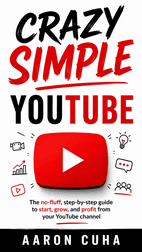
Crazy Simple YouTube by Aaron  Cuha Book Cover

5 Main Takeaways from Crazy Simple YouTube

Your YouTube Content Compounds Like an Asset, Not a Post

Unlike social media posts that vanish in hours, a single YouTube video can generate revenue equivalent to a full-time salary over three years. The compound effect means your library works for you indefinitely — one well-targeted video keeps paying out long after it’s published.

Chase Search Traffic and Useful Topics, Not Viral Subscribers

Subscriber count is a vanity metric; instead focus on watch time, click-through rate (CTR), and average view duration. The algorithm rewards searchable content that answers real questions — study YouTube autocomplete and competitors in the 10k–100k range to find proven demand.

Design a Lead Generation System Before You Need It

Views and subscribers don't equal revenue. Build a single focused lead magnet with a stripped-down capture page, and place it where viewers will see it multiple times. Doing this early, not when your channel feels “big enough,” turns content into a 24/7 sales machine.

Consistency and Simple Systems Beat Perfection and Expensive Gear

A smartphone, $25 mic, and window light are enough for a six-figure channel — never upgrade until you’ve filmed 20 videos and diagnosed a real problem. Post one video per week consistently, batch film to save six to eight hours monthly, and use a repeatable launch sequence to make results predictable.

Optimize for Retention and Engagement, Not Vanity Metrics

The algorithm cares about total watch time, CTR, and average view duration far more than raw view counts or subscribers. Analyze your retention graph to find drop-off points, keep the first 30 seconds below 70% loss, and run a fifteen-minute weekly review to spot structural issues before they compound.

Executive Analysis

These five takeaways together form the book’s central argument: YouTube is not a platform for viral fame but a long-term business asset that grows through search-driven content, systematic lead generation, and consistent execution over perfection. Aaron Cuha rejects the “post daily and pray” advice, replacing it with a data-backed framework that treats every video as a compoundable investment. The core thesis is that success comes from aligning content with what the algorithm actually rewards (watch time, engagement, search intent) and building a lead conversion system that turns viewers into clients.

This book matters because it cuts through the noise of generic YouTube advice with tactical, low-cost steps that anyone can implement immediately. It is uniquely practical for business owners, solopreneurs, and consultants who want their channel to generate leads and revenue, not just views. In a genre crowded with hype about gear and virality, “Crazy Simple YouTube” stands out as a grounded, psychology-aware roadmap that prioritizes mindset, systems, and measurable ROI over vanity metrics.

Chapter-by-Chapter Key Takeaways

The $387,000 Youtube Video (Chapter 1)

  • YouTube content compounds over years, unlike social media posts that disappear in hours

  • A single video can generate the revenue equivalent of a full-time employee's salary over three years

  • The YouTube compound effect means your content works for you indefinitely

  • Every chapter provides real stories, tactical frameworks, AI tools, case studies, and actionable steps

  • The system is designed to turn your channel into a business asset that generates leads and revenue on autopilot

Try this: Commit to treating each video as a long-term asset by focusing on evergreen searchable topics that will generate revenue for years, not hours.

Why Most Youtube Advice Is Wrong (Chapter 2)

  • Post one video per week initially, not daily—quality beats burnout.

  • Subscriber count is vanity; track watch time, CTR, and average view duration instead.

  • The algorithm rewards useful, searchable content—study what works, don’t fight it.

  • Use the provided AI prompt to audit your strategy for hidden myths before you waste time.

  • Drop one bad habit now (e.g., checking subscriber numbers) to reset your mindset for the chapters ahead.

Try this: Audit your current strategy using the AI prompt to identify hidden myths, then drop one bad habit like checking subscriber numbers and commit to posting one quality video per week.

The 2026 Youtube Algorithm Decoded (Chapter 3)

  • Watch time (total minutes) matters more than percentage retention. Longer videos almost always build more algorithmic momentum.

  • Engagement signals (CTR + AVD) drive suggested traffic; external traffic (from your own channels) kickstarts the cycle.

  • Use the algorithm analyzer prompt to diagnose your bottleneck—fixing one metric at a time beats scattered efforts.

  • For business channels, search traffic captures intent-driven leads, suggested traffic expands reach, and external traffic is the spark.

Try this: Diagnose your channel’s algorithmic bottleneck by analyzing watch time, CTR, and AVD separately, then fix one metric at a time rather than guessing.

Your Youtube Business Model (Chapter 4)

  • Your business model determines whether your YouTube channel is a hobby or an asset—the content alone isn’t enough.

  • Authority channels focus on positioning, not direct leads, and revenue comes from opportunities like speaking and consulting.

  • Digital products turn videos into automated sales machines, with each video acting as a 24/7 employee.

  • The direct lead gen model can be wildly profitable once you align content with the right revenue path, as Sarah’s case proves.

  • Use the provided AI prompt to calculate your numbers and commit to one primary model before moving forward.

Try this: Calculate your revenue model using the AI prompt and commit to one primary path—authority, digital products, or direct lead gen—before creating another video.

The “Good Enough” Equipment Stack (Chapter 5)

  • Your smartphone (iPhone 11+ or flagship Android from 2020) is a sufficient 4K camera for a six-figure YouTube channel.

  • Invest in a $25 lavalier mic for clear audio, and use natural window light for free, flattering lighting.

  • A $15–$30 phone tripod solves shaky footage. Keep the total investment under $150.

  • Never upgrade gear until you’ve filmed 20 videos and diagnosed a real problem.

  • The best equipment reduces setup friction, enabling daily consistency. Consistency builds channels, not cameras.

Try this: Use your existing smartphone, a $25 lav mic, and window light to film your next 20 videos without spending more than $150 on gear.

Channel Setup That Converts (Chapter 6)

  • The banner’s safe zone is only 1546 by 423 pixels in the center—keep critical text there.

  • Your About section must serve both humans and search: first 150 characters = value proposition, then credibility, then content schedule, then CTAs.

  • Use the provided AI prompt to draft your channel text, but always edit to keep your voice.

  • Test your channel on mobile: within five seconds a new visitor should know what you do, why they should trust you, and what to watch first.

Try this: Rewrite your channel banner and about section to clearly state your value proposition within the first 150 characters, then test on mobile to ensure a visitor knows what you do in five seconds.

Finding Topics Your Audience Actually Searches For (Chapter 7)

  • Use YouTube autocomplete as a live research tool—each suggested phrase is a potential video with proven demand.

  • Study competitors in the 10k–100k subscriber range to spot topic patterns without reinventing the wheel.

  • Vet every idea with five checks: demand, rankability, audience fit, expertise, and evergreen shelf life.

  • One well-targeted video can outperform dozens of guesswork videos, both in views and in qualified leads.

  • The difference between a lead-generating channel and an empty one isn't production quality or posting frequency—it's whether you're answering questions people are actually asking.

Try this: Mine YouTube autocomplete and study competitors with 10k–100k subscribers to find searchable topics, then vet each idea using the five-check framework before filming.

Titles And Thumbnails That Get Clicks (Chapter 8)

  • A title must combine benefit, curiosity, and search intent—missing any one kills clicks.

  • Use proven formulas: mistake warning, comparison, insider secret, complete guide, case study.

  • Keep a swipe file on your phone and always write at least three title options per video.

  • Thumbnails need a clear focal point, an expressive face, and minimal text (3–4 words max).

  • Spend 30 minutes retrofitting your best existing videos—it’s the highest‑ROI upgrade available.

  • Plan title and thumbnail before filming so the content aligns with the promise you’re making.

Try this: Brainstorm at least three title options using proven formulas (mistake warning, comparison, complete guide) and design a thumbnail with one focal point, an expressive face, and minimal text before you film.

The First 30 Seconds: Hooks That Keep Viewers Watching (Chapter 9)

  • The first 30 seconds are the highest-leverage part of any video; small improvements here cascade into massive gains in reach and conversions.

  • Never open with weakness—no apologies, no excuses, no context before value.

  • Choose a hook formula that matches your content: Problem-Agitate-Promise for teaching, Shocking Statement for challenging assumptions, and six others detailed in the chapter.

  • Use the AI script generator to brainstorm multiple options, then pick the strongest.

  • Run the Hook Audit on your last three videos; if retention at 30 seconds is below 70%, rebuild your opening immediately.

Try this: Open your next video with a problem-agitate-promise hook or shocking statement, and run a hook audit on your last three videos to ensure retention at 30 seconds is above 70%.

Structuring Videos For Maximum Retention (Chapter 10)

  • Retention drops are not random—they’re triggered by predictable problems you can fix before you film.

  • Structure your video around five value peaks, each followed by a tease that pulls viewers toward the next payoff.

  • Pattern interrupts (every 90 seconds or so) reset attention and prevent the brain from tuning out.

  • The best structure is the one that fits your format—don’t force a story arc onto a tutorial. Pick the framework, then let it do the work.

Try this: Structure your video around five value peaks with a pattern interrupt every 90 seconds, using the framework that best fits your format—tutorial, story, or list.

Scripting And Delivery: Finding Your On-Camera Voice (Chapter 11)

  • Script level matters: Start with detailed outlines (first 20 videos), then move toward bullet points as you learn your rhythm.

  • Structure anchors engagement: Hook (word-for-word) → credibility statement (brief) → body (outline).

  • Ritualize your prep: Physical, vocal, and mental warm-ups before every filming session.

  • Practice deliberately: Film, watch, note one fix, re-film. Repeat. Progress beats perfection.

Try this: Write a detailed outline for your first 20 videos with a word-for-word hook and brief credibility statement, then ritualize a physical and vocal warm-up before each filming session.

Editing For Engagement, Not Perfection (Chapter 12)

  • Jump cuts are your primary tool—cut pauses and filler, leave a breath between clips.

  • Cover jarring cuts with B-roll, keeping clips short (2–5 seconds) and relevant.

  • On-screen text (3–4 words max) hooks sound-off viewers.

  • Free stock footage (Pexels, Pixabay) works when you lack custom B-roll.

  • Before adding any edit, ask: “Does this keep the viewer watching?” If not, skip it.

Try this: Edit out all pauses and filler with jump cuts, covering jarring transitions with 2–5 second B-roll clips, and add on-screen text of 3–4 words for sound-off viewers.

Publishing And Optimization: The Launch Sequence (Chapter 13)

  • First 48 hours matter most because YouTube measures early engagement rate, not raw views.

  • For small channels, timing is secondary to consistency—pick a schedule and stick with it.

  • Prepare your full metadata package before uploading to avoid last-minute scrambling.

  • Scheduling tools let you batch production and maintain a steady cadence even during busy periods.

  • Chaos in publishing = chaos in results; a repeatable launch sequence turns luck into predictability.

Try this: Prepare your full metadata package (title, description, tags, end screens) before uploading, and schedule your video to publish at the same day and time each week to build algorithmic trust.

Building Your Content Calendar: Consistency That Lasts (Chapter 14)

  • Consistency outweighs quality in YouTube’s algorithm—showing up reliably drives long-term growth.

  • One video per week is a sustainable frequency; batching filming sessions saves six to eight hours monthly.

  • Divide content into a mix: 50–60% pillar (search), 20–30% trending (timely), 10–20% trust-building (relationship).

  • Build a safety net: a buffer of scheduled content plus emergency stash videos for unexpected breaks.

  • A repeatable system, not willpower, is the only way to maintain consistency year-round.

Try this: Batch film four videos in one session weekly to save six to eight hours, and maintain a content mix of 50–60% pillar search topics, 20–30% trending, and 10–20% trust-building relationship content.

Analytics That Actually Matter: Reading Your Data (Chapter 15)

  • Focus on CTR, AVD, and average percentage viewed—not vanity metrics like total views.

  • AVD below 40% is a structural problem; the retention graph reveals exactly what to fix.

  • A fifteen‑minute weekly review gives you all the insight you need without analysis paralysis.

  • Use AI prompts during monthly deep‑dives to surface hidden patterns.

  • Your opening must deliver value or create curiosity immediately—credentials come later, if at all.

Try this: Review your CTR, AVD, and average percentage viewed in a fifteen-minute weekly check, and if AVD is below 40%, use the retention graph to identify and fix the drop-off point.

Youtube Shorts: The Strategic Approach For Business Channels (Chapter 16)

  • Shorts operate on a separate algorithm: completion rate is king, and shorter (under 40 seconds) almost always performs better.

  • Understand that Shorts audiences and long-form audiences are largely different—set expectations accordingly.

  • The first two seconds are everything; open with the most compelling statement, no pleasantries.

  • Always include on-screen text for mute viewers, and design for loopability.

  • Track conversion to long-form viewing, not just vanity metrics like total views.

  • Repurpose existing long-form content: extract one strong moment, crop, caption, and add a call-to-action to the full video. It's a 20-minute weekly investment that can meaningfully boost channel growth.

Try this: Create a Short under 40 seconds with a compelling opening in the first two seconds, on-screen text for mute viewers, and a call-to-action to your long-form video, repurposing one strong moment from existing content.

Building Your Lead Generation System (Chapter 17)

  • Views and subscribers are not revenue. Only a lead generation system converts content into clients.

  • Design a single, focused lead magnet that solves one immediate problem—then place it where viewers will see it multiple times.

  • Your capture page must have no other goal than getting the email; strip away everything else.

  • Build the system now, not when your channel feels “big enough.” Sandra’s eight-month delay cost her a fortune.

  • Use a repeatable prompt to generate lead magnet ideas and build the entire system in about 90 minutes.

Try this: Design one focused lead magnet solving a specific problem, place it prominently in your video description and end screen, and build a simple capture page with no other goal than getting the email.

Converting Youtube Leads To Clients (Chapter 18)

  • YouTube leads come pre-loaded with trust, self-qualification, philosophy alignment, and reduced skepticism—your close rate should be 2–3× higher than cold leads if you handle the conversation properly.

  • Handle common objections (free content is plenty, skipping formalities, “why should I pay?”) by reinforcing the value of personalized application over general education.

  • Don’t skip the connection phase—acknowledge that they already know you, but pivot to learning their specific situation.

  • Never give away the full solution on the call. Tease the outcome, but save the plan for paid engagement.

  • Be specific about your process and outcomes so the lead can visualize the value. And always ask for the commitment directly.

Try this: When a YouTube lead books a call, skip the credentials and dive into their specific situation, then handle objections by reinforcing the value of personalized application over free content.

Building Your Youtube Team (Chapter 19)

  • Don’t hire until you have systems. A style guide, documented workflow, and feedback framework are non-negotiable prerequisites.

  • Use paid test projects. Before hiring anyone, have 2-3 finalists complete the same task using your documentation. The right candidate will ask smart questions.

  • Front-load training. Invest heavily in the first few weeks—review everything, give specific feedback, update your style guide. This shortens the ramp-up dramatically.

  • Move from constant oversight to review checkpoints. Review rough cuts and finals (for editing) or concepts and finals (for thumbnails). Reduce check-in frequency as the team member proves reliable.

  • Scale incrementally. Handle one role at a time. First an editor, then a thumbnail designer, then a VA. Each new hire benefits from the systems you built for the previous one.

Try this: Document your style guide and workflow before hiring anyone, then use paid test projects with 2–3 finalists and front-load training before moving to review checkpoints.

The Mental Game: Psychology And Resilience For Creators (Chapter 20)

  • The comparison spiral distorts reality—you’re comparing your messy process to someone else’s highlights. Stop it by looking at trajectories, not snapshots.

  • Vanity metrics (subscribers, raw views) can trick you into thinking you’re failing when you’re actually building momentum in the right direction.

  • Commit to 100 videos before making any judgments about your channel. Growth compounds, but only if you survive the slow period.

  • Use the AI mindset reset prompt when you’re in a creative rut to get an outside perspective and break the spiral.

  • Leah’s story proves that psychology is often the bottleneck—fix the mindset first, and the tactics you already know will start working.

Try this: Commit to filming 100 videos before judging your channel’s performance, and use the AI mindset reset prompt whenever you spiral into comparison or vanity metrics.

Building Your Youtube Community: From Viewers To Advocates (Chapter 21)

  • The algorithm rewards engagement signals per video, not total subscriber count. A small, active community beats a large passive one.

  • Community provides social proof that sells your authority, makes your channel resilient to underperformers, and turns viewers into an unpaid marketing team.

  • Attract the right people by being crystal clear about your channel’s values; let your identity filter out short-cut seekers.

  • Manage engagement sustainably by using fixed time slots and triaging comment types—not all responses are equal.

  • Give your community a shared identity (e.g., “The Financial Freedom Crew”) to foster ownership, which naturally drives word-of-mouth growth.

Try this: Engage with every comment in the first 48 hours after publishing, and give your community a shared identity like 'The Financial Freedom Crew' to foster word-of-mouth growth.

Repurposing Content: Maximum Reach, Minimum Effort (Chapter 22)

  • Repurpose with intent: tailor each platform’s format, don’t just cross-post raw.

  • Email is your highest-ROI distribution channel because you own the audience.

  • A single video can become a blog post, a podcast episode, social clips, and an email—no extra creation needed.

  • Use a templated system (quote, platforms, CTA) to avoid decision fatigue.

  • Schedule a weekly batch block for repurposing; consistency beats sporadic bursts.

Try this: Repurpose each video into a blog post, podcast episode, social clips, and an email, using a templated system with consistent format and CTA to avoid decision fatigue.

Measuring Your Youtube Roi: Tracking What Actually Matters (Chapter 23)

  • Define your ROI model upfront—choose Revenue ROI, Lead Value ROI, or Cost Per Acquisition based on your business type.

  • Build a simple tracking system with UTM parameters, CRM lead source capture, pipeline stage logging, and a close-the-loop process.

  • Map your full funnel from views to revenue; identify the weakest conversion stage and prioritize improving it.

  • Account for the lag effect and compounding library—evaluate ROI over quarters, not weeks, to see the true picture.

  • Indirect benefits (authority, faster closes, referrals) are real but hard to measure—acknowledge them without relying on spreadsheets.

  • Run a 10-minute quarterly ROI review; trend lines over several quarters give you the best strategic direction.

Try this: Define your ROI model (revenue, lead value, or CPA) and build a simple tracking system with UTM parameters and CRM logging, then run a ten-minute quarterly review to spot trends over quarters.

Your 90-Day Roadmap: From Here To 10,000 Subscribers (Chapter 24)

  • Blueprint for the first 90 days: Setup (weeks 1–3), Launch (weeks 4–6), Optimize (weeks 7–10), and a final push to 10,000.

  • Rhythm over perfection: A consistent publishing day and rapid comment engagement establish both audience trust and algorithmic visibility.

  • Data-driven iteration begins at video four: Don’t keep guessing once you have data; use analytics to refine every element.

  • Personalized planning avoids generic advice: The worksheet forces you to define your why, schedule, weekly actions, and accountability upfront.

  • Execution beats reading: The entire book is validation that these strategies work—now the only step left is to publish.

Try this: Follow the 90-day roadmap: setup weeks 1–3, launch weeks 4–6, optimize weeks 7–10, and final push, sticking to a consistent publishing day and using analytics starting at video four.

Continue Exploring