Copywriting for Marketers — Interactive Mindmaps

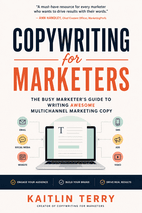
Copywriting for Marketers by Kaitlin Terry Book Cover

by Kaitlin Terry

Kaitlin Terry's Copywriting for Marketers provides busy marketers with a step-by-step system for planning, writing, and optimizing multichannel copy using psychological principles and data-driven decisions, covering audience research, persuasion tactics, channel-specific strategies, and rigorous A/B testing.

On Insta.page you also get an Apply This Book tool that lets you combine insights from up to 3 books to solve your specific situation.

Chapter mindmaps

Free preview: chapters 1–4 are fully interactive. Click any node to expand or collapse. Subscribe to unlock the rest.

Chapter 1: Chapter 1: Foundations

Key concepts: Chapter 1: Foundations

1. Chapter 1: Foundations

What a Copywriter Does

  • Creates emotional connections that change behavior
  • Works as detective, psychologist, and storyteller
  • Uncovers wants, fears, and motivations beyond demographics

Evolution of Copywriting

  • From dry, feature-heavy newspaper ads to brand stories
  • Now conversational, personality-driven, and data-informed
  • SEO and ethical expectations shape modern copy

Copywriting's Role in Campaigns

  • Voice of the brand shaping perception
  • Takes audiences on an emotional journey
  • Consistency builds trust across platforms

The B2B Difference

  • Group decision-making requires logic and credibility
  • Focus on ROI, long-term value, and case studies
  • Longer sales funnel needs educational content

Psychology Behind Persuasion

  • Emotional triggers: joy, FOMO, belonging
  • Rational benefits must back up emotions
  • Scarcity, social proof, and reciprocity influence behavior

Audience Research Methods

  • Surveys and interviews reveal pain points
  • Social media and website analytics show behavior
  • Competitor analysis and trend monitoring

Real-World Examples

  • Dove's 'Real Beauty' mirrors audience values
  • Spotify personalizes playlists for engagement
  • Old Spice uses irreverent humor effectively

Chapter 2: Chapter 2: Planning

Key concepts: Chapter 2: Planning

2. Chapter 2: Planning

Audience Empathy & SMART Goals

  • Deep audience understanding drives effective copy
  • SMART framework: specific, measurable, achievable, relevant, time-bound
  • Clear purpose for each piece of copy

Research Methods & AI Enhancement

  • Market analysis, competitor breakdowns, customer surveys
  • B2B data-focused vs B2C psychological insights
  • AI predicts trends, personalizes content, refines headlines
  • Real-world examples: Volkswagen, JP Morgan, Mastercard

Content Calendar & Centralized Management

  • Living, linked document as single source of truth
  • Specify types, frequencies, platforms using Trello or Sheets
  • View-only access for team, edit control for few

Visual Planning & Cross-Platform Integration

  • Map logical message flow for each asset and segment
  • Tailor messages to personas across blog, social, email
  • Coordinate early with email, SEO, and other teams

Brand Examples & Flexibility

  • HubSpot: consistent posting; Red Bull: diverse multimedia
  • Airbnb: cross-platform alignment with 'Live There'
  • Use digital tools but build in adaptability

Chapter 3: Chapter 3: Persuasion

Key concepts: Chapter 3: Persuasion

3. Chapter 3: Persuasion

Cialdini's Principles of Persuasion

  • Reciprocity: Offer value first to create obligation
  • Commitment & Consistency: Small steps lead to larger ones
  • Social Proof: Show others have chosen well
  • Scarcity: Trigger fear of missing out

Additional Persuasion Principles

  • Authority: Borrow credibility from experts
  • Liking: Build warmth through shared values
  • Unity: Foster shared identity and belonging

Real-World Campaign Examples

  • Nike's 'Just Do It' sells empowerment, not shoes
  • Apple's 'Think Different' uses authority and liking
  • Coca-Cola's 'Share a Coke' personalizes mass product
  • Dove's 'Real Beauty' builds loyalty through authenticity

Building Audience Personas

  • Go beyond demographics to psychographics
  • Create profiles with names and backstories
  • Refine continuously with surveys and A/B testing
  • Tailor messaging to each persona's motivations

Tailoring Copy to Personas

  • Budget-Conscious Parent: Reassure with value and durability
  • Tech-Savvy Millennial: Highlight innovation and social proof
  • B2B roles: Focus on efficiency, ROI, or integration
  • Adjust tone and channel for each group

Storytelling and Emotional Appeal

  • Use power words and sensory imagery
  • Vary sentence rhythm to evoke emotions
  • Transform dry facts into emotional narratives
  • Case studies: Airbnb (belonging) and #LikeAGirl (empowerment)

B2B Persona Development

  • Focus on professional roles and business challenges
  • Line managers want efficiency; executives care about ROI
  • Use industry jargon to signal expertise
  • Target content to professional networks and publications

Chapter 4: Chapter 4: Channels

Key concepts: Chapter 4: Channels

4. Chapter 4: Channels

Email Subject Lines

  • Must be clear, urgent, and personal
  • Avoid misleading or overly clever lines
  • Personalization boosts open rates
  • A/B testing is essential for optimization

Email Body Structure

  • Reward skimmers with short paragraphs and bullets
  • Place deadlines and offers prominently
  • Use storytelling and clear language
  • Maintain brand consistency with visuals

Calls to Action (CTAs)

  • Make the desired action unmistakable
  • Use urgency and contrasting button colors
  • Personalize and A/B test wording and placement
  • Incentives motivate clicks and conversions

Audience Segmentation

  • Target based on age, location, behavior, interests
  • Adapt content for each segment
  • Raises relevance, engagement, and revenue
  • Avoid treating all subscribers the same

Blog and Article Writing

  • Understand audience through personas and empathy
  • Use storytelling to make ideas personal
  • Focus on benefits, not features
  • Back claims with evidence and visuals

Web Advertising Copy

  • Hook instantly with curiosity or urgency
  • Adapt rhythm to each platform (Google, Instagram, X)
  • Emotional connection outperforms generic pitches
  • Measure success beyond CTR to conversions

Channel Convergence

  • Connect email, blog, and ads into one conversation
  • Consistent message builds trust across platforms
  • Layer each channel's strengths to nudge conversion
  • Adaptability and testing are non-negotiable

Continue exploring Copywriting for Marketers