Copywriting for Marketers Key Takeaways
by Kaitlin Terry
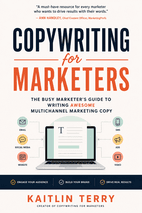
5 Main Takeaways from Copywriting for Marketers
Combine Demographics, Psychographics, and Behavior for Audience Insight
Effective copy starts with a multi-layered understanding of your audience—not just age or income, but what they fear, aspire to, and how they act. Terry shows that segmenting by behavior (e.g., new visitors vs. cart abandoners) forces you to craft completely different messages, and real-world examples prove personalization and emotional resonance outperform generic copy every time.
Plan Content with a Centralized, Living Calendar and Team Coordination
A content calendar should be a dynamic, shared document that ties together email, SEO, social, and other functions. By mapping the logical flow of messages for each audience segment and coordinating early with other marketing teams, you avoid last-minute surprises and ensure consistency—inspired by brands like HubSpot and Red Bull.
Persuade with Psychology, Emotional Stories, and Well-Crafted Personas
Cialdini’s principles work only when applied genuinely, and Terry emphasizes using them alongside deep persona research that goes beyond demographics to capture motivations. Case studies like Nike’s “Just Do It” and Dove’s “Real Beauty” show how story-driven emotional appeal—through precise language, vivid imagery, and rhythmic pacing—creates lasting connections.
Adapt Copy to Each Channel and Optimize Through A/B Testing
Persuasive writing changes by channel: benefits and conversational tone for web pages, strong headlines for ads, and SEO-friendly keyword integration for articles. Visuals boost comprehension, and continuous A/B testing with KPIs ensures you’re maximizing impact—measuring everything from CTAs to buyer journey alignment.
Balance Short-Term Wins with Long-Term Growth and Continuous Learning
Resource allocation must align with campaign scale, but sacrificing future growth for immediate results is a trap. Terry advocates for structured decision-making (ROI analysis, data insights) and treating every campaign as a lesson. Ethical persuasion, cultural sensitivity, and constant skill development form the foundation of lasting success.
Executive Analysis
These five takeaways form the core thesis of Copywriting for Marketers: that effective copywriting is not a single act of writing but a strategic, end-to-end process. It begins with deep audience understanding, flows into systematic planning and cross-functional coordination, leverages psychological and emotional persuasion through well-researched personas, adapts execution to each channel with rigorous testing, and finally relies on continuous optimization and ethical integrity. Together, they reframe copywriting from a creative task into a data-informed, audience-centric discipline that connects at every stage.
This book matters because it bridges the gap between theory and practice for modern marketers. Terry provides actionable frameworks—from building a living content calendar to applying Cialdini’s principles without sleaze—that can be applied immediately. It sits squarely in the professional marketing genre, complementing classic persuasion texts with a channel-specific, measurement-driven approach. For anyone tired of generic advice, this book offers a repeatable system to turn copy into a driver of real business results and deeper audience relationships.
Chapter-by-Chapter Key Takeaways
Foundations (Chapter 1)
Audience research requires a blend of demographics, psychographics, behavior, pain points, and competitor analysis—not just one source of data.
Segmentation by behavior (new visitors, loyal customers, cart abandoners) demands completely different messaging approaches.
Real-world examples show that personalization, emotional resonance, and authentic positioning consistently outperform generic copy.
The ultimate goal of copywriting is connection, not just persuasion—words should reflect what your audience already feels.
Try this: Blend demographic, psychographic, behavioral, pain point, and competitor data into a single audience profile, then segment by actions like new visitor or cart abandoner to tailor every message uniquely.
Planning (Chapter 2)
A content calendar works best as a living, linked document—keep it centralized, version-controlled, and accessible to the whole team.
Break down content creation visually (whiteboards, columns) and plan the logical flow of messages for each asset and audience segment.
Coordinate early with other marketing functions (email, SEO, social) to ensure consistency and avoid last-minute surprises.
Use digital tools (CMS, analytics, project management) but build in flexibility to adapt to changing conditions.
Study successful brand schedules (HubSpot, Red Bull, Airbnb) for inspiration on consistency, variety, and cross-platform integration.
Try this: Create a central, version-controlled content calendar accessible to all teams, coordinate early with email, SEO, and social, and visually map the logical flow of messages for each asset and audience segment.
Persuasion (Chapter 3)
Persuasion in copywriting is rooted in psychological principles that trigger innate human responses.
Cialdini's principles are powerful only when applied genuinely and tailored to context.
Famous campaigns like Nike's "Just Do It" and Dove's "Real Beauty" show how these principles create lasting emotional connections.
Audience personas go beyond demographics to capture psychographics, turning abstract targets into relatable characters.
Crafting personas involves data gathering, detailed creation, and continuous validation.
Tailoring copy to different personas means adjusting messaging, tone, and channels to speak directly to each group's unique motivations and pain points.
B2B personas require a close look at professional roles, pain points, and industry-specific content preferences.
Practical exercises help cement persona-based writing for different audiences.
Emotional appeal relies on precise language, vivid imagery, rhythmic pacing, and targeted emotion evocation.
Case studies like Airbnb and Always #LikeAGirl show how story-driven campaigns create powerful connections.
The ultimate goal is crafting an experience that resonates personally and emotionally, turning reading into a journey of persuasion.
Try this: Build detailed persona profiles that include psychographics and motivations, then adjust tone, messaging, and channels for each group; apply Cialdini’s principles genuinely and evoke emotion through precise language and storytelling.
Channels (Chapter 4)
Persuasive writing thrives on benefits, conversational tone, proof, and a strong CTA.
Visuals dramatically boost comprehension and retention.
Case studies show empathetic storytelling and visual explanations drive measurable growth.
SEO-friendly articles require careful keyword research and natural integration.
Balance user engagement with business goals by aligning content, CTAs, and KPIs with the buyer’s journey.
Web ad copy succeeds with strong headlines, concise messaging, emotional appeal, and platform-specific adaptation.
A/B testing and continuous measurement are nonnegotiable for optimization.
Try this: Write every piece with a conversational tone, strong benefits, proof, and a clear CTA; adapt headlines and formats per platform and integrate A/B testing to continuously improve based on real performance data.
Next chapter: “Optimization” is locked
Keep learning from Copywriting for Marketers — and unlock all 600+ book summaries with audio, mindmaps and AI Q&A.
$0.00 due today · 7 days free, then $89.99/year ($7.49/mo) · Cancel anytime before day 7
plus sales tax where applicable