Claude Skills for Beginners Quotes
by Giovanni Kavalakis
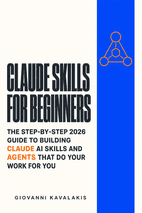
On this page you will find short, practical lines from a beginner's guide to building reusable Claude Skills. They cover the shift from one-off prompts to saved instructions, the value of dull, repeatable work, and the habit of fixing mistakes by adding one clear rule at a time.
The book is quotable because it turns ordinary admin frustration into compact rules you can use. The sentences are plain, specific, and often funny in a dry way, which makes them easy to remember and easy to test in your own week.
Top Quotes from Claude Skills for Beginners
“A prompt is something you type once and lose. A Skill is saved, named, and reusable: the difference between shouting instructions and writing the training manual.”
The chapter distinguishes a one-off prompt from a reusable Skill.
The contrast is memorable because it reframes Skills as durable training manuals rather than fleeting commands.
“A Skill never fails randomly. It fails exactly where your instructions went quiet. That sentence is your repair manual forever.”
After listing the five questions, the chapter explains how to diagnose a broken Skill.
It turns failure into a precise, findable gap instead of random bad luck. That makes debugging feel practical and repeatable.
“This is the mental shift that separates people whose Skills work from people who give up: stop writing prompts, start writing job descriptions for a stranger on day one.”
This follows the stranger test, where readers are asked whether a newcomer could do the job from the page alone.
It reframes prompt writing as writing a job description, which is the central mindset shift of the chapter.
“Build the boring Skill first. Boring is where the hours are.”
The chapter boils its payback-score method down to a direct instruction.
It reframes automation around hidden time savings rather than excitement, making the safest first build feel obvious.
“Every miss becomes a line, and every line makes the next miss rarer. Skills are not built good. They are made good.”
The chapter explains why incremental repair beats a full rewrite.
It reframes Skill quality as accumulated learning, not initial brilliance.
“The moral is not that structure is bad. It is that in Skills, as in businesses, continuity beats elegance. A messy page carrying six months of learned fixes outperforms a beautiful page carrying none.”
After Dev’s repeated rewrite cycle, the chapter draws the lesson from his experience.
It praises practical continuity over cosmetic polish, which is reassuring for beginners maintaining messy but working systems.
Themes Behind the Quotes
The main theme is moving from scattered requests to written, reusable systems. The book treats automation as a practical craft: describe a repeated job clearly, save the instructions, and let the tool handle the routine parts while you keep judgment and boundaries in view. It returns often to small, unglamorous tasks because that is where time is actually lost.
Another theme is improvement through specific feedback. Mistakes are not mysterious; they usually point to a missing fact, unclear rule, or stale file. The response is to add one precise correction, test again, and keep the working version even if it is not pretty. The quotes also stress continuity, clear handoffs, and keeping each fact in one place so a set of simple Skills can work together.
Quotes by Chapter
Introduction. The Two-Hour Problem
“Somewhere in your week there is a block of hours that does not belong to you.”
The chapter opens by naming the hidden time drain that business owners recognize.
It frames lost time as something taken from you, which makes the problem feel personal and urgent. The phrasing is simple enough to stick.
“It is the work that is not the work: the replying, confirming, chasing, formatting, summarising.”
The chapter defines the repetitive tasks that consume a business owner's week.
The paradox 'work that is not the work' captures the invisible overhead of running a business. The list makes it instantly concrete.
“The claim is narrow and testable: if you can write a note to a new employee, you can train an Al to do your repeating tasks, in your voice and by your rules, and you can do it this week, without learning anything technical.”
The chapter states its central, deliberately limited promise.
It makes AI delegation feel as familiar as onboarding a new hire. The concrete conditions keep the claim from sounding like hype.
“The trades change; the two-hour problem does not.”
After listing cleaners, tutors, tradespeople, and other owners, the chapter universalizes their shared struggle.
It condenses the book's premise into a single memorable contrast. Readers in any trade can see themselves in it.
Chapter 1. Meet Your New Employee
“Maria runs a small cleaning company in Manchester. Every Sunday night she used to sit at her kitchen table for two hours, turning the week's phone messages into a schedule for her four cleaners. Same task, every week, forever. Today that job takes her four minutes.”
The chapter opens with Maria's before-and-after story to show what a Skill can change.
It makes the benefit concrete and emotional: hours of repetitive Sunday work become four minutes without hiring or coding.
“A Skill is simply written instructions that an Al keeps and follows every time: a recipe card that never gets lost and never needs repeating.”
The chapter defines a Skill in plain English after setting aside the technical name.
The recipe-card image makes an abstract tool feel familiar, durable, and easy for a beginner to imagine building.
“A Skill ends that. You explain the job once, properly, and it stays explained. From then on you hand over the work, not the instructions.”
This follows the description of re-explaining tone and rules to Al every morning.
It captures the central shift from repeatedly prompting to delegating finished work, which is the book's core promise.
Chapter 2. Your First Skill in 20 Minutes
“She lost the job to people who answered at lunch with a warm, complete message. Dana now answers in under a minute, in her own voice, with her prices and her calendar link, every single time.”
The chapter opens with Dana, a photographer who was losing bookings because her replies were slow.
It makes the payoff of a Skill concrete: faster, on-brand replies can win work that slow replies lose.
“That last instruction line matters more than any other. Never invent prices or dates. You are telling your new Skill where its job ends and yours begins. Good instructions always include this.”
The chapter explains the instruction that tells a Skill when to stop rather than invent.
It names the safety boundary every useful Skill needs: never make up facts, prices, or dates.
“One problem, one new line of instruction. This is how Skills get good.”
The chapter gives a simple method for improving a Skill when a test reply goes wrong.
It turns debugging into a small, repeatable habit instead of a full rewrite.
“The win is not “no involvement.” The win is four minutes instead of forty.”
The chapter answers the question of how much a user should trust a Skill.
It reframes automation as faster involvement, not zero involvement.
Chapter 3. The Five Questions Every Skill Must Answer
“Because that is what Claude is: a brilliant stranger, every single time. It has never met Dave. It does not know Mrs, Patel hates early bookings. It cannot see your calendar, your prices, or your patience wearing thin. If a fact lives only in your head, it does not exist.”
The chapter uses Tomasz's tenant-message failure to explain what Claude does and does not know.
It makes the abstract stranger test concrete and memorable. The line about facts in your head is a useful warning against implicit knowledge.
“Soft words (professionally, appropriately, ideally, where possible) are where wrong answers get in. If you catch one in your instructions, replace it with the specific thing you actually mean.”
It appears among the four writing rules that do most of the work.
It names the vague words that create hidden gaps and gives a simple fix. Readers can apply it immediately to any instruction.
Chapter 4. Which Skill to Build First
“Something you do on autopilot is something you can describe perfectly, and something you can describe perfectly is a Skill waiting to be written.”
The chapter explains why the highest-scoring tasks are often the ones people overlook.
It links familiar, half-conscious work to teachable instructions, giving readers a practical test for what to automate.
“The messages took his time. The chasing took his energy.”
Tomasz chose the rent chaser after scoring two tasks closely.
It captures the difference between clock time and emotional drain, and why dreaded work deserves extra weight.
“The score exists to protect you from your own enthusiasm.”
The chapter contrasts fun or dramatic tasks with the boring tasks that score highest.
It explains the scoring method as a guardrail against novelty bias, which is memorable and immediately useful.
Chapter 5. Give Your Employee the Filing Cabinet
“Instructions are for rules. Files are for facts.”
The chapter states this as the dividing line after Steve attaches his price list and terms instead of typing facts into instructions.
It gives readers a simple, memorable rule for separating stable behavior from changing knowledge. It is the chapter's core upgrade in one line.
“One home per fact. If it exists twice, one copy is already wrong.”
The chapter introduces this as the rule that prevents facts from living in both instructions and attached files.
It makes single source of truth concrete and urgent. Readers remember that duplication itself creates future errors.
“A Skill never fails randomly, and a stale file is your instructions going quiet in a new way: they speak, but from last year.”
The chapter explains what happens when a file is not updated after the business changes.
It reframes stale content as confidently outdated rather than obviously broken. The image of instructions speaking from last year is memorable.
“The risky file is not the one that changes most. It is the one you believe changes least.”
Hannah learns this after a discontinued cake flavour stayed in a flavours file she trusted as static.
It warns readers that trusted, unchanging files are where staleness hides. The counterintuitive phrasing makes the lesson stick.
Chapter 6. When It Gets It Wrong
“Every wrong result is one of three kinds. Deciding which one you are looking at is half the fix, because each kind points to a different part of your Skill.”
Dana’s mis-replied bride email prompts the chapter’s method for diagnosing what went wrong.
It turns a vague sense of failure into a practical sorting step, making repairs feel tractable rather than overwhelming.
“Fact, rule, boundary. File, instruction, handover. Once you sort the failure into its box, the fix nearly writes itself.”
The chapter summarizes its diagnostic categories for Skill failures.
The parallel phrasing makes the repair framework memorable and suggests clarity follows classification.
Chapter 7. Skills That Work as a Team
“No single Skill got smarter. The line got built.”
The chapter explains that Maria's four-minute Sunday job is actually three ordinary Skills passing work down a line.
It reframes automation as coordination rather than genius. A simple line can outperform a smarter single tool.
“The team move is simple: the output of one Skill becomes the input of the next.”
After describing business tasks as chains, the chapter states the basic move for making Skills work together.
It gives readers the whole chapter in one actionable sentence. The phrase "team move" makes the concept easy to remember.