Claude Skills for Beginners — Interactive Mindmaps

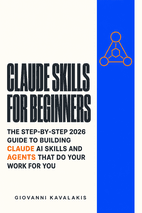
Claude Skills for Beginners by Giovanni Kavalakis Book Cover

by Giovanni Kavalakis

Buy on Amazon

As an Amazon Associate, we earn from qualifying purchases.

Giovanni Kavalakis's Claude Skills for Beginners teaches non-technical small business owners, freelancers, and side-project builders to reclaim hours lost to repeating tasks by writing plain-instruction Skills an AI follows every time, covering the five questions, payback scoring, failure diagnosis, and turning the method into a paid service.

On Insta.page you also get an Apply This Book tool that lets you combine insights from up to 3 books to solve your specific situation.

Chapter mindmaps

Free preview: chapters 1–4 are fully interactive. Click any node to expand or collapse. Subscribe to unlock the rest.

Chapter 1: Introduction. The Two-Hour Problem

Key concepts: Introduction. The Two-Hour Problem

Introduction. The Two-Hour Problem

The Hidden Cost of Unclaimed Hours

  • Weekly hours vanish into unpaid repeating tasks like late-night replies and after-close admin.
  • Obvious fixes only rearrange the week, not reclaim the hours.
  • Reclaiming hours seems to demand technical skill, spare time, or trust you lack.
  • These hours are recoverable even for a busy, non-technical owner.

The Core Promise: Teach AI Like a New Hire

  • If you can draft instructions for a new hire, you can teach AI repeating tasks.
  • Training takes about twenty minutes per task and fits on an index card.
  • By Chapter 2, you will have done it once on real work.
  • AI handles routine but does not replace judgment or run the business.

The Method: Skill-Building and Five Delegation Questions

  • For any task done more than twice; no technical skills required.
  • Chapters 1-3 teach skill-building and the five questions.
  • Chapters 4-5 cover task choice and documents; 6-8 cover fixing, chaining, safety.
  • Method rests on five parts: job, facts, rules, voice, boundaries.

Timeless Principles Over Changing Tools

  • Tools change, but delegation principles remain constant.
  • Five parts are facts about delegation, not about software.
  • People have trained employees with written instructions for centuries.
  • Maria's cleaning company story illustrates the familiar Sunday night problem.

Actionable Takeaways for Immediate Implementation

  • Inventory the week for unclaimed hours and treat them as recoverable.
  • Choose one task done more than twice and write instructions for a new hire.
  • Budget twenty minutes for first attempt; aim to finish one real task.
  • Reduce instructions to job, facts, rules, voice, boundaries on an index card.

Chapter 1. Meet Your New Employee

Key concepts: Chapter 1. Meet Your New Employee

Chapter 1. Meet Your New Employee

What a Skill Is

  • Stored written instructions an AI follows every time
  • Like a recipe card that cannot be lost
  • Trained once, reused without re-explaining
  • Hand over the task, not the briefing

What a Skill Is Not

  • Not programming; write it like a note to an assistant
  • Not a one-time prompt; it is named, saved, reusable
  • Not only for tech firms; any repeated task qualifies
  • Avoid one giant catch-all Skill; work needs boundaries

Real-World Examples

  • Maria's cleaning schedule: two hours to four minutes
  • Leeds driving instructor's parent progress reports
  • Landscaping firm drafts quotes from a price sheet
  • Ray's garage-door summaries via voice memo

Getting Started

  • List three tasks repeated this week and last week
  • Each describable task becomes a first job description
  • A paid Claude plan is generally required
  • Paste your sent messages to match your voice

Boundaries and Judgment

  • Keep passwords and private data out of the chat
  • Retain judgment, relationships and decisions yourself
  • Pass on repeatable work you would rather not do
  • Start with small, sharp roles, then teach collaboration

Chapter 2. Your First Skill in 20 Minutes

Key concepts: Chapter 2. Your First Skill in 20 Minutes

Chapter 2. Your First Skill in 20 Minutes

Why Build a Customer Reply Skill First

  • First reply to an enquiry often wins the job
  • Slow, tired replies lose bookings you already earned
  • Dana now answers in under a minute, saving four hours weekly
  • Payoff lands the same day

Gather Real Material Before Building

  • Two real replies you sent and liked, from your sent folder
  • Your facts: prices, inclusions, availability, booking steps
  • Your rules: the always and never (e.g., never promise dates)
  • Made-up examples teach the Skill nothing about your voice

Build the Skill with a Recipe Card

  • Find Skills under Settings, then Capabilities or Skills
  • Name it plainly: Customer Reply Skill
  • Recipe card has six parts: name, job, facts, rules, voice, end
  • Last line is a hard stop: never invent prices/dates, use [CHECK THIS]

Test with Real Messages and Fix One Line at a Time

  • Test easy, hard, and weird messages; 80% right first time is normal
  • Fix faults by adding a line, not rewriting the Skill
  • Examples: cap replies at 120 words, strengthen [CHECK THIS] rule
  • Answer every question in the customer's order

The Universal Build Loop

  • Prepare real material, write plain instructions, test with real work
  • Fix one line at a time
  • Applies to all Skills, including Chapter 10 templates and Chapter 9 client work
  • Carry this loop into everything you build afterward

Chapter 3. The Five Questions Every Skill Must Answer

Key concepts: Chapter 3. The Five Questions Every Skill Must Answer

Chapter 3. The Five Questions Every Skill Must Answer

The Five Questions Every Skill Must Answer

  • Job: what exactly is the task?
  • Facts: prices, availability, policies, paperwork.
  • Rules: always-and-never lines.
  • Voice: real examples, not adjectives.

The Stranger Test

  • Ask if a smart stranger could do the job from the page alone.
  • Claude is that stranger every time.
  • Knowledge in your head is invisible to the Skill.
  • Write as if hiring a stranger for their first day.

Four Rules That Do Most of the Work

  • Use never and always, not try to.
  • Show rather than describe with real examples.
  • Write for exceptions like the 2am tenant.
  • Say what to do when unsure: [CHECK THIS].

Overwriting and the Repair

  • Extra material shifts emphasis and causes stiff replies.
  • Delete anything that does not change a reply.
  • Keep only job, facts pointer, rules, examples, boundaries.
  • Give a stranger what they need on day one.

One Skeleton, Different Businesses

  • Maria's cleaning Skill: schedules, client preferences, pairing rules.
  • Dana's wedding Skill: packages, prices, no discounts, flag dates.
  • Steve's plumbing Skill: price list, ranges, no photo diagnoses.
  • Three trades, one skeleton.
You've reached the end of the free mindmaps

Next chapter: “Chapter 4. Which Skill to Build First” is locked

See every chapter of Claude Skills for Beginners as an interactive mindmap — and unlock all 700+ book summaries with audio and AI Q&A.

$0.00 due today · 7 days free, then $89.99/year ($7.49/mo) · Cancel anytime before day 7

plus sales tax where applicable

Continue exploring Claude Skills for Beginners