Biological War Quotes
by Annie Jacobsen
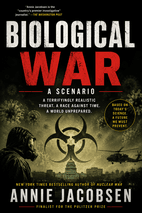
These quotes come from Annie Jacobsen's Biological War, a book that pulls back the curtain on the secretive world of bioweapons and the labs where they are studied. What makes the book so quotable is how often it pairs cold science with human dread. One line can explain an obscure defense program, and the next can put you inside a dying person's body.
The lines below are selected because they stick. They are vivid, unsettling, and easy to share. Some capture the dark logic of weapons policy. Others reveal how fragile our safety really is. Together they give a sense of why biological war is one of the most frightening subjects of our time.
Top Quotes from Biological War
“He has no idea that, days earlier, he became infected with a highly contagious, genetically modified, biological weapon engineered to kill human beings in the most atrocious ways.”
The narrator describes the American traveler inside a Frankfurt disco during the incubation period.
It turns an ordinary party scene into a ticking biological time bomb. The clinical specificity makes the invisible threat feel inescapable.
“This was the sought-after superweapon. A microscopic demon germ. Cunning and deceptive. Invisible and alive. Airborne. How did civilized people get here?”
The narrator builds the prologue's image of the engineered pathogen before asking how humanity reached this point.
The staccato fragments give the germ a predatory, almost mythical character. The question at the end turns the horror back on civilization itself.
“It’s a nuclear equivalent, except it’s cleaner. It leaves all the infrastructure intact. Full stop. That's what it is about.”
Davis explains the terrifying logic of a plague attack compared with nuclear weapons.
The blunt, cold assessment makes biological warfare feel disturbingly rational and devastating.
“A large-scale attack with a biological weapon can set off a pandemic, but so can a lab leak.”
Narrator’s warning after describing Vector’s stockpiled pathogens.
It collapses the distinction between deliberate attack and accident, making the danger feel immediate.
“We don’t know how it works. Anyone who tells you they know how it works is lying to you.”
Dr. Henry Heine, who has spent his life studying plague, describes the immune system.
It expresses the unsettling mystery at the center of the outbreak—no one can fully predict or control it.
“The locals are calling what's happened at Vector “Chernobyl with germs.””
A CIA analyst tells his boss over a secure line what locals are saying about the Vector incident.
It fuses the Soviet nuclear disaster with the biological threat, making the scale of the event instantly vivid.
“Covid had a case fatality rate of 1 percent. This is 25.8 percent.”
The BioDefense chief answers the president's dismissive comparison to Covid.
The numerical contrast strips away false reassurance and forces the threat into focus.
Themes Behind the Quotes
One major theme is the tension between scientific progress and national security. The same research meant to defend against pandemics can create pathogens that threaten everyone. Decisions about risk are made behind closed doors, often without public oversight. This secrecy makes it impossible to know whether the next outbreak will be natural, accidental, or intentional.
Another theme is the terrible asymmetry of biological weapons. They are cheap, quiet, and able to spread through travel networks before anyone notices. The threat is not just mass death, but the way it exposes how unprepared and unequal our systems are. Vulnerable populations are overlooked, governments downplay dangers, and ordinary people are left to face a threat they cannot see.
Quotes by Chapter
Chapter One: Recombinant DNA
“We focused on the science.... We didn’t discuss biological warfare.”
Paul Berg, the biochemist who created the first recombinant DNA molecule, later reflected on the 1975 Asilomar conference.
It exposes the catastrophic blind spot of the scientific community at the birth of genetic engineering, and foreshadows the treaty violations that follow.
“We believed, somewhat naively, that there was a treaty that everyone held to, prohibiting the use of [recombinant DNA] technology to make biological weapons.”
Nobel laureate David Baltimore, who attended the Asilomar conference, recalls his early faith in the Biological Weapons Convention.
It shows how the hope placed in a treaty blinded even leading scientists to the reality of secret offensive programs.
Chapter Two: The Top Secret Plan to Create Genetically Modified Biological Weapons
“[S]everal rabbits also displayed signs of another illness. They twitched and then lay still. Their hindquarters had been paralyzed.”
Ken Alibek recalls the unexpected result of a genetically altered pathogen test at Obolensk.
The sudden, inexplicable paralysis makes the experiment's unnatural consequences visceral and disturbing.
Prologue: The Demon Germ
“I always believed [these weapons] would never be used.”
Popov, a Soviet biological weapons scientist, says this in his own defense.
It captures the hollow self-justification of the people who built the unthinkable. The bracketed words make the excuse feel even more damning.
Chapter Three: The Secrets Spill Out
“You chose plague because you're going to take out the other person's country.”
Dr. Christopher Davis, a British intelligence officer, describes why Soviet scientists chose plague as a weapon.
It strips the Cold War threat down to a chillingly direct strategic intent—extermination of an entire nation.
“Caffa should be recognized as the site of the most spectacular incident of biological warfare ever, with the Black Death as its disastrous consequence.”
Microbiologist Mark Wheelis comments on the medieval siege of Caffa.
It connects a centuries-old legend to modern fears, framing the Black Death as the ultimate result of biowarfare.
“Buboes are so intensely painful that even nearly comatose patients attempt to shield them from trauma and will abduct their extremities to decrease pressure.”
A U.S. Army medical textbook on biological warfare describes the agony of bubonic plague.
The medical detail makes the historical and strategic abstraction of plague horrifyingly visceral.
Chapter Four: Offense as Defense
“Transparency all but disappeared. A biodefense industrial complex emerged.”
The text describes Washington’s power center shifting toward classified biodefense research after 9/11.
It turns a policy shift into an ominous phrase, echoing Eisenhower’s warning about the military-industrial complex. The image of a secretive new power center is hard to forget.
Chapter Five: Global Catastrophic Risk
“In the H5N1 ferret flu experiments, scientists took one of the deadliest influenza viruses ever observed in humans and taught it to spread through the air, demonstrating how a pandemic-causing airborne pathogen can be easily engineered in a lab.”
Critics of gain-of-function research pointed to the 2011-2012 H5N1 ferret flu experiments as a warning.
It translates laboratory science into a vivid, threatening image. The phrase 'taught it to spread through the air' is what makes the danger memorable.
“With millions dead, and key questions unanswered, people around the world became outraged.”
The author describes public reaction after Covid-19 raised unresolved questions about lab origins.
It condenses the global grief and anger into one plain sentence. The pairing of 'millions dead' with 'unanswered' makes it especially resonant.
“What goes on inside these high- and maximum-containment biosecurity laboratories is, by design, unknowable to the outside world.”
The author concludes after noting a 2025 survey of BSL-3 and BSL-4 labs worldwide.
It states the book's central warning about secret biological research. 'By design' turns secrecy from a side issue into a deliberate feature.
“As before, decisions about what constituted acceptable risk remained all but hidden from the general public, siloed away inside the rubric of national security.”
The author describes how gain-of-function policy was reframed under the term P3CO.
It exposes the lack of public oversight in high-risk biology. The word 'siloed' captures how ordinary citizens are locked out of the debate.
Day One: Hour Zero
“Unlike nuclear weapons, the release of a biological weapon—on purpose or by accident—is invisible to the naked eye and current space-based sensors.”
The NRO’s satellites cannot detect biological releases in real time.
It underscores how much harder it is to see a bioweapons strike coming than a nuclear one.
“As the living weapon was growing inside his body, it was multiplying, and it was changing.”
Dr. Ustinov lies dying from an accidental Marburg infection at Vector.
It turns a virus into a sinister living weapon inside a human being, and the mutation becomes a bioweapon.
“But the story of Dr. Ustinov demonstrates that nations, like people, cheat. That accidents can happen. And they do.”
The narrator reflects on the weaponization of the mutated Marburg strain from Ustinov’s body.
It is the chapter’s moral: even mishaps in secret weapons programs are exploited, and accidents are inevitable.
Day Two
“His lungs are filled with necrotic cell tissue, and he is drowning in plague.”
A Vector scientist dying in the Siberian woods feels the plague destroy his body.
It makes an intimate, visceral horror out of an abstract biological catastrophe.
“Once it infiltrates your lungs, unless you take antibiotics within a twenty-four-hour time frame, you will die.”
Dr. Heine warns how quickly untreated pneumonic plague kills.
It states the fatal deadline without sentiment, which makes the race against global spread feel urgent.
“Contagious disease spreads around the world at the speed of human travel. It always has.”
As the infected hunters fly home, the narrative notes how disease moves.
It distills the entire global-threat premise into one memorable image.
Day Three
“Russia knows something it has not yet told the world: the pathogen is airborne.”
The narrator observes Russian RKhBZ troops in full hazmat gear guarding a hospital.
This quiet reveal turns official silence into a concrete, terrifying fact.
“If Americans start dying, this is an act of war.”
The secretary of defense speaks during the Situation Room briefing.
It transforms a biological outbreak into a geopolitical flashpoint with blunt Cold War logic.
Day Four
“There's no [health] surveillance done in these homeless shelters or other places where vulnerable populations are found in such densities, and are so ignored by the healthcare system.”
Infectious disease expert Dr. Michael V. Callahan, speaking about why Skid Row's homeless population is vulnerable.
It names the root cause of vulnerability: these populations are not just poor, they are invisible to the healthcare system.
“If I'm gonna die, maybe my dog doesn't have to.”
A homeless man dying of pneumonic plague at a Skid Row clinic speaks to the nurse after asking her to care for his dog.
It captures love and selflessness in the face of death, making an anonymous victim heartbreakingly human.
“But dissent is dangerous in the Russian Federation, and this fact is ignored.”
After Russian officials blame a wet market for a plague outbreak near a BSL-4 lab, the narrator notes the cost of questioning the official story.
It highlights how covering up a biological catastrophe is made possible by fear, and how that silence can kill.