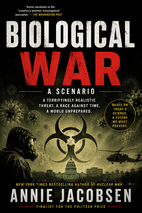
Biological War Key Takeaways
by Annie Jacobsen
5 Main Takeaways from Biological War
Biological weapons ban is hollow—defensive exemption hides offensive arms programs.
The Biological Weapons Convention lacks enforcement, and the U.S. State Department identifies Russia and North Korea as running offensive programs. Soviet defector Ken Alibek confirmed secret stockpiles of anthrax, plague, and smallpox, proving that treaty compliance cannot be assumed. Treating bioweapons as a niche issue leaves a civilization-scale loophole open.
Genetic engineering is dual-use: the same knowledge that heals can weaponize.
Paul Berg's first recombinant DNA experiment demonstrated that the same tools which produce vaccines can also engineer pathogens. Asilomar's safety guidelines regulated laboratories but ignored the battlefield, so no technical fix can separate healing from weaponizing. Every dual-use advance carries both possibilities.
Engineered bioweapons target trust in government and medicine, not just bodies.
Soviet scientists designed two-stage pathogens, including a tuberculosis-like illness paired with a paralytic second phase, to defeat vaccines and medical response. In the book's scenario, an engineered plague with an antibiotic-triggered viral payload makes treatment lethal. The deepest casualty is faith in institutions, which lets a biological attack collapse society without destroying infrastructure.
Biodefense itself creates catastrophic risk through gain-of-function and lab sprawl.
The post-Project BioShield boom has produced over 110 BSL-4 labs and thousands of BSL-3 labs, with no agency tracking aggregate risk. Gain-of-function studies have made mousepox evade immunity and H5N1 spread through the air, which critics call weaponization by another name. The counterterrorism response has become a foreseeable source of accidental release.
A biological attack will break the constitutional order unless leaders choose trust.
The book's scenario shows devolution, emergency powers, and the Insurrection Act stripping legal limits on domestic troops. Perceived rationing of antibiotics to officials triggers armed chaos, while the engineered plague turns treatment into a death sentence. The president's only response is an act of trust, making democratic safeguards essential to biosecurity planning.
Executive Analysis
Jacobsen's central argument is that biological weapons are the ultimate asymmetric threat because they exploit a broken treaty system, dual-use science, and the vulnerabilities of open societies. The hollow Biological Weapons Convention allows defensive exemptions to hide offensive programs, while genetic engineering makes the same knowledge both therapeutic and lethal. Engineered pathogens are uniquely dangerous not only because they kill, but because they are designed to destroy trust in government and medicine—making them civilizational weapons. Meanwhile, the biodefense response, from gain-of-function research to expanding BSL-4 labs, has become another source of catastrophic risk. The book's day-by-day scenario demonstrates that when a chimera plague arrives, America's legal and operational plans default to martial law, triage, and secrecy, which accelerates social collapse rather than preventing it.
This book matters because it turns dense biosecurity history into a page-turning warning. It sits in the investigative scenario genre of nuclear-war books, but replaces the mushroom cloud with an aerosol plume: a superweapon of concealment. For the reader, the practical impact is a call to demand enforceable arms control, accountable lab oversight, and emergency plans with democratic safeguards. The threats documented in defector testimony are current vulnerabilities, and avoiding the worst case requires citizen attention, not just scientific expertise.
Chapter-by-Chapter Key Takeaways
Recombinant DNA (Chapter 1)
The Biological Weapons Convention's ban is hollow: its "defensive" exemption goes unenforced, and the U.S. State Department identifies Russia and North Korea as running offensive programs.
Genetic engineering was dual-use from the moment Paul Berg spliced the first recombinant DNA molecule; the same knowledge that heals can also be weaponized, so no technical fix can separate the two.
Asilomar's safety guidelines addressed only the laboratory, never the battlefield, leaving biological warfare entirely outside the scientific community's self-regulation.
The Soviet Union's secret stockpiles of anthrax, plague, and smallpox, confirmed by defector Ken Alibek, show that treaty compliance cannot be assumed even among signatories.
A genetically engineered pathogen attack threatens not just mass casualties but the collapse of society itself, making the bioweapons loophole a civilizational risk rather than a niche security concern.
Try this: Advocate for enforceable bioweapons inspections and public oversight of dual-use genetic engineering; the BWC's defense loophole lets offensive programs hide, and no technical fix can separate healing from weaponizing.
The Top Secret Plan to Create Genetically Modified Biological Weapons (Chapter 2)
The Obolensk meeting of 1989 reveals that Soviet participation in the Biological Weapons Convention was a cover for a continuing offensive program aimed at mass casualties in the West.
Biopreparat's fake sanatorium, complete with actors, shows that the program's deception was institutionalized rather than incidental, and Domaradskij's later account exposes how fully the facade was maintained.
Sergei Popov's gene-spliced agent, combining tuberculosis-like disease with a paralytic second illness, marked a genuine leap in weaponry because a single exposure could disable both immune defenses and medical response.
The two-stage killer was designed to do more than kill: by making vaccines and antibiotics ineffective, it aimed to shatter public confidence in government and medicine.
Ken Alibek's reaction to the dying rabbits captured the turning point: an engineered pathogen had transformed biological weapons from a blunt instrument into a tool of psychological collapse.
Try this: Treat declared compliance as potentially cover: verify bioweapons programs through defectors, supply chains, and independent inspections, and assume deception is institutionalized rather than incidental.
The Demon Germ (Prologue)
A genetically engineered airborne bioweapon is fundamentally a weapon of concealment: it acts before anyone can see it, which is what makes it the ultimate superweapon.
The path to building such a weapon was paved by strategic anxiety, not by a simple lust for destruction.
The conviction that such weapons would never be used did not prevent their production; it was precisely that belief which made them easier to build.
Perceiving the enemy as irredeemably evil created a perceived necessity for a weapon that could match that evil, making the demon germ a product of its era's propaganda as much as of its science.
Try this: Question the assumption that a new superweapon will never be used; history shows that comforting belief made production easier, so assess threats by capability and intent rather than expecting restraint.
The Secrets Spill Out (Chapter 3)
The Biopreparat defection revealed a Soviet offensive program of thousands of scientists and cruise missiles modified for aerosol attack, an intelligence failure of the first order for the CIA and British security services.
An aerosolized plague weapon shifts the disease from flea-borne bubonic form to pneumonic form, and Richard Preston reports that untreated pneumonic plague is almost universally fatal within a day, making it a uniquely fast and contagious agent of mass death.
Plague was chosen for weaponization not just because it kills but because it preserves the enemy's infrastructure, giving the Soviet Union a strategic mass-extermination capability without nuclear fallout.
The 1346 Caffa incident, where plague corpses were catapulted into a besieged city, shows that the idea of plague as a weapon long predates the twentieth century, yet the Soviet program gave it a scientific and industrial realization that could actually depopulate a country.
Try this: Update outbreak plans for aerosolized pneumonic plague's near-100% untreated fatality within a day, and map infrastructure assets that make preservation a strategic motive for bioweapons.
Offense as Defense (Chapter 4)
The pattern of defections, from Pasechnik onward, moved the Soviet bioweapons program from speculative concern to documented fact, which recast the post-1991 security problem as one of controlling expertise rather than confirming capability.
The 2001 anthrax letters imposed their impact through disruption and fear rather than casualties, so any biological attack's true threat is measured in government paralysis and public panic as much as in bodies.
The explosion of BSL-4 and BSL-3 laboratories after Project BioShield created a nationwide hazard with no oversight entity held responsible for the aggregate risk, meaning the counterterrorism response itself became a source of possible exposure.
Gain-of-function research alters pathogens to become more transmissible, more infectious, more immune-evasive, or more persistent in the environment, which is why its opponents see it as weaponization by another name and its defenders as necessary preparedness.
A state arsenal and a lone mailing both show that the bioweapons threat is now dispersed, ambiguous, and recursively dangerous: defending against it has meant building more containment labs and engineering more dangerous organisms, making accidental release a foreseeable consequence.
Try this: Treat biodefense itself as a risk source: control dual-use expertise, track the boom in BSL-3/4 labs, and factor accidental release into every counterterrorism decision.
Global Catastrophic Risk (Chapter 5)
Gain-of-function research makes pathogens more dangerous on purpose, and it remains a core part of biodefense despite public opposition.
The 2001 mousepox and 2011–2012 H5N1 studies showed that such work can erase immunity or make deadly viruses spread through the air.
The Obama administration paused this research in 2014, but the policy shift to P3CO replaced a ban with risk management, not safety.
Covid increased public anger, yet governments continue to fund these experiments.
The number of high-containment labs has grown sharply: over 110 BSL-4 labs and more than 3,500 BSL-3 labs now operate worldwide.
Try this: Demand independent oversight and public accounting for gain-of-function research; replacing a ban with risk management is not safety when scientists are deliberately making pathogens more dangerous.
Day One: Hour Zero (Chapter 6)
A breached BSL-4 lab is an active outbreak from the moment of the blast: Raina MacIntyre's modeling shows the aerosol plume outruns the fire response, and the official accident story is part of the hazard.
Satellites can show a lab burning and intercepts can show officials lying, but neither reveals whether the blast was an accident or an attack; the CIA therefore risks an embedded asset, because intention is the fact that determines the response.
Bioweapons are outside the logic of deterrence, since a pathogen has no leadership to retaliate against; that is why a nuclear strike option persisted from the Clinton administration through the 2005 joint doctrine and why the B61-11 remains in the arsenal.
Containment is a function of population density, not of how fast a leak is detected: Koltsovo can be isolated, but the BSL-4 labs in Tokyo, Berlin, Atlanta, and Johannesburg sit inside the cities that would have to be cut off.
The Washington-Moscow emergency channel only means something when the other side answers; the beep that comes back this time signifies only the absence of war, not an offer of help, and that is how the crisis outlives diplomacy.
Try this: Design bioweapon response plans assuming a lab breach cannot be classified as accident or attack from overhead; pre-identify isolation zones in dense cities because population density, not detection speed, determines containment.
Day Two (Chapter 7)
Because the plague’s incubation period left the hunters contagious before any symptom appeared, their rescue did not prevent death: it turned one man’s suicide attempt into a multicontinental outbreak.
The size of the infectious dose sets the order in which new clusters ignite, so the entrepreneur who breathed directly into the scientist’s lungs carried the heaviest load and became the first overseas index case.
Typhoid Mary established the official category of the asymptomatic carrier, and Covid later forced public health authorities to accept the same phenomenon; pneumonic plague, by contrast, has no true silent stage, leaving the engineered euphoria phase as the closest equivalent to a hidden contagious state.
Former USAMRIID bacteriologist Henry Heine holds that without antibiotics within twenty-four hours pneumonic plague kills everyone it infects, which is why a modified strain that rewrites that rule represents a fundamentally new class of biological weapon.
Jet travel has erased the geographic margin that once contained outbreaks; before their symptoms appeared, three infected men reached Santo Domingo and exposed more than two hundred people at a gym and a cafe, while the Black Death needed months to cover the same distance.
Try this: Build surveillance and quarantine systems that treat every exposed person as potentially contagious before symptoms; jet travel has erased geographic margins, and a single incubating carrier can ignite multiple continents.
Day Three (Chapter 8)
Moscow's day-three behavior, from roadblocks to signal jamming to a request for cremation units, carries the operational signature of a government that already knows a lethal release happened rather than one weighing a possibility.
The pneumonia announcement reproduces the declarative pattern of China's first Covid statement, a shape intelligence reads as a cover story designed to forestall questions, and it leaves out the maximum-containment facility twelve miles away while offering no genetic sequence to test.
The convoys to Immunotekhnologii and the satellite retasking over Gamaleya put Russia's vaccination effort ahead of its official story, making the logistics, not the announcement, the most honest record of what the Kremlin believes it faces.
The rebreathers worn by troops at the Novosibirsk hospital settle the airborne question, and the White House's conclusion that no countermeasure can be built from satellite data alone turns that settled question into a race Washington is already behind in.
Try this: Monitor logistics, troop gear, satellite retasking, and vaccine movements rather than official statements; in a bioweapon release, actions reveal the true situation while cover stories only deepen the crisis.
Day Four (Chapter 9)
Detection systems are built around known pathogens and confirmatory tests, so an engineered plague will be recognized only after it has seeded multiple superspreading clusters.
The Sverdlovsk episode shows the standard playbook for state bioweapons accidents: a false natural-origin story holds until mass casualties force acknowledgment, and genetic evidence lags far too late to change the response.
The Diamond Princess and the Clade X exercise both demonstrate that once a modified pathogen combines short incubation with high infectiousness, containment decisions become triage decisions, and every boundary now just shifts where the overflow appears.
The United States enters this scenario with no deployable plague vaccine and an isolation-bed capacity that a single outbreak would overwhelm, meaning pre-exposure prophylaxis is the only viable countermeasure and it does not exist.
Try this: Develop diagnostics for engineered pathogens and deployable plague vaccines before the next outbreak; once a modified agent spreads widely, containment decisions become triage and every boundary just shifts the overflow.
Day Five (Chapter 10)
Syndromic surveillance that excludes homeless shelters and clinics will read the opening hours of a biological attack as a drug overdose, so the first responders and officials will be acting on the wrong diagnosis until deaths are already widespread.
A pneumonic plague attack collapses a city's healthcare system within a few transmission generations, and since 2000 the only thing that has changed is biotechnology, which makes the pathogen harder to treat and faster to spread.
First responders and victims are the same population in an aerosol attack, so pulling back emergency forces to keep them alive is a rational response, not an abandonment; an established pneumonic plague outbreak has no braking mechanism.
The legal tools for a governmental takeover are already loaded: quarantine can be imposed on people merely suspected of exposure, and a National Emergencies Act declaration grants the president control over banking, communications, and troop deployment without further congressional action.
The continuity of the state no longer depends on the president: as nuclear alert levels escalate, power passes to backup leaders, so the government can survive even a catastrophe that kills a large fraction of the population.
Try this: Expand syndromic surveillance to shelters and clinics, and pre-plan for first responders as victims; the legal machinery for massive emergency powers already exists, so guardrails must be built before an attack.
Day Six (Chapter 11)
For a novel pathogen, the government's stochastic infection tables are guesswork, so continuity-of-government plans such as Devolution protect leaders and records while leaving the medical and logistical response to fail in real time.
When scarce antibiotics are perceived as rationed to officials, as in Dark Winter and the LA stockpile, public trust collapses into armed chaos, and the vulnerability is multiplied if chatbot users can extract classified depot locations in seconds.
The Insurrection Act can activate troops and CONPLAN 3502, but biological-defense units need days to deploy and the Strategic National Stockpile cannot be delivered, so the military ends up abandoning cities to guard nuclear reactors and the Pantex plutonium stockpile.
The engineered Yersinia pestis carries a viral payload triggered by antibiotics, so treatment becomes a death sentence and the attack's real objective is to destroy the population's faith in medicine itself.
The book leaves the question of whether aggression is nature or nurture unresolved, yet the hunters' meeting shows both paranoia and trust are available, and the president's final act of singing to an unknown audience chooses trust as the only answer to an adversary who built a weapon to make trust impossible.
Try this: Ensure stockpile distribution is visibly equitable before a crisis; perceived rationing to officials triggers armed chaos, and an antibiotic-triggered pathogen turns treatment into a death sentence.
Biological Twilight (Epilogue)
Pneumonic plague is the concrete threat that turns the documented record into a present vulnerability: Vector engineered Yersinia pestis into an untreatable chimera, Ayyadurai's study shows it stays infectious in damp sand for forty weeks, and the United States has no vaccine against it.
Russia's offensive bioweapons capability did not die with the Soviet Union: the State Department's 2023 compliance review still finds the federation in violation of the Biological Weapons Convention, and defector testimony describes a program whose ambition was to invent diseases from scratch.
The American response to a biological attack would itself break the constitutional order: devolution doctrine presumes Washington is unusable, a national emergency and the Insurrection Act strip legal limits on domestic troops, and Bill Perry feared martial law would never end.
The system fails to predict: COVID's shifting transmission defeated the best models, TOPOFF 2000's plague scenario overwhelmed its responders, and BioSense only registers illness once a patient reaches a facility, so the chimera Vector built slips past every plan.
Try this: Act now to close the loopholes the book documents: enforce BWC compliance findings, stockpile plague countermeasures, and create emergency-power sunset clauses to keep a biological attack from permanently breaking the constitutional order.