Big Trust Quotes
by Shadé Zahrai
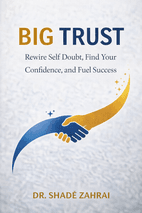
The quotes in this collection cut straight to the heart of self doubt and identity. You will find lines that reframe familiar struggles, challenging the way you think about your own inner critic. Each one feels like a gentle but firm reminder that you are not broken.
What makes Big Trust so quotable is how it mixes psychological insight with everyday language. Shadé Zahrai does not lecture. She invites you to see your doubts differently, to stop fighting them and start understanding them. The result is a book full of sentences you want to underline and share.
Top Quotes from Big Trust
“That's the irony. Self-doubt isn’t trying to sabotage you; it's trying to shield you.”
The author reflects on the protective function of self-doubt after explaining how it hooks into your mind like a burr.
This line reframes self-doubt from an enemy to a misguided protector, offering a compassionate and empowering perspective that eases the shame often associated with it.
“The mistake isn't having self-doubt. The mistake is thinking you have to defeat it.”
The author challenges the common belief that self-doubt must be silenced or conquered.
It liberates readers from the exhausting battle against self-doubt, suggesting a more realistic and sustainable path of understanding rather than eradication.
“Self-doubt is not only a confidence problem. It's an identity problem. A crisis of self.”
The author after diving into over fifty years of research on self-image and personal growth.
This reframes self-doubt from a surface-level confidence issue to a profound identity crisis, making readers realize it is about their sense of self, not just skills.
“Your doubts were never proof of your limits. They were just the edges of a pot you were never meant to stay in.”
After the analogy of a potted Manila palm tree whose growth is limited by its pot.
This poetic line transforms self-doubt from a permanent limitation into a removable constraint, empowering readers to see their potential beyond learned boundaries.
“Because doubt doesn't define your limits. You do.”
Closing lines of the chapter, urging readers to take ownership.
Simple, memorable, and empowering—it shifts agency back to the reader, reinforcing that they are in control of their own growth.
“Perfectionism likes to pretend it's about high standards, but that’s a lie. It's not about excellence—it’s about safety.”
The author analyzes the true nature of perfectionism.
This reframe is powerful because it exposes perfectionism as a fear-based defense mechanism, not a virtue. It helps readers see their own behavior in a new, liberating light.
“Don't aim at success—the more you aim at it and make it a target, the more you are going to miss it. For success, like happiness, cannot be pursued; it must ensue, and it only does so as the unintended side-effect of one's dedication to a cause greater than oneself.”
Viktor Frankl shares the lesson he learned from the unexpected reception of his book Man’s Search for Meaning.
This line reframes success as a byproduct of purpose, freeing readers from the exhausting chase for external validation and reminding them that meaning comes from serving something larger.
Themes Behind the Quotes
The first major theme is that self doubt is not your enemy. It is a protective mechanism. The goal is not to eliminate it but to change how you respond to it. This shift in perspective runs through many of the quotes.
Another theme is that your identity is not fixed. The labels you give yourself shape your reality, but those labels can be rewritten. The book emphasizes that you are enough as you are, and that perfectionism is a trap born from a need for safety, not excellence. Ultimately, the quotes urge you to stop seeking validation from others and to trust your own worth.
Quotes by Chapter
Introduction: We Are All More Than Our Self-Doubts
“You don't overcome self-doubt by silencing it—though that's what too many of us believe (and too many “experts” teach). You take away its power by noticing it, understanding it, and changing your relationship to it.”
The author contrasts the ineffective strategy of silencing doubts with her own research-backed approach.
It provides a clear, actionable alternative that shifts focus from suppression to mindful engagement, making the process feel manageable and hopeful.
“If you strengthen the right habits aligned with each of the Four Attributes, you don’t just reduce self-doubt. You fundamentally change who you are.”
The author introduces the core promise of her Doubt Profile framework.
This line promises deep, identity-level transformation rather than surface-level coping, inspiring readers to invest in the habit-building process.
1. Who’s Running the Show?
“Self-doubts are not immovable facts. They are the products of your brain's wiring, your formative experiences, and your internalized stories about your identity.”
The author explains the nature of self-doubt early in the chapter.
This line reframes self-doubt as a malleable construct rather than a fixed truth, empowering readers to question and reshape their negative self-perceptions.
“Your thoughts have a greater influence on your happiness than your actual circumstances.”
The author references a study by Harvard researchers Matthew Killingsworth and Daniel Gilbert.
It delivers a startling, liberating insight that challenges the common belief that external conditions determine well-being, emphasizing the power of internal narrative.
“Your brain's Gatekeeper is a master at zooming in on information that supports what you already believe and quietly filtering out anything that doesn’t.”
The author describes confirmation bias and the brain's filtering mechanism during Taylor's story.
This line vividly captures how self-doubt can distort perception, making readers aware of their own cognitive biases and the need to retrain their focus.
2. Should I Believe Everything I Think?
“Your beliefs shape your reality. Literally. Your thoughts have that much power.”
After describing Robert Kleck's scar experiment, the author concludes that our beliefs shape our reality.
This line distills the chapter's core insight into a memorable statement, challenging readers to recognize the profound influence of their own thoughts on their experiences.
“Who you believe you are is the blueprint for your entire life.”
Summarizing the findings from Kleck's experiment and Maltz's plastic surgery observations, the author states this core principle.
It reframes self-image as a blueprint that dictates life outcomes, prompting readers to reflect on how their self-beliefs may be limiting their potential.
“Every time you say, “Iam...” you're sticking a label on yourself—one your brain interprets as permanent and unchangeable.”
While discussing how people adopt self-limiting labels, the author points out the permanence implied by 'I am' statements.
This line reveals how casual self-talk can cement negative identities, encouraging readers to become aware of the language they use to describe themselves.
“You weren't born with a self-doubt pathway etched into your brain.”
Explaining neuroplasticity and the formation of self-doubt, the author reminds readers that doubt is not innate.
This is hopeful and empowering, reinforcing that self-doubt is learned and can be unlearned, countering the feeling that insecurity is unchangeable.
3. What Is My Doubt Profile Telling Me?
“But they knew the doubt wasn’t them. It was something they could peel off, burr by burr.”
The author describes the second group of people who balanced doubt rather than being defined by it.
The vivid metaphor 'peel off, burr by burr' offers a hopeful image that self-doubt is separable from one's core identity and can be gradually removed.
4. Am I Enough?
“Turns out, you can’t outrun the feeling of unworthiness.”
The author reflects on her experience of overcompensating through hard work and perfectionism in an attempt to quiet self-doubt.
This line captures the futility of trying to escape self-doubt through external achievement, resonating with anyone who has tried to outrun their insecurities.
“You are enough, right now, as you are.”
The concluding affirmation of the chapter on self-acceptance.
It is a simple, powerful reminder that worth is intrinsic and not conditional on perfection or external validation, offering a moment of peace.
“But no, the burrs of doubt are way more clingy than that.”
The author describes how her doubts followed her even after leaving law for banking.
The metaphor of burrs vividly conveys how self-doubt stubbornly attaches to us, making the insight both relatable and memorable.
“You stop outsourcing your worth.”
The author describes the promise of self-acceptance and how it changes one's relationship with validation.
This phrase encapsulates the shift from seeking external approval to internal self-worth, a key turning point for readers seeking to build trust in themselves.
5. Should I Believe the Voices in My Head?
“The real battle hadn't been against skepticism in the room; it had been against the voices in my head.”
The author reflects after a difficult keynote presentation to skeptical CEOs.
This line reveals the central insight of the chapter: the greatest opponent is not external but internal, making it universally relatable.
“Those voices that no one hears shape your very identity.”
The author summarizes the impact of internal self-talk after quoting performance psychologist Dr. Jim Loehr.
It succinctly captures the profound power of inner dialogue to define who we become.
“Your Inner Deceivers may never disappear entirely, but that's not the goal. The goal is to notice them, question their logic, and choose a better response.”
The author concludes the chapter by setting realistic expectations for dealing with inner critics.
It provides a practical and empowering takeaway: the aim is not elimination but mindful management, which builds lasting confidence.
6. Why Am I Hiding?
“You water yourself down, sacrificing what you actually want, need, or believe—just to keep everyone else happy.”
The author describes the cost of people-pleasing and the habit of masking.
It vividly captures the self-betrayal behind chronic agreeableness, making the reader reflect on their own compromises.
“We tailor a version of ourselves that we believe is “acceptable” to others, which means that by default, we believe we aren't acceptable as we are.”
The author explains social desirability bias during her PhD research.
This line reveals the painful irony of hiding who we are to be accepted, highlighting how approval-seeking reinforces self-rejection.
“Once you give them the power to tell you you're great, you've also given them the power to tell you you're unworthy.”
Ronda Rousey's insight on the danger of outsourcing self-worth to others.
A sharp, memorable warning that seeking approval from others hands them control over your sense of value.
“I wish I'd had the courage to live a life true to myself, not the life others expected of me.”
Bronnie Ware's recording of the top regret of the dying in her palliative care work.
This poignant reflection from life's end powerfully urges readers to prioritize authenticity over pleasing others.
7. Do I Have to Be Perfect?
“I just needed proof that done was better than perfect.”
The author reflects on her decision to film forty videos in a single day.
This succinctly captures the core antidote to perfectionism: valuing completion over flawlessness. It's a memorable mantra that challenges the reader to prioritize action.
“Don't let “perfect” get in the way of “good enough for now.” You can always polish later. But if you wait for perfection, you might never hit publish, launch, or step on that stage.”
The author concludes her advice on overcoming perfectionism.
This delivers an actionable and memorable rule that directly counters the urge to delay. It empowers readers to start imperfectly and trust the iterative process.