Big Trust Key Takeaways
by Shadé Zahrai
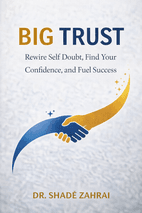
5 Main Takeaways from Big Trust
Self-doubt is a habit, not a truth; you can reprogram your brain.
The book explains that self-doubt stems from neural pathways and learned beliefs, not from inherent flaws. By using tools like the Doubt Profile and practicing opposite actions, you can rewrite these mental grooves and build new, empowering habits.
Build self-trust by strengthening four key attributes: Acceptance, Agency, Autonomy, Adaptability.
Your self-doubt operates through specific channels: worthiness (Acceptance), capability (Agency), ownership (Autonomy), and emotional regulation (Adaptability). Targeting growth in these areas with strategies like diversifying identity for Acceptance or curating evidence for Agency creates a solid foundation for self-trust.
Confidence comes from action, not the other way around; start before you feel ready.
Waiting for confidence is a trap that leads to paralysis. The book emphasizes that you earn self-trust by taking imperfect action, embracing the 'ugly baby' stage, and using play and experimentation to discover your capabilities.
Your emotions are data, not defects; learn to manage them, not suppress them.
Feelings like anxiety or self-doubt are signals pointing to unmet needs or values. By naming emotions, using cognitive reappraisal, and seeking awe, you can build adaptability and respond with choice rather than being controlled by reactions.
True self-acceptance is found through contribution and self-forgetting, not self-analysis.
Directly chasing self-worth through achievement often reinforces lack. Instead, redirecting focus to helping others or a meaningful purpose quietens the inner critic and allows inherent worth to emerge naturally.
Executive Analysis
The book's central argument is that self-trust is cultivated through a structured understanding of self-doubt's four channels—Acceptance, Agency, Autonomy, Adaptability—and by applying targeted interventions. The takeaways emphasize that doubt is a habit, not identity; action builds confidence; emotions are informative; and self-worth emerges from contribution. This framework allows readers to diagnose their doubt profile and use strengths to support growth in vulnerable areas.
'Big Trust' matters because it translates psychological insights into daily practices, offering a science-backed alternative to vague self-help advice. For anyone facing imposter syndrome or burnout, it provides tools to reclaim mental bandwidth, make aligned choices, and build resilience, ultimately enabling a life of authentic performance and reduced anxiety.
Chapter-by-Chapter Key Takeaways
We Are All More Than Our Self-Doubts (Introduction)
The Doubt Profile assessment is a practical tool for translating abstract self-doubt into measurable, specific attributes.
Your scores are diagnostic, not judgmental; they reveal areas of strength to leverage and vulnerability to strengthen.
Self-doubt operates through four core channels: Acceptance (worthiness), Agency (capability), Autonomy (ownership), and Adaptability (emotional regulation).
A mixed score profile is the most common outcome, and you can strategically use your stronger attributes to support growth in weaker ones.
Understanding your unique profile is the essential first step toward building "Big Trust" and interrupting the exhausting cycles of doubt.
Try this: Use the Doubt Profile assessment to identify your specific self-doubt channels and create a targeted growth plan.
1. Who’s Running the Show? (Chapter 1)
You are not your self-doubt. Doubt is a product of your brain's wiring, not an immutable fact about you.
Sync your internal boardroom. Identify whether your CEO (vision), Strategist (planning), Automations Lead (routines), or Risk Analyst (fear) is hijacked by doubt and take a specific, small action to recalibrate it.
Manage the craving for certainty. Use the "Worry Time" technique to contain anxious confabulations, fact-check them, and reclaim mental bandwidth.
Retrain your attention filter. Combat confirmation bias by inviting your internal Fact Checker and Confidence Consultant to challenge negative stories and refocus on evidence and your strengths.
Try this: Identify which internal 'boardroom' role is hijacked by doubt and take a small, specific action to recalibrate it, such as scheduling 'Worry Time'.
2. Should I Believe Everything I Think? (Chapter 2)
Your beliefs construct your reality: Expectation bias means we often see what we believe, not objective truth. An insecure belief can act like an "invisible scar," distorting social interactions and opportunities.
Self-image is a story, not a fact: Your "mental blueprint" is built from accumulated labels and stories, many absorbed uncritically. These narratives feel true because they've been repeated, not because they are fundamentally accurate.
Labels can be examined and rewritten: You have the power to peel off limiting labels like "intense" or "anxious" and reframe them into strengths like "passionate" or "imaginatively deep." This is an act of reclamation, not fixing something broken.
Change your brain by changing your actions: Self-doubt is maintained by well-worn neural pathways. You can overwrite these "mental grooves" through deliberate, repeated opposite actions. By changing your physical response (posture, engagement) in moments of doubt, you can fundamentally shift the mental and emotional pattern.
Growth requires disrupting the automatic narrative: Real change begins when you challenge the automatic stories you tell yourself. This creates space for new possibilities and allows your self-image to evolve in alignment with who you want to become.
Try this: Examine a limiting belief you hold about yourself, reframe it as a strength, and physically act opposite to the doubt to create new neural pathways.
3. What Is My Doubt Profile Telling Me? (Chapter 3)
Self-doubt is an identity crisis ("self + doubt"), not just a confidence issue. Lasting change requires addressing how you see your fundamental worth and place.
The Doubt Profile’s Four Attributes (Acceptance, Agency, Autonomy, Adaptability) pinpoint where your self-doubt is most active, providing a clear map for targeted growth.
Doubt is reinforced by daily habits and patterns. Change comes not from fighting the doubt, but from consistently practicing new habits that strengthen your vulnerable Attributes.
Your potential is not defined by your doubts. Like a potted plant, your growth is limited by your environment—the mental "pot" of internalized stories and beliefs. Expanding this space begins with changing your daily habits.
Try this: Recognize that self-doubt is an identity crisis tied to habits, and commit to one new daily practice that strengthens your weakest attribute.
4. Am I Enough? (Chapter 4)
The central question of the Acceptance Attribute is "Am I enough?" and struggling with it leads to inward-turning self-doubt and self-rejection.
This manifests in four common patterns: the pressure to prove, the likeability trap, shrinking from visibility, and comparing oneself to others.
These behaviors often spring from a "scarcity outlook" on worthiness, a learned belief that value must be earned, which can be unlearned.
A major barrier to acceptance is "Role Fusion"—tying your entire identity to one role (e.g., your job), which makes you vulnerable to collapse when that role is threatened.
The most effective strategy to build acceptance is to diversify your identity by investing in hobbies and passions unrelated to your work, creating multiple pillars for your self-worth.
True self-acceptance results in internal resilience, where your sense of worth is stable and no longer dependent on external validation or perfect performance.
Try this: Diversify your self-worth by investing time in a hobby or passion unrelated to your main role, reducing dependence on external validation.
5. Should I Believe the Voices in My Head? (Chapter 5)
Negative self-talk is not a monolithic "inner critic" but often a chorus of four specific Inner Deceivers: the Classic Judge (past-focused), the Misguided Protector (future-focused), the Ringmaster (productivity-obsessed), and the Neglecter (approval-seeking).
These voices pose as protectors but their "help" is flawed, leading to playing small, paralysis, burnout, and the erosion of self-trust.
The goal is not to silence these voices permanently, but to change your relationship with them. By naming and separating from them, you realize they are habitual noise, not truth.
Practical tools like the quick "Thanks, but no thanks" method and the deeper Recognize, Remember, Reframe, Respond process give you the agency to challenge deceptive inner narratives.
Consistently practicing these responses builds new mental habits, weakening the grip of self-doubt and allowing you to act from a place of growing clarity and self-acceptance.
Try this: When negative self-talk arises, name the specific 'Inner Deceiver' and use the 'Thanks, but no thanks' method to detach from its message.
6. Why Am I Hiding? (Chapter 6)
Masks are born from fear: We hide behind personas—from hairpieces to habitual agreeableness—to avoid judgment, but this reinforces the belief that we are inherently not enough.
People-pleasing is costly: Unlike healthy agreeableness, compulsive approval-seeking silences your true self, drains your energy, and fuels an obsessive cycle of self-doubt.
Freedom lies in authenticity: Shedding disguises, as Andre Agassi did, allows you to access self-trust and perform at your highest potential, unburdened by the weight of pretense.
Start with small acts of honesty: Combat hiding by questioning your "shoulds," pausing before people-pleasing impulses, and aligning actions with your values, even if your voice shakes.
Your worth is not external: True liberation comes from validating yourself rather than outsourcing your value to others, enabling you to live a life true to yourself, not one expected by others.
Try this: Challenge a people-pleasing impulse today by pausing before agreeing to something and asking if it aligns with your true values.
7. Do I Have to Be Perfect? (Chapter 7)
Perfectionism is about fear, not standards. It's a protective strategy that prioritizes safety from judgment over progress, leading to procrastination and self-sabotage.
Distinguish between excellence and perfection. Healthy striving is learning-focused and embraces mistakes as data. Unhealthy perfectionism is fear-focused and equates mistakes with personal failure.
Prioritize "done" over "perfect." Progress begins when you choose "good enough for now" and commit to the process itself, not a flawless outcome.
Depersonalize failure. Use tools like "Quack Your Duck" to create psychological distance from criticism and rejection, preventing them from damaging your self-worth.
Honor your failures as lessons. Conduct a structured "Reality Check" to move from judgy thoughts to an "Excellence Statement," extracting actionable lessons to inform future growth.
Try this: Choose one task where you're striving for perfection, deliberately complete it at a 'good enough' standard, and depersonalize any feedback.
8. The Gift of Self-Forgetting: Acceptance in the Here and Now (Chapter 8)
Self-acceptance is often found obliquely, not head-on. The direct pursuit of "feeling enough" through self-analysis and achievement often reinforces the feeling of lack.
Self-forgetting is the antidote to self-consciousness. Redirecting your attention from your internal insecurities to an external purpose, mission, or person in need of service quiets the inner critic.
Your value is inherent, not contingent. Self-worth is not something you earn; it is something you recognize when you stop measuring yourself and start contributing from your existing capabilities.
Confidence follows contribution. When you focus on how you can add value, help, or connect meaningfully, confidence and a sense of belonging emerge as natural byproducts, freeing you from the need for constant validation.
Try this: Quiet self-doubt by shifting focus from internal scrutiny to helping someone else or contributing to a cause, even in a small way.
9. Can I Handle This? (Chapter 9)
The "Can I handle this?" doubt is common, even among high performers. It signals a vulnerability in the Attribute of Agency.
Agency is the belief in your capacity to learn, adapt, and act. Its absence, inefficacy, leads to hesitation, avoidance, and missed opportunities.
Your brain operates on schemas—mental templates formed from past experiences. Negative schemas about your capability can play automatically, but they are not unchangeable.
Your environment profoundly shapes your Agency. Toxic cultures can erode it (Golem effect), while supportive, high-expectation environments can build it (Pygmalion effect).
You can rebuild Agency by actively curating evidence of your competence. Create a personal "highlight reel" of past successes and positive feedback to counter moments of doubt.
Agency drives action. Believing you can figure things out—even without all the answers—is what enables you to start, persist, and ultimately succeed.
Try this: Build agency by creating a 'highlight reel' of past successes and reviewing it when you doubt your capability to handle a challenge.
10. Am I an Imposter? (Chapter 10)
Imposter feelings are common and rooted in distorted self-perception, not reality; even highly accomplished people experience them.
Reframing negative thoughts with a growth mindset, using tools like adding "yet," can shift your narrative toward self-trust and action.
Hidden expertise and transferable skills from past experiences are valuable assets often overlooked when doubting yourself.
Core essence qualities—such as resilience, curiosity, and adaptability—are frequently more critical for success than technical expertise alone.
Practical exercises, like identifying essence qualities and bridging skill gaps, empower you to build confidence and maintain agency in the face of uncertainty.
Try this: Counter imposter feelings by listing your transferable skills and essence qualities that have contributed to past achievements.
11. Why Is Everyone Better Than Me? (Chapter 11)
Comparison-itis is a trap: Measuring your worth against others’ highlight reels is a sure path to anxiety and perpetual dissatisfaction, as it focuses you only on what you lack.
Focus on your own lane: Confidence comes from trusting your own path and progress. Like an athlete, concentrate on your form, pace, and preparation, not on the runners beside you.
Turn comparison into emulation: You can choose to see others’ success not as a judgment but as a learning opportunity and a proof of possibility, asking “What can I learn from them?”
Prepare, don’t compare: Build agency and quiet anxiety by proactively anticipating obstacles and creating specific “if-then” plans. Mental rehearsal of challenges and your responses makes you resilient and less distractible.
Success is personal: The only meaningful comparison is with your past self. Your journey has its own starting line, pace, and obstacles; your goal is to keep moving forward on your own terms.
Try this: When comparing yourself to others, redirect your energy to preparing for your own goals by creating an 'if-then' plan for obstacles.
12. Do I Just Need to Be More Confident? (Chapter 12)
Confidence is a product, not an ingredient. You earn it through action, not by waiting for it to arrive magically.
"Ready" is a myth that promotes paralysis. The only way to begin is to begin, especially when you doubt yourself.
Embrace the "ugly baby." Give yourself permission to be a messy, imperfect beginner. Nurturing early attempts is how everything worthwhile grows.
Play is a serious strategy for growth. It lowers stakes, sparks creativity, reduces fear of failure, and is a hallmark of highly innovative minds.
Discover yourself through experimentation. You cannot think your way into knowing your passions or talents. You must act, try, and explore through low-risk "side quests" to gather evidence of what you can do and who you can become.
Try this: Start a low-risk 'side quest' or playful project without waiting for confidence, embracing the messy beginner phase as essential growth.
13. The Gift of Inner Authority: Agency in the Here and Now (Chapter 13)
Agency is activated by action, not by waiting for confidence. Building it requires stepping forward even when self-doubt is present.
Your belief in your limitations is often your greatest obstacle. The story of George Dantzig proves that amazing capability can be unlocked when you are freed from the belief that something is impossible for you.
Inner Authority is the unshakable trust in your existing strengths and ability to learn. It is the decision to focus on what you can do and draw upon, rather than fixating on perceived gaps.
Shift your focus from your deficits to your strengths. As the author's mentor advised, you are where you are because of what you can do. Leveraging your unique qualities like curiosity, conviction, and passion is the path to growth.
Honoring your Inner Authority is a daily practice that quiets comparison and self-doubt. It enables you to show up authentically, see challenges as opportunities, and embrace a mindset of being "open for opportunities," trusting you will find the answers along the way.
Try this: Act from your Inner Authority by identifying one strength you possess and using it to take the next step in a challenging situation.
14. Do My Choices Matter? (Chapter 14)
Autonomy is the belief that your choices matter. Its absence leads to resignation and a feeling that life is happening to you.
Powerlessness is often reinforced by habits of complaining, resentment, and dwelling, which create negative feedback loops.
Your "locus of control" is a foundational belief that can be shifted inward by focusing on your sphere of influence, as exemplified by Tom Brady's early career shift.
Language is a powerful lever for change. Intentionally using phrases like "I choose to" can rebuild a sense of agency.
Ownership is the active practice of Autonomy. It means investing your energy in what you can control—your actions and responses—which builds resilience and is a cornerstone of Big Trust.
Try this: Reclaim autonomy by replacing a complaint with an 'I choose to' statement, focusing on an aspect within your control.
15. Why Can’t Life Be Easier? (Chapter 15)
Discomfort is Non-Negotiable: Life is not meant to be easy; challenge is constant. Your pivotal choice is between the "hard" of growth and the "hard" of regret.
Progress Fuels Motivation: The feeling of making progress, more than a grand purpose, is the core engine of motivation because it restores a sense of control.
Autonomy is Earned Through Action: You build trust in yourself and reclaim control by consistently choosing to act in the face of discomfort, not by waiting for fear to disappear.
Luck is a Consequence of Exposure: You can dramatically increase your "Luck Surface Area" by showing up consistently and being ready to capitalize on unexpected opportunities.
Growth is Incremental: Systematic desensitization—"microdosing" hard tasks—is a sustainable way to expand your capabilities and tolerance for the unknown.
Try this: Increase your 'Luck Surface Area' by committing to show up consistently in an area of interest, ready to seize unexpected opportunities.
16. Why Is This Happening to Me? (Chapter 16)
Hardship is non-negotiable and often chooses us; our power lies solely in how we respond.
Replacing "Why me?" with "What now?" and "Why not me?" is the first step toward reclaiming agency.
Struggle is not an obstacle to a good life but often the forge that builds resilience, creativity, and strength.
The story you tell yourself about your hardships—your explanatory style—profoundly shapes your future. You can choose a redemption narrative over a contamination narrative.
You cannot change the past, but you have total authority over the meaning you derive from it. Rewriting your personal story is a foundational act of autonomy and a critical component of building self-trust.
Try this: Reframe a current hardship by asking 'What now?' instead of 'Why me?' and write a redemption narrative that highlights growth.
17. The Gift of Hope: Autonomy in the Here and Now (Chapter 17)
Hope is a cognitive skill, not just a feeling. It is the sustaining belief that a better future is possible and that you can find a way toward it.
Hope transforms suffering. It reframes hardship from a source of lament into fuel for learning, purpose, and future strength.
Hope requires and fuels action. It anchors you in the present by shifting focus from what you can't control to the next small, purposeful step you can take.
Autonomy depends on hope. You cannot take ownership of your life and build self-trust without the foundational belief that your actions matter and can shape your future.
Practice hope across time: Honor your resilient past, act on your influenceable present, and hold space for a possible better future.
Try this: Cultivate hope by taking one small, purposeful action today that aligns with a better future you believe is possible.
18. Can I Manage My Emotions? (Chapter 18)
The defining question of the Adaptability attribute is: "Can I manage my emotions?"
Self-doubt is defined by your emotional response to it, not the doubt itself. Strong Adaptability allows you to feel emotions without being controlled by them.
A vicious cycle exists where perceived threats trigger doubt, which fuels difficult emotions, which in turn amplify the doubt.
Emotional management is challenging due to meta-emotions (judging your feelings), innate high sensitivity in some, and the brain's counterproductive "fix-it" reflex to discomfort.
You can build groundedness by recognizing triggers, pausing, and choosing your response. Leaning on Acceptance, Agency, and Autonomy can provide support when Adaptability feels shaky.
Try this: When overwhelmed by emotion, pause to identify the trigger and lean on one of the other attributes to choose a grounded response.
19. Can I Believe What I Feel? (Chapter 19)
Emotions are data, not defects. They are "neon signs" pointing to something that needs your attention, often related to your core values or identity.
Name it to tame it. Precisely identifying an emotion, often by first noticing where you feel it in your body, reduces its intensity and power.
Use the Emotional State Matrix. Mapping feelings by intensity and pleasantness provides clarity and helps you assess if your current emotional state is serving you.
Separate yourself from your feelings. Practice cognitive defusion by saying "I'm noticing frustration" instead of "I am frustrated." This creates space for choice.
Listen to the message, not just the discomfort. Unpleasant emotions like guilt or anger carry specific insights about unmet needs or misaligned values. Unpacking them leads to aligned action that strengthens self-trust.
Try this: Practice emotional granularity by naming exactly what you're feeling and where in your body you sense it, then listen for the underlying message.
20. Can I Change What I Feel? (Chapter 20)
You can change your emotional experience by shifting your interpretation of physical sensations. The same adrenaline rush can fuel either panic or peak performance.
Practice cognitive reappraisal: actively reframe anxiety as excitement and nervous energy as your body preparing you to excel.
Self-doubt is often a symptom of overload. Identify and lighten the hidden cognitive, emotional, physical, and stimulation loads you are carrying.
Cultivate the habit of stepping onto your mental “balcony” to gain perspective, separate fear from intuition, and make intentional choices.
True adaptability and self-trust are built by learning to work with your emotional energy, not against it, and by having the courage to set down burdens that are not yours to carry.
Try this: Reframe nervous energy as excitement by using cognitive reappraisal, and lighten your load by identifying one unnecessary burden to set down.
21. The Gift of Awe: Adaptability in the Here and Now (Chapter 21)
Awe Fuels Adaptability: Stepping outside of self-focused worry through awe provides emotional space, resilience, and a broader perspective essential for adaptability.
Accessibility is Key: Profound awe can be found in everyday, simple moments of beauty, human connection, or nature; you don't need a dramatic event to experience it.
Notice and Savor: The full benefit comes from actively savoring—deliberately lingering in and absorbing the positive emotion—rather than just passively noticing.
It Creates an "Undoing Effect": Awe has a measurable physiological and psychological impact, actively reducing stress and negative emotional states.
Builds Compassion: Regular experiences of awe don't just make you feel better; they make you more compassionate and connected to the people around you.
Start a Positive Cycle: Intentionally seeking and savoring small moments of awe makes you more likely to notice them, creating a self-reinforcing habit of gratitude and presence.
Try this: Seek and savor a small moment of awe in your daily life, such as observing nature, to reduce stress and gain perspective.
22. Making Self-Trust Your Story (Chapter 22)
Imposter syndrome is a common cognitive bias, not a truth; it can be managed by challenging distorted thoughts and embracing a growth mindset.
Unchecked upward social comparison undermines self-trust; practice gratitude and use others’ success as inspiration, not a measuring stick.
Competence, built through action and playful experimentation, is the true foundation of self-trust, not a vague feeling of confidence.
Emotional self-trust requires granularity—seeing feelings as specific data—and effective regulation, not suppression.
Developing an internal locus of control and reframing obstacles as opportunities for growth are essential for maintaining self-trust through adversity.
This final portion of the chapter provides a comprehensive academic foundation, citing the research and experts that inform the preceding discussions on emotional agility, self-trust, and the cultivation of awe.
The extensive references cover seminal works in emotional science, including Lisa Feldman Barrett’s constructionist theory of emotion and Daniel Siegel’s work on integration. It cites meta-analyses on techniques like cognitive reappraisal and facial feedback, and highlights key studies on stress mindset, the creativity benefits of walking, and the profound psychosocial impact of self-transcendent emotions like awe and compassion. This bibliography essentially maps the scientific terrain upon which the book’s practical strategies are built.
The journey to self-trust is not merely philosophical but is robustly supported by contemporary neuroscience and psychological research.
Core competencies like emotional granularity, cognitive reappraisal, and somatic awareness are evidence-based skills that can be developed.
Practices such as savoring positive experiences, engaging in acts of kindness, and actively seeking awe are experimentally validated methods for building well-being and resilience.
The provided references serve as a trusted roadmap for readers who wish to delve deeper into the science behind their personal transformation.
Try this: Consolidate your self-trust journey by regularly challenging comparison thoughts with gratitude and viewing feelings as specific data for action.
Continue Exploring
- Read the full chapter-by-chapter summary →
- Best quotes from Big Trust → (coming soon)
- Explore more book summaries →