Big Time Quotes
by Laura Vanderkam
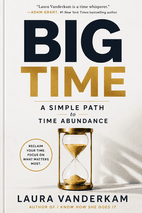
This collection brings together the most memorable lines from Laura Vanderkam's book on time, abundance, and life design. You will find insights that challenge how we think about our hours, encouraging a shift from scarcity to possibility.
The book is endlessly quotable because Vanderkam combines research with real stories, and her words have a way of sticking. Each quote invites reflection without feeling preachy, making them perfect for sharing or journaling. Whether you are looking for motivation, perspective, or a gentle nudge, these lines deliver.
Top Quotes from Big Time
“Given how improbable each minute of actually existing is, I prefer to view the hours as not somehow fewer than one hoped there would be, but all as being a bit of a bonus.”
The author reflects on the improbability of existence after discussing the Permian extinction.
This reframes time scarcity as abundance, encouraging appreciation for every moment.
“We've been given this amazing, unlikely resource—and we get to choose what to do with it!”
The author expresses excitement about time management after discussing agency.
It captures the empowering shift from viewing time as an adversary to a gift.
“What happens when you truly believe that time is abundant? What happens when you believe that time is big enough for you to create a life where you make a difference in your chosen field, enjoy meaningful relationships, pursue passion projects, have little adventures, and get open space too?”
The author poses rhetorical questions to introduce the book's premise.
These questions inspire readers to imagine the possibilities of an abundant time perspective.
“One hundred sixty-eight hours is a vast amount of time.”
The author concludes an analysis of time logs, revealing hidden capacity.
It directly challenges the common belief that time is too scarce, opening the door to possibility and intentional scheduling.
“People overestimate what they can do in the short run. They underestimate what they can do in the long run.”
The author reflects on the philosophy behind breaking big projects into small steps.
It encapsulates the chapter's core message—that consistent small actions lead to remarkable achievements over time, inspiring a shift in perspective.
“Putting big and worthwhile things into a schedule actually makes you feel like you have more time, because in your mind, you become the kind of person who has the time to do big and worthwhile things.”
The author discusses the time paradox—how committing to meaningful projects creates a sense of abundance.
It reframes time scarcity, showing that purposeful scheduling not only accomplishes goals but also transforms one's identity and perception of time.
“Yes” makes possible a great many things. Indeed, if you think about it, you'll soon see that almost all new relationships, projects, and shark-swimming adventures come out of a “yes.”
The author reflects on her decision to say yes to swimming with sharks, which led to an unforgettable experience.
This line encapsulates the chapter's central message that saying yes opens doors to unexpected opportunities, making it a memorable rallying cry for readers.
Themes Behind the Quotes
A central theme is reframing time as abundant rather than scarce. The quotes encourage seeing each week as spacious enough for meaningful work, relationships, and rest. This mindset shift helps people prioritize what truly matters and reduces the feeling of being constantly behind.
Another key idea is the power of small, consistent actions over long periods. The book emphasizes that big results come from many modest steps, not from dramatic sprints. It also highlights openness to serendipity, planning with flexibility, and designing daily life for joy and flow rather than mere productivity. The overall message is one of hope and intentionality.
Quotes by Chapter
Introduction: How to Fall in Love with Your Schedule
“Life may be finite, full of heartbreaks and setbacks, but time can be a friend for the journey.”
The author summarizes the book's philosophy near the end of the introduction.
It poetically reconciles life's hardships with the potential for a positive relationship with time.
Chapter 1: Rewrite Your Story
“We're not guaranteed the time of the next day.”
Joel reflects after the deaths of his sister-in-law and father.
This line starkly reminds readers of life’s brevity, motivating a shift from passive time use to intentional living.
“When we get the sense that time is finite, it starts to put the focus on what is important.”
Joel explains how recognizing time’s limits changed his priorities.
It captures a powerful reframing of mortality as a tool for clarity, encouraging readers to align actions with values.
“Tracking time takes away that treadmill feeling and gives a 30,000-foot view of your week.”
A time tracker describes the effect of logging their hours.
This line vividly captures the liberating perspective shift from feeling stuck in a grind to seeing the big picture, making it both memorable and aspirational.
Chapter 2: Become the Ringmaster
“Complexity isn't the enemy. Chaos is. Complexity and chaos are not the same things at all.”
The author distinguishes between the natural complexity of a busy life and the disorganization of chaos.
This line reframes the problem from needing to simplify to needing to manage chaos, empowering readers to embrace a full life without fear.
“I had a different thought: Honey, you wish your life was a circus.”
The author responds to someone who complained that their chaotic schedule made their life a circus.
This witty retort flips the negative connotation of 'circus' into an ideal of organized, exciting control, inspiring a mindset shift.
“And finally, all this looks like magic, because no one enjoys a circus that looks like drudgery. A good ringmaster manages for delight.”
The author summarizes the final principle of managing a complex life with seamless joy.
It encapsulates the aspirational goal: not just efficiency, but creating a life that feels magical and delightful for everyone involved.
“The fact that things change is not an argument against planning, because having a plan means you know how to pivot when you need to.”
The author explains why planning remains valuable even in the face of unpredictability.
This concise wisdom validates the effort of planning and reframes it as a tool for adaptability, reducing anxiety and increasing confidence.
Chapter 3: Dream Big, Plan Small
“You dream big and plan small. You never tackle too much at once. Nothing feels onerous. But as the days keep passing, even little things add up.”
The author explains the method for tackling daunting projects like visiting all national parks.
This concise, motivational mantra captures the essence of sustainable progress without overwhelm, making large goals feel achievable.
“Over big enough stretches of time, you can do anything.”
The author after finishing War and Peace by reading a chapter a day.
A simple, powerful statement of possibility that inspires readers to trust the process of long-term commitment.
Chapter 4: Stop Wishing Time Away
“Even in an average job it might be possible to look up and say “Oh, is it five o'clock already?””
The author reflects on the possibility of enjoying work hours instead of wishing them away.
This line challenges the common feeling of clock-watching and offers hope that even mundane jobs can be engaging. It's a memorable, uplifting vision of a better workday.
“All time is valuable, and even if you work mostly because you have to, there's no reason not to make these hours as pleasant as possible.”
The author summarizes the book's philosophy after describing the Better Workday Challenge results.
This quote reframes work time as inherently valuable, empowering readers to seek improvement rather than resignation. It's a practical and optimistic call to action.
“I think most of us would like more joy and less exhaustion.”
The author contrasts the results of the challenge where participants reported more joy and less exhaustion.
Simple and universally relatable, this line captures a fundamental human desire. It resonates because it acknowledges the trade-off many face and suggests it's achievable.
“For the first time in a VERY LONG TIME I didn’t want to stop working on Tuesday. I was having fun and I was in a flow state. I am not sure that has happened in the past two years.”
A participant in the Better Workday Challenge reports their experience after implementing the strategies.
This vivid, emotional testimony proves the strategies work, making the advice feel credible and inspiring. The emphasis on 'VERY LONG TIME' highlights the rarity of such enjoyment, making it powerful.
Chapter 5: Embrace Your Golden Hours
“What is transformative is how one chooses to view this time.”
The author reflects on Rebecca's experience of feeling more relaxed despite only a 15-minute change in her commute.
This line encapsulates the central theme of the chapter: that mindset, not just minutes, determines how we experience our evenings.
“There is no reason to be miserable. There is no reason to feel like this time doesn’t exist.”
The author explains his own mindset shift after setting small evening intentions.
It's a powerful, direct affirmation that even busy people can reclaim evening hours as valuable and enjoyable.
“Just as retirees might celebrate their “golden years” of leisure and family time after decades of work, I think we can celebrate our “golden hours” every evening—truly enjoying this family and personal time after our paid labors are done.”
The author introduces the concept of 'golden hours' as a reframing of weekday evenings.
This metaphor creates a compelling, aspirational image that helps readers see their post-work time as a precious gift rather than leftover scraps.
“If you wait until you get home from work at 6:30 p.m. to decide what you want to do in the evening, the answer is going to be “nothing.””
The author advises setting intentions ahead of time to avoid decision fatigue.
It's a relatable, humorous truth that highlights the importance of proactive planning, making the advice memorable and actionable.
Chapter 6: Be Open to Serendipity
“Life is full of serendipity— roughly defined as finding wonderful things you aren’t actively looking for. While the nature of serendipity is that you aren't seeking it, you do have to be open to it.”
The author defines serendipity and explains the mindset needed to benefit from it.
This pithy definition clarifies a key concept and emphasizes the proactive openness required, making it both quotable and instructive.
“Across a big time span, being open to serendipity is more productive and probably more enjoyable than walling yourself off in the misguided belief that this is how you get things done.”
The author argues against the common productivity advice of saying no too often.
It challenges conventional wisdom with a compelling redefinition of productivity, encouraging readers to embrace uncertainty for greater long-term gains.
“It is the accumulation of many small bets over the long haul that tips the odds of something wonderful happening in our favor.”
The author describes the mindset of making little bets to invite serendipity.
This line offers a hopeful, actionable perspective on risk-taking, resonating with anyone seeking to balance effort with openness to chance.
Chapter 7: Think 8,760 Hours, Not 24
“I have so much more opportunity at 45 than I did at 22 just because I know how to plan.”
Jin Zheng reflects on how her long-term planning has opened up her life.
This quote inspires hope and agency, showing that opportunity grows with experience and intentionality. It challenges the cultural narrative that youth is the prime time for possibility.
“Most likely, there will be a lot of not-last days.”
The author counters the advice to 'live each day as if it were your last' with a cartoon insight.
This wry, statistically grounded line reframes a common cliché, freeing readers from the pressure of treating every day as final. It's memorable for its blunt humor and permission to think long-term.