BE 2.0 - Beyond Entrepreneurship 2.0 Quotes
by Jim Collins
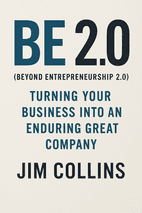
This collection brings together some of the most memorable and practical insights from BE 2.0, a book that blends timeless leadership wisdom with hard won lessons from real companies. You will find quotes about building teams, making tough decisions, and staying true to a purpose bigger than yourself.
What makes this book so quotable is its honesty. Jim Collins does not sugarcoat the challenges of building something great. His words cut through the noise and get straight to what matters: people, character, and discipline. Each quote feels like a conversation with someone who has been there and wants you to succeed without the fluff.
Top Quotes from BE 2.0 - Beyond Entrepreneurship 2.0
“If you define success by money, you always lose.”
Jim Collins reflecting on Bill Lazier's fundamental lesson.
This line reframes success in terms of relationships and values, offering a memorable antidote to materialistic definitions of achievement.
“Life is just too short not to enjoy what you're doing. If we can’t make this fun, we should stop doing it!”
Bill's response to Jim's struggle with writing the manuscript.
This reminds readers that passion and enjoyment are essential for sustained effort and excellence, not mere discipline.
“Without the right people, you simply cannot build a great company, period.”
Jim Collins summarizing the core lesson of the "first who" principle.
Its blunt, absolute simplicity cuts through complexity, underscoring that people decisions are non-negotiable for greatness.
“Leadership is the art of getting people to want to do what must be done.”
Jim Collins crystallizes his short definition of leadership after reflecting on General Eisenhower's words at West Point.
This definition is both elegant and actionable, distilling leadership into three key components: clarity, inspiration, and artistry.
“True leadership only exists if people follow when they would otherwise have the freedom to not follow.”
Jim Collins references James MacGregor Burns to distinguish leadership from brute power.
It challenges leaders to earn followership rather than rely on coercion, making it a litmus test for genuine leadership.
“Level 5 leaders are incredibly ambitious. They are fanatic, obsessed, monomaniacal, relentless, exhausting. But their ambition is first and foremost for the cause, for the company, for the purpose, for the work, not themselves.”
Jim describes the nature of Level 5 leadership from the Good to Great research.
This vivid contrast between intense ambition and selflessness captures the essence of transformative leadership.
“You're confusing what's rare with what's new.”
Jim says this to a young person who demanded a new kind of leadership with purpose beyond profits.
It's a memorable and sharp rebuke that challenges the mistaken belief that timeless principles of greatness are actually novel inventions of each generation.
Themes Behind the Quotes
A central theme is the primacy of people. Again and again, the quotes emphasize that no company can become great without the right team. Leadership is not about titles or charisma but about earning followership through sincerity and a commitment to a cause larger than oneself.
Another theme is the importance of disciplined decision making. The quotes urge leaders to decide clearly and take responsibility, even when the path is uncertain. They also warn against confusing activity with progress, reminding us that greatness is a continual journey, not a destination. The book challenges conventional thinking about success, arguing that money and fame are poor measures of a life well led.
Quotes by Chapter
Introduction: What Is Be 2.0?
“I'm already eating three meals a day, and couldn't eat a fourth.”
Bill's favorite case quote from Leon Bean, used to challenge students about money.
It captures a powerful sense of sufficiency and contentment, redirecting focus away from wealth accumulation.
“I've already had a great life. Everything from here is just a bonus. So, I’m putting butter on my waffles.”
Bill explaining his attitude after quintuple-bypass surgery.
It encapsulates a joyful, grateful approach to life that prioritizes quality over quantity, inspiring readers to live fully in the present.
2. Jim's View From 2020: Great Vision Without Great People Is Irrelevant
“If one indicator of a life well led is that you have changed the lives of others—that some people's lives are different and better because of you—it would be hard to have a better life than Bill's.”
Jim Collins reflects on his mentor Bill Lazier at his memorial service.
This line encapsulates a profound measure of a meaningful life—impact on others—and resonates because it reframes success away from personal achievement to service.
“He spoke of them almost like the remnants of the scattered Jedi, hiding away below the radar screen of the Empire, ready to rise again at the right time.”
Steve Jobs describing the passionate people he found at Apple's low point in 1997.
The Star Wars analogy powerfully conveys finding hidden talent and hope in a dark time, making the idea of rebuilding with the right people vivid and memorable.
“If you're going to climb a big, scary mountain that's never been climbed before, your best hedge against unexpected obstacles is making sure you have the right partners on the other end of the rope, people who can adapt to whatever you encounter on the mountain.”
Jim Collins explaining why uncertainty demands prioritizing the right people.
The mountain-climbing metaphor is relatable and emphasizes adaptability; it makes the abstract principle of "first who" concrete and urgent.
3. Leadership Style
“The key to a leader's impact is sincerity. Before he can inspire with emotion he must be swayed by it himself. Before he can move their tears his own must flow. To convince them he must himself believe.”
Attributed to Winston Churchill at the start of the chapter.
This line captures the essence of authentic leadership, emphasizing that a leader must first feel deep conviction before inspiring others.
“M's leadership style was so ineffective—so oppressive—that it hung over the organization like a cold, penetrating mist.”
Part of the description of the M Syndrome, a case study of a failed CEO.
The metaphor of a cold, penetrating mist powerfully conveys how a destructive leadership style can suffocate an organization.
“Simply put, it's impossible to build a great company if you have a destructive leadership style.”
Conclusion drawn from the analysis of M's failures.
This blunt statement underscores the critical importance of leadership style as a non-negotiable foundation for building a great company.
“An effective style grows from within you. It should be entirely yours. No one except you should have a style exactly like yours.”
Advice on cultivating a genuine personal leadership style rather than imitating others.
These sentences remind readers that authenticity is key—forcing an unnatural style leads to absurdity and ineffectiveness.
Jim’s View from 2020: Just What Exactly Is “Leadership”?
“You do not need a powerful, charismatic personality to inspire people to do great things.”
After describing Wendy Kopp's quiet, reserved manner at West Point, Jim Collins underscores this essential truth.
This liberates aspiring leaders from the cult of personality and validates diverse leadership styles.
“If you rely primarily on rank or title or position or money or incentives or celebrity or any other form of raw power to get things done, quite simply, you've abdicated leadership.”
Jim Collins warns against confusing power with leadership in a direct, emphatic statement.
The stark phrasing forces leaders to self‑examine whether they are truly leading or merely exercising authority.
Jim’s View from 2020: What Cause Do You Serve?
“What cause are you willing to sacrifice and suffer for, when you must make decisions that cause pain for yourself and others to advance that cause?”
Jim poses this question as the spark to ignite Level 5 leadership.
It challenges leaders to find a purpose greater than themselves, inspiring selfless dedication and clarity of mission.
“If you've got a pressing problem, make a decision and get on with it. Indecision is often worse than making a wrong decision.”
Jim advises on decision-making for small to mid-sized companies.
It delivers a practical, memorable lesson that action—even imperfect—outweighs paralysis.
“Do not fear mistakes. Wisdom is often born of such mistakes.”
Jim quotes Paul Galvin, founder of Motorola.
This short aphorism reframes failure as a source of growth, encouraging courage in decision-making.
Jim’s View from 2020: Good Decisions, Right Timeline
“It takes courage when things go awry to say, “It's my responsibility.” But that's exactly what you should say —at least if you want to garner people's lasting respect and commitment.”
From the chapter on decision-making, Jim Collins discusses the importance of leaders accepting responsibility for poor decisions.
This line challenges leaders to embrace accountability, which builds trust and respect. It contrasts common blame-shifting behavior with the courage that earns lasting commitment.
“Great leaders make clear decisions, but not always fast decisions.”
After discussing historical examples like Alfred Sloan and George Washington, Collins emphasizes the value of deliberate decision-making.
It succinctly counters the myth that speed equals effectiveness, reminding leaders that clarity and thoughtfulness often matter more than haste.
“The right decision made in the wrong time frame is a bad decision.”
Following the analysis of Ben Sliney's 9/11 decisions, Collins introduces the concept of decision timing.
This aphorism captures a critical insight: timing is integral to decision quality, not an afterthought. It urges leaders to match their decision pace to the situation's risk profile.
“Without disagreement, you might not fully understand the problem. Without unified commitment, you'll almost certainly fail to execute.”
From the summary of Level 5 leadership decision-making, Collins explains the dual need for debate and alignment.
It pairs two essential truths—disagreement sharpens understanding, while unified commitment drives execution. The balanced formula is memorable and actionable.
4. Vision
“If you lose your voracious curiosity about tactical details, if you lose passionate interest in people and how they are feeling, if you insulate yourself in the protective cocoon of executive comforts, you may well wake up one day to discover your company has already entered a doom loop of decline and self-destruction.”
The author warns against the dangers of executive detachment, drawing on research of once-great companies that declined.
The vivid imagery of a 'protective cocoon' and 'doom loop' creates a memorable cautionary tale, urging leaders to stay connected to details and people to avoid organizational decline.
“There is no shortage of people interested in doing something in which they can take pride. But there is a vast shortage of leaders who provide the stimulation of stiff challenge and high standards, combined with the uncompromising belief that seemingly ordinary people can do extraordinary things.”
The author discusses the role of high standards and belief in people as a key leadership element.
This passage challenges leaders to shift from demanding performance to offering opportunity, and its balanced phrasing makes it both inspiring and convicting.
“If something looks like a duck, quacks like a duck, and waddles like a duck, then it's probably a duck.”
This is from a section advising leaders to be honest and direct when communicating unpleasant news, using the duck analogy.
It's a memorable and universally understood adage that reinforces the importance of transparency in leadership. Leaders who avoid sugarcoating build trust and respect.
“Greatness is not an end point. It's a path—a long, arduous, torturous trail of continual development and improvement.”
From the 'Ever Forward' section, emphasizing that greatness is a continuous journey.
This quote inspires leaders to view their company's development as an ongoing process rather than a final destination. It encourages relentless improvement and resilience.
Jim’s View from 2020: Purpose Beyond Profits— Don’t Confuse Rare with New
“To build an enduring great company in any era requires being almost obsessive in pursuit of a purpose. This has always been true. It is still true today. And it will almost certainly remain true forever.”
Jim reflects on the exchange with the young person, asserting the timeless nature of purpose-driven leadership.
The rhythmic repetition and unwavering conviction make this a powerful reminder that the core ingredient of greatness never changes, cutting through the noise of passing trends.