Abundance or Collapse Quotes
by Farzad Mesbahi
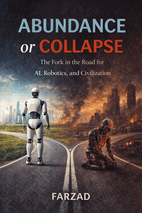
On this page you will find a collection of the most striking lines from Farzad Mesbahi's book Abundance or Collapse. These quotes capture the core arguments about AI, robotics, energy, and the future of society. They are meant to be shared and remembered.
What makes this book so quotable is the way it packs big ideas into tight, vivid statements. Mesbahi has a gift for turning complex predictions into simple, memorable phrases. He challenges assumptions and forces you to think about where we are headed. Each quote stands alone as a tiny essay, yet they all fit together into a powerful warning and a hopeful vision.
Top Quotes from Abundance or Collapse
“We're not living through three separate revolutions - Al, robotics, and energy. We're living through one Revolution.”
The author explains a common misconception about technological trends.
This line encapsulates the central thesis of the chapter, reframing three separate trends as a single interconnected force. It is memorable because it challenges readers to see the bigger picture of technological convergence.
“What seems impossible becomes inevitable, faster than most people expect, but slower than I thought.”
The author reflects on his decade of predictions about Tesla and the broader convergence.
This line conveys both the surprising pace of technological change and the humility of an expert who still underestimates it. It is relatable and memorable as a realistic take on exponential progress.
“The global market for human labor is somewhere north of $40 trillion per year. That's not a typo. Forty trillion dollars. Every year.”
The author introduces the staggering size of the labor market that humanoid robots could address.
The sheer scale of the number shocks the reader and grounds the entire argument in a concrete, undeniable economic reality.
“The top 20 percent will thrive. The bottom 20 percent will actually be lifted up. And the middle 60 percent - the vast majority of people in developed nations - will get crushed during the transition.”
The author introduces the central 'barbell' thesis of how AI will affect different socioeconomic groups.
This is the core, counterintuitive argument of the chapter: the extremes win while the comfortable majority suffers, forcing readers to reconsider common optimistic or pessimistic narratives about AI.
“Compassion without action is just spectatorship.”
The author transitions from acknowledging the pain of the middle class to insisting on practical solutions.
It is a sharp, memorable aphorism that challenges passive empathy and demands proactive measures, making it a rallying cry for readers who want to do more than just worry.
“You cannot catch up to a target that is accelerating away from you.”
The author discusses how legacy automakers are futilely trying to match Tesla's rapidly advancing capabilities.
This line vividly illustrates the hopelessness of competing when the pace of disruption outruns traditional strategic planning cycles.
“The price of freedom is eternal vigilance, and Al makes that vigilance both more difficult and more necessary.”
Reflecting on safeguards against authoritarian drift in the US.
Updates a classic political maxim for the AI age, making the reader feel both the weight of responsibility and the urgency of the moment.
Themes Behind the Quotes
The first major theme is the convergence of technology. Mesbahi argues that AI, robotics, and energy are not separate trends but one interconnected revolution. This unified force is accelerating at a pace that outstrips our ability to adapt, creating both unprecedented opportunity and disruption. The second theme is the economic and social upheaval that follows. The book warns that the middle class will suffer most during this transition, while the wealthy concentrate more power.
Another central theme is the choice between abundance and collapse. Mesbahi presents a future where either we harness technology for widespread benefit or it becomes a tool for authoritarian control. He emphasizes the urgency of proactive government action and ethical vigilance. The quotes repeatedly highlight that inaction is a decision, and that the time to position ourselves is now.
Quotes by Chapter
Chapter 1
“What happens when the technology itself can participate in its own improvement?”
The author contrasts previous technological revolutions with AI's self-improving capability.
This rhetorical question highlights the unprecedented nature of AI, forcing readers to consider a world where innovation is no longer limited by human speed. It resonates because it captures the core difference that makes The Convergence so transformative.
“Tesla isn't just an automaker. It's the body of a system that includes the most advanced Al, the most capable space infrastructure, and the manufacturing base to build all of it at scale.”
The author explains why Tesla is central to the ecosystem thesis.
This line reframes Tesla from a car company into a systemic platform, underscoring the interconnected bet the author is making.
Chapter 2
“Full Self-Driving is the proof of concept. It's the first massive demonstration that Al can replace human labor at scale.”
The author introduces the core thesis of the chapter, arguing that FSD is the real-world proof of AI replacing human labor.
This line crisply frames FSD as a watershed moment, making the abstract concept of AI displacement tangible and urgent.
“This is why I've said in the past that Uber is completely and utterly cooked by this dynamic. Not damaged. Not hurt. Cooked.”
The author summarizes his view on Uber's vulnerability to Tesla's Robotaxi economics.
The blunt, repetitive phrasing drives home the inevitability of disruption with memorable force.
“Uman drivers kill over 40,000 people per year in the United States. A self- driving system that's merely twice as safe as humans would cut that number in half. Should we wait years for perfection while people die in preventable accidents?”
The author makes a moral case for deploying autonomous vehicles despite imperfect safety data.
It reframes the regulatory debate as a life-or-death choice, creating a powerful ethical challenge to delay.
“FSD is the canary in the coal mine. It's showing us exactly how this plays out.”
The author introduces Full Self-Driving as an early indicator of AI's broader impact on labor.
This vivid metaphor conveys that FSD is a warning signal for massive disruption, making the abstract concept of AI-driven change tangible and urgent.
Chapter 3
“I think it's going to be the most important product in the history of not just Tesla - but civilization.”
The author states his belief about Optimus, Tesla's humanoid robot program.
This bold, visionary claim elevates the robot beyond a corporate product to a civilization-shifting technology, making it instantly memorable and provocative.
“At a certain point, not deploying robots becomes a competitive disadvantage so severe that it threatens the existence of companies that don't adapt.”
The author explains the economic pressure that will force widespread robot adoption.
This line captures the inevitable, almost Darwinian logic of automation, making the future feel both urgent and unstoppable.
“When labor becomes cheap enough that scarcity of human workers is no longer the constraint, the economics of production fundamentally change.”
The author reflects on the long-term implications of cheap robotic labor.
It articulates a profound shift in how we think about scarcity and abundance, hinting at a radically transformed society.
Chapter 4
“For the next 10 to 20 years, we are going to see a massive demand for energy generation unlike anything we have ever witnessed.”
The author explains why energy is the overlooked third leg of the AI story.
This sets the scale of the coming energy challenge, making it clear that the AI revolution will reshape infrastructure as dramatically as the digital revolution did.
“A single data center training a large language model can consume as much electricity as a small city.”
Describing the AI energy appetite at the start of that section.
A startling, concrete comparison that makes the abstract power demand of AI tangible and drives home the urgency.
“But energy and Al have become the same conversation. They're inseparable now.”
After explaining that AI's power needs tie directly to energy production and storage.
A crisp encapsulation of the book's core thesis: energy is not a separate issue but the foundation of AI's future.
“The Sun delivers more energy to Earth in one hour than humanity uses in a year.”
Arguing that solar energy will win in the long run over nuclear.
A humbling, awe‑inspiring fact that reframes the energy problem as one of capture, not scarcity, and makes the solar case nearly irrefutable.
Chapter 5
“Every single one of those activities is being automated right now. Not in ten years. Not after some mythical AGI moment. Right now.”
The author lists common white-collar tasks and asserts that automation is already happening.
The repetition of 'right now' creates urgency and forces readers to confront that the disruption is not a distant threat but an immediate reality.
“A generation was promised that education plus hard work plus showing up every day equaled security. That promise is breaking, and the people who kept their end of the bargain are the ones paying the price.”
The author reflects on the betrayal felt by middle-class professionals who followed societal rules.
This line captures the deep injustice and emotional weight of the transition, resonating with anyone who feels their hard-earned stability is being rendered worthless.
Chapter 6
“They died because the structure of their businesses made it impossible to respond. The thing that made them successful became the thing that killed them.”
The author explains why companies like Blockbuster, Kodak, and Nokia failed despite seeing threats clearly.
This succinctly captures the core paradox of the innovator's dilemma—success breeds rigidity, and the very strengths of an incumbent become fatal liabilities.
“Successful companies fail not despite their capabilities, but because of them.”
The author introduces Clayton Christensen's key insight from 'The Innovator's Dilemma'.
It is a memorable, counterintuitive twist on conventional wisdom that forces readers to rethink why dominant firms collapse.
“The question is not whether it will happen. The question is whether you are positioned on the right side of it.”
The author concludes by urging readers to reflect on their own industries' vulnerability to disruption.
It delivers a powerful, direct challenge that resonates personally and prompts immediate self-assessment about one's career or business.
Chapter 7
“The way I see it, this is the most important variable in determining whether the Age of Abundance I've described actually materializes as something good for humanity, or becomes a tool for control that makes previous authoritarian regimes look primitive.”
The author explains why the US-China AI race is the critical factor for the future.
It succinctly frames the existential choice between a beneficial era of abundance and a dystopian authoritarian tool, making the stakes visceral and memorable.
“In China, the ceiling is the Party. And the Party will always protect itself first.”
Comparison of individual achievement ceilings between the US and China.
This stark, rhythmic statement captures the fundamental limit of authoritarian systems with brutal clarity, leaving a lasting impression.
“The difference is between a system where course correction is possible and a system where it is not.”
Concluding the discussion on the stakes of the AI race.
It distills the core advantage of democratic systems into a simple, powerful contrast that resonates with anyone concerned about adaptability and freedom.
Chapter 8
“The real danger isn't that Al will develop too fast. The real danger is that its benefits will concentrate too narrowly.”
The author distinguishes between the common fear of rapid AI development and the more pressing issue of wealth concentration.
It reframes the AI risk debate from technological speed to economic inequality, offering a counterintuitive and powerful insight that challenges mainstream regulatory priorities.
“Without effective government action, the benefits concentrate, the middle gets crushed, and social instability spirals into something much darker.”
The author summarizes the likely outcome if governments fail to intervene in the AI transition.
This line crystallizes the stakes of inaction in vivid, memorable language, making a compelling case for urgent and competent government intervention.