Chapter 1
Key concepts: Chapter 1
Chapter 1
The Civilizational Fork in the Road
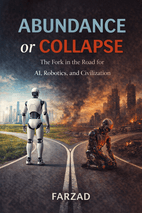
- Humanity faces a binary choice between a future of abundance or collapse
- The outcome depends on how we manage the intertwined forces of AI, robotics, and energy
- We are witnessing one singular accelerating event called The Convergence, not three separate revolutions
- These technologies can either eradicate scarcity or concentrate power destructively
The Three Interdependent Forces
- AI requires massive compute power fundamentally constrained by energy availability
- Robotics are physical AI requiring intelligence, manufacturing, and reliable power
- Energy infrastructure is increasingly optimized by AI and built/maintained by robots
- SpaceX-xAI merger exemplifies this: using space-based solar to power AI compute clusters
The Self-Improving System
- The Convergence creates a historically unique self-improving feedback loop
- AI can participate in designing better AI architectures
- Robots can help manufacture more advanced robots
- AI-optimized energy systems become cheaper, enabling more AI and robotics
- Removes human innovation speed as primary constraint on progress
The Flywheel Mechanism
- AI advancement drives better energy solutions and robotic intelligence
- Robotic deployment builds and maintains the infrastructure of abundance
- Energy abundance powers more AI development and robotic operations
- Each revolution of the wheel accelerates faster than the last
- Driven by Wright's Law: costs plunge exponentially with production scaling
The Transition Challenge
- Technologies will rapidly displace millions of jobs, challenging work-survival link
- Change is presented as an economic certainty that cannot be stopped
- Critical questions shift to distribution of benefits and societal restructuring
- Preparation is essential to navigate upheaval and reach abundance future
- Most people underestimate the speed of change due to linear thinking
The Interlocking Core Constraints
- AI's primary constraint is compute, which depends on energy availability.
- Robotics' primary constraints are manufacturing scale and intelligence, both solvable by AI advancements.
- Energy's primary constraints are cost and installation, both solvable by robotics automation.
- Progress in one area creates cascading breakthroughs in the others through a systemic feedback loop.
The Underestimated Timeline of Change
- Human psychology and linear thinking cause dramatic underestimation of the Convergence speed.
- Change is projected in years, not decades, with acceleration being the norm.
- By 2027: AI performing 80% of digital tasks at top-20% human level; robots expanding beyond factories.
- By 2030: A world dramatically reshaped with transformed industries and eliminated work categories.
The Multi-Company Convergence Landscape
- The transformation does not depend on any single company's success.
- NVIDIA provides foundational compute hardware for the AI industry.
- Amazon integrates AI, robotics, and physical logistics in its operations.
- Companies like BYD, Figure AI, and Boston Dynamics advance key pieces of the puzzle.
Tesla & The Musk Ecosystem's Unique Integration
- Tesla holds a uniquely integrated position across AI, robotics, and energy.
- The ecosystem architecture: xAI as the brain, SpaceX as the vessel, Tesla as the body.
- Vertical integration allows optimizations to flow directly across the technological stack.
- Controlled coordination enables testable feedback loops unmatched by disconnected companies.
The Economic Flywheel of Wright's Law
- Wright's Law drives cost reductions with each cumulative doubling of production.
- This creates a powerful economic flywheel: scaling reduces costs, enabling wider deployment.
- Most analysts underestimate acceleration when multiple technological curves interact.
- Companies riding multiple Wright's Law curves operate on fundamentally steeper trajectories.
The Dual Promise and Peril of Transition
- The Convergence promises abundance by relaxing constraints on labor, energy, and intelligence.
- Simultaneously, it threatens chaotic disruption through rapid displacement of workers.
- The critical questions are societal: distributing benefits and restructuring society post-work.
- Western individualistic societies may struggle more with disruption than communal ones.
Roadmap for Navigating The Convergence
- The book's structure examines core technologies, resulting disruption, and finding opportunity.
- Goal is to equip readers to understand, prepare for, and benefit from the transformation.
- Focus shifts from debating if jobs will be replaced to addressing how society adapts.
- Emphasis on positioning oneself to avoid being crushed by inevitable change.
The Economic Engine of Convergence
- Wright's Law drives exponential cost reductions in foundational technologies like batteries, solar, and compute.
- Cost reductions accelerate with cumulative production scale, creating a self-reinforcing economic flywheel.
- This non-linear progress is systematically underestimated by traditional linear forecasting models.
The Goal and the Path of Disruption
- The ultimate objective is a future of radical abundance in labor, energy, and intelligence.
- The transition to this abundance will be achieved through devastating economic disruption.
- Jobs and industries will become obsolete not due to lack of skill, but because their economic value is undercut by cheaper technological alternatives.
Reframing the Critical Societal Debate
- The central question is no longer how to prevent technological displacement, as this is now inevitable.
- The essential debate must shift to managing the societal aftermath of widespread economic obsolescence.
- Society must redesign its economic structures, social contracts, and concepts of meaning and purpose in an age of potential abundance.
The Nature and Urgency of the Transition
- The disruptive shift will occur on a timescale of years or decades, not generations.
- Western societies, with their high labor costs, will feel the impact disproportionately and first.
- Conscious, urgent preparation at both individual and societal levels is critical to avoid being blindsided by the speed of change.