Zero Click Marketing Quotes
by Amanda Natividad
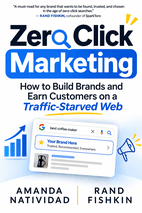
This page gathers the lines from Zero Click Marketing that stick with you after the tab closes. You will find blunt observations about shrinking clicks, platforms keeping attention, and the strange gap between what analytics can see and what actually shapes a purchase.
What makes the book quotable is the way it turns dry marketing problems into vivid, funny, useful statements. Some lines are warnings, some are reframes, and some are simple reminders that influence rarely follows a tidy path. They are easy to share and even easier to argue with.
Top Quotes from Zero Click Marketing
“A click murder had been committed. Thousands of them, actually.”
After ruling out a drop in search demand, Rand concludes that Google is killing clicks.
The vivid murder metaphor makes a dry analytics problem feel dramatic and memorable.
“Someone murdered those clicks. Scratch that... Everyone murdered those clicks. The search engines, the social networks, the app and phone makers, the toothless antitrust regulators, even the people who use the web. We're all guilty.”
The chapter concludes that responsibility for the decline in clickable traffic is collective.
It reframes the zero-click problem as systemic rather than attributable to one villain. The repetition and escalation make it a strong thesis statement.
“Ads don't need to earn a click to influence action! It's Zero Click Advertising.”
The author is describing the fastest-growing category of digital ads, which are seen but not clicked.
It turns the chapter's thesis into a compact, memorable slogan.
“A purchase can happen in a moment, but influence builds over dozens of touchpoints.”
Amanda’s barrel-jeans purchase illustrates the chapter’s core claim about delayed influence.
It compresses the chapter’s thesis into a single memorable contrast between instant conversion and cumulative influence.
“The places that send traffic are not the same places that earn attention. Search is often the visible path from intent to action. It’s not necessarily the source of the intent itself.”
Following the referral-traffic chart, the authors distinguish visible traffic from actual attention.
It clarifies why referral data can mislead marketers about where demand is created.
“The bumpers in the pinball machine move the ball, but your analytics only see the chute.”
The authors introduce the pinball-machine model of messy customer journeys.
It gives readers a sticky image for the gap between visible analytics and unseen influence.
“Because Big AdTech is so low-friction, it's also the most expensive way to earn an additional sale. Almost every other form of marketing, done with even modest sophistication, can produce higher ROI.”
The authors explain the hidden cost of relying on Big Tech’s ad ecosystem.
It reframes low-friction advertising as expensive and challenges marketers to build higher-ROI alternatives.
Themes Behind the Quotes
The book keeps returning to a power shift: search engines and social platforms now answer questions and hold attention without sending visitors anywhere. That breaks old website-centered marketing models and makes click-based measurement feel less reliable. The quotes also explore how advertising can influence people without a click, and why big ad platforms are convenient but costly.
A second theme is that influence is messy and often invisible in analytics. People may act after many unnoticed touchpoints, and the places that earn attention are not always the places that send traffic. The final thread is strategic: build organic recognition, earn trust with audiences and the publications or platforms around them, and understand that stronger brand awareness makes paid efforts work better.
Quotes by Chapter
Introduction: Eulogy for a Web Without Traffic
“Hope you enjoyed it while it lasted, because the quarter century of ever-rising referrals is over. And no DeLorean is coming to take us back to the traffic-opportunity-laden days of the open web.”
The opening eulogy declares the end of the open web’s referral boom.
It frames the book’s premise with a blunt, memorable image of an era closing.
“Today, search engines and Al tools answer billions of queries without sending a single visit.”
The authors explain what has replaced the old traffic model.
It states the zero-click shift in a single, concrete sentence.
“Because there's good news, too: People did not stop buying things on the internet.”
The authors pivot from decline to the book’s source of optimism.
It reassures marketers that consumer behavior has not disappeared; only the pathway has changed.
“Zero Click Marketing is here to help you master the art of earning an audience and nudging them to buy from your company despite the clickless web we inhabit.”
The authors introduce the book’s central promise.
It defines Zero Click Marketing as audience-building and persuasion without relying on visits.
1: Who Killed the Click?
“Clicks were down ~20 percent, but the number of keywords and the average rankings were both up.”
Rand revisits old Google Search Console emails for Moz and notices an SEO paradox.
It captures the counterintuitive shift at the heart of the chapter: better rankings no longer guarantee more traffic.
“Friends, what we have is a massive, unaddressed, barely talked-about conundrum: Clicks are dying, but marketers still act like they're the gold standard.”
The book pivots from anecdotes to the core marketing problem the chapter will address.
It sharply names the central tension: marketers keep optimizing for a metric that is losing relevance.
2: How the Web’s Walled Gardens Won
“If your content helps Facebook hold attention, it can still travel. If your content tries to send people elsewhere, you might as well distribute through the Metaverse.”
The chapter explains how Facebook's organic reach now rewards on-platform attention over outbound links.
It distills the zero-click bargain in concrete, memorable terms. The Metaverse comparison makes the penalty for driving traffic feel absurd and vivid.
“If the product is free, you are the product.”
The chapter explains why free platforms prioritize advertiser revenue and retention over outbound traffic.
This classic aphorism captures the incentive shift behind zero-click marketing. It makes the platform-user relationship instantly legible.
“When people no longer need to visit your website to benefit from your work, the business model breaks.”
After the Tailwind CSS and All About Berlin examples, the chapter states the core economic problem of the Zero Click Web.
It states the chapter's central threat in one clean sentence. It connects user behavior directly to business viability.
“The Zero Click web destroys that model, and as it does so, entirely shifts how marketing effort should be applied at each level of the classic marketing funnel.”
The chapter contrasts the old 'digital home' model with the new need for Zero Click Marketing.
It marks the strategic pivot the book is arguing for. It shows that the change is not tactical but structural across the funnel.
3: Native Content or GTFO
“Store designers optimize for store economics. Tech platforms do the same thing. The goal is to keep you engaged, exposed to ads, and inside the system.”
The authors compare grocery store design to tech platform design.
It distills the chapter’s central analogy and the incentive behind platform design.
“Engaging in native content on platforms that have your audience's attention is worthy of as much investment as all the click-driving tactics of the past quarter century.”
The authors state the book's core argument after describing platform control.
It is the chapter's thesis and directly justifies a native content strategy.
“We can’t fight the platform's product designers and win. But we might be able to sidle alongside and benefit by optimizing for the same metrics they're so desperate to boost.”
The authors conclude after describing how platforms suppress clicks and traffic.
It captures the pragmatic pivot from fighting platforms to aligning with their incentives.
4: Ad Clicks, Misclicks, and the Flow of Traffic
“Sort of. Sometimes. If you're really good at it, in the right fields, and don't mind poor profit margins.”
The chapter answers whether advertisers can simply pay platforms to keep traffic flowing.
It gives a blunt, practical correction to the paid-traffic reflex while leaving room for narrow exceptions.
“In essence, advertisers as a whole are recognizing that digital ads don't need to drive traffic in order to be valuable.”
The author summarizes the broader shift in how advertisers value digital ads.
It captures the chapter's core recognition that ad value is no longer reducible to clicks or traffic.
“What if I was going to take action anyway, and the ad had nothing to do with my decision to do so?”
The author voices the reader's suspicion about view-through conversions and ad attribution.
It exposes the attribution problem at the heart of digital advertising and invites healthy skepticism.
5: Who Turned My Analytics Into a Joke?
“These web analytics really did feel a little like a 1.21-gigawatt time machine—at least, good enough that marketers got dangerously used to believing the past could be reconstructed on demand.”
The chapter recalls what 2012-era web analytics could do.
It captures both the promise of early analytics and the trap of assuming the past is always recoverable.
“If you weren't doing marketing back then, it's almost hard to fathom the precision with which marketers could earn buy-in for particular investments.”
The chapter contrasts today's fractured data with the precision marketers once had.
It makes the loss of attribution feel tangible by tying it to budget buy-in.
“Then, one by one, these sources of data disappeared. By 2020, almost everything that went into building these analytic and predictive models (outside of paid ads) became nigh on impossible to acquire. What happened? The flux capacitor blew.”
The chapter explains how the rich data sources behind 2012-style analytics vanished.
It delivers the chapter's central disappearance and its Back to the Future punchline in one sweep.
“Today, Google Analytics (and their only major competitor, Adobe) is primarily focused on helping you measure and invest in digital advertising.”
The chapter says major analytics platforms now center on advertising measurement.
It succinctly explains why non-ad attribution has become so difficult.
6: Zero Clicks. Not Zero Influence.
“It's the designers and the lifecycle marketing team who did the work of making jeans you couldn't forget. Google merely showed up at the finish line and stole the credit.”
After describing Google’s prediction of Amanda’s purchase, the authors contrast influence with last-click credit.
The finish-line metaphor makes attribution bias vivid and memorable.
7: RULE #1: Audience Research: Gain a Deep Understanding of Your Audience
“In Zero Click Marketing, your audience is not just the people who might buy from you. It's also the people, platforms, and publications that shape what those buyers see, trust, remember, and talk about.”
The chapter distinguishes audience from customers when defining Zero Click Marketing.
It broadens targeting to include the influencers and media that shape buyer perception, a key zero-click insight.
“The stronger your organic marketing, the more effective your paid ads. Platforms reward higher engagement and higher-converting ads, and both improve when people already know, like, and trust your brand.”
The chapter explains why organic and paid marketing reinforce each other.
It gives a clear strategic reason to invest in brand and organic presence before scaling ads.