Your Perfect Portfolio — Interactive Mindmaps

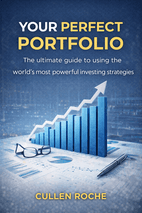
Your Perfect Portfolio by Cullen Roche Book Cover

by Cullen Roche

Cullen Roche's Your Perfect Portfolio presents an evidence-based framework for constructing resilient investment portfolios, guiding thoughtful individual investors through a process of matching proven global asset allocation models to their unique financial profiles and long-term goals.

On Insta.page you also get an Apply This Book tool that lets you combine insights from up to 3 books to solve your specific situation.

Chapter mindmaps

Free preview: chapters 1–4 are fully interactive. Click any node to expand or collapse. Subscribe to unlock the rest.

Chapter 1: Introduction: Does The Perfect Portfolio Exist?

Key concepts: Introduction: Does The Perfect Portfolio Exist?

1. Introduction: Does The Perfect Portfolio Exist?

Personal Fit Over Perfection

  • No universally perfect portfolio exists
  • Find one that fits your goals and temperament
  • The key is long-term discipline and consistency

Mindset: Saver vs. Investor

  • You are primarily a saver, not an investor
  • Manage a Savings Portfolio for future expenses
  • Distinct from spending on skills or education

Behavioral Enemy & Robust Planning

  • You are your portfolio's worst enemy
  • Prehistoric instincts urge panic selling
  • Build a plan to withstand impulses

Market Realities & Core Strategy

  • Beating the market is extremely hard
  • Focus on a sustainable personal plan
  • Diversification is the only free lunch

Erosion of Returns

  • The brutal math of fees erodes wealth
  • Focus on real returns after inflation and taxes
  • Risk is uncertainty of lifetime consumption

Temporal Conundrum & Realism

  • Asset allocation matches long-term assets to liabilities
  • Past data is thin; adapt to an uncertain future
  • Wealth primarily comes from labor, not the portfolio

Portfolio as a Tool for Goals

  • Foundation is a clear financial plan first
  • Align investment strategy with life goals
  • Embrace diversity and customization of strategies

Chapter 2: Chapter 1: The Warren Buffett Portfolio

Key concepts: Chapter 1: The Warren Buffett Portfolio

2. Chapter 1: The Warren Buffett Portfolio

Author's Initial Misunderstanding

  • Reduced Buffett to simple stock-picking mantra
  • Fell for value traps and penny stocks
  • Learned Buffett's genius is in structure, not selection

Evolution of Buffett's Strategy

  • Began with aggressive Buffett Partnership
  • Pivoted from cigar butts to wonderful businesses
  • Masterstroke was acquiring insurance float via National Indemnity

Berkshire's Cash-Flow Engine

  • Insurance float acts as perpetual, interest-free loan
  • Creates low-cost, cash-generating machine
  • Enables patient acquisition of undervalued companies

The 90/10 Buffett Portfolio

  • 90% S&P 500 index fund, 10% Treasury bills
  • Buffett's own advice for most individual investors
  • Embraces his equity philosophy without his leverage

Implementing the Strategy

  • Requires discipline to dollar-cost average
  • Use T-bills as dry powder during market panics
  • Demands long-term horizon and mental fortitude

Trade-Offs and Suitability

  • Volatile with deep drawdowns
  • Won't replicate Buffett's alpha
  • Best for investors with decades-long horizon

Behavioral and Structural Lessons

  • Buffett's frugality creates behavioral bandwidth
  • Treat consistent cash flow as portfolio's moat
  • Leverage tax-advantaged accounts and legal structures

Chapter 3: Chapter 2: Why Not 100% Stocks?

Key concepts: Chapter 2: Why Not 100% Stocks?

3. Chapter 2: Why Not 100% Stocks?

Theoretical Foundation for 100% Stocks

  • Stocks are long-term claims on corporate profits
  • Market acts as a 'weighing machine' over decades
  • Index funds provide exposure to global capitalism's growth
  • Corporations are inherent inflation hedges

Reality of Risk and Volatility

  • Severe short-term volatility is the price of admission
  • Regular 20-30%+ declines are historical norm
  • High 'Ulcer Index' indicates extreme portfolio stress
  • Emotionally taxing ride for superior long-term returns

Critical Drawbacks and Risks

  • Sequence-of-returns risk devastates retirees
  • Ultimate behavioral test during market crashes
  • Requires selling depreciated assets in bear markets
  • Few investors can stay committed through losses

Portfolio Construction Approach

  • Use low-cost, diversified index funds only
  • Global fund (VT/ACWI) or disaggregated components
  • Broad diversification across thousands of companies
  • Rebalance to global market weights for control

Ideal Candidates and Suitability

  • Ultra-aggressive investors with stable high income
  • Very long time horizons (decades) to wait out volatility
  • Exceptionally high psychological risk tolerance
  • Targeted asset location in young retirement accounts

Chapter 4: Chapter 3: T-Bill And Chill (Or Why Not 100% Cash?)

Key concepts: Chapter 3: T-Bill And Chill (Or Why Not 100% Cash?)

4. Chapter 3: T-Bill And Chill (Or Why Not 100% Cash?)

The Hidden Cost of Cash Management

  • Banks profit from spreads on cash products
  • High-yield savings accounts have hidden fees vs T-bills
  • Tax inefficiency worsens the real return loss

T-Bills as a Legitimate Asset Class

  • Most stocks historically underperform one-month T-bills
  • Preserves purchasing power over long periods
  • Provides nominal safety and optionality

Building a T-Bill Ladder Strategy

  • Stagger purchases across 1-12 month maturities
  • Automate rollovers to maintain liquidity
  • Use ETFs for fund-based alternatives

Pros and Cons of T-Bill Strategy

  • Pros: Tax efficiency, liquidity, cash flow certainty
  • Cons: Only keeps pace with inflation, not beats it
  • Vulnerable in zero-rate or hyperinflation environments

Strategic Role in a Portfolio

  • Ideal for emergency funds and short-term needs
  • A component for capital preservation, not growth
  • Requires diversification with other assets

Continue exploring Your Perfect Portfolio