You Know Why Themes
by J.T. Ellison
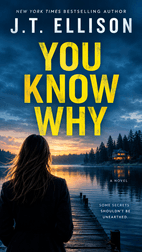
Beneath the twists and body count, this book wrestles with something more uncomfortable: how little we truly know the people we love. Every relationship hides a false identity, every memory is suspect, and the past refuses to stay buried. Even domestic life turns out to be a stage set, ready to collapse.
Here you'll find each major theme grounded in specific scenes, from Brooklyn's unreliable vision to Eden's poisonous sisterhood, plus the recurring symbols that give the story its texture. Scissors, children's tales, and pregnancy all carry double meanings, showing how danger hides inside the ordinary.
Major Themes in You Know Why
Hidden Lives, False Identities, and the Limits of Knowing Someone
The novel repeatedly shows that people are not what they appear: Trey is actually Andrew Locke, a man with an erased past; Eden poses as a helpful caretaker while plotting against Brooklyn; even family figures hide major histories. These reveals ask whether anyone can truly know another person.
- Eden recognizes Trey as Andrew Locke in the Atlanta airport and says she knew him from high school, while Trey denies knowing her and hurries his family away.
- At the FBI office, Baldwin exposes Andrew/Trey as a long-term undercover asset inside the classified Operation Angelmaker.
- Brooklyn tells investigators she never googled her husband because he never gave her reason to doubt him, making her realize she did not know his past at all.
Memory, Trauma, and Unreliable Perception
Brooklyn’s traumatic brain injury makes her memory, vision, and sense of reality deeply unreliable. The narrative uses her fractured consciousness to blur the line between what is true and what is imagined, leaving both Brooklyn and the investigators uncertain.
- Waking in Nashville, Brooklyn asks for Alex—who has been dead for years—then confuses Alex with Trey and cannot remember her own children.
- Her hallucinations of monsters and dead loved ones are partly caused by an Adderall reaction, and Brooklyn cannot tell whether she hurt herself or Alex attacked her.
- At home, because of her face blindness, Brooklyn recognizes rooms only while looking through her camera viewfinder; when she drops the camera, those same rooms become alien.
The Past Refusing to Stay Buried
Chloe’s murder, Andrew Locke’s old identity, Alex Durov’s apparent death, and Eden’s grudges all resurface violently in the present. The characters repeatedly fear that history is about to repeat itself by taking someone else away.
- Eden calculates the odds of seeing Andrew on her flight and calls the encounter destiny, then uses it to reopen the eleven-year-old murder case.
- At Brooklyn’s hospital bed, Trey thinks he cannot let history repeat itself after Chloe was taken from him.
- Alex Durov, whom Brooklyn believed Roger Bandolier killed, appears on airport surveillance and is later confirmed alive by DNA before coming after the family.
Sisterhood: Protection vs. Destruction
The book contrasts the sustaining twin bond between Brooklyn and Margot with the poisonous, envious sisterhood of Eden and Chloe. Family can be a refuge or a source of jealousy, obsession, and violence.
- Margot whispers a childhood story to calm Brooklyn during her agitated sleep at the hospital and later arranges her move to Vanderbilt.
- Eden locks Chloe out of the bathroom on Grand March night, jealous that Chloe has Andrew and the spotlight.
- In the end, Brookie and Margot thank each other for taking blame and helping kill their enemies, showing that their sisterhood still protects them.
The Illusion of Domestic Safety
Again and again the novel opens warm domestic scenes—a Christmas cottage, a family bed, a homecoming dinner—and then lets violence invade them. Home and family become places of danger rather than sanctuary.
- Chloe is murdered with scissors in her decorated Christmas cottage while gifts, a lit tree, soup, and a burning pie surround her.
- The Locke family’s happy three-week Italy trip unravels when Trey abandons them at the airport, the bank account is closed, and threats arrive on Brooklyn’s phone.
- Eden stages an elegant dinner in Brooklyn’s home, poisons the household, spills wine on the antique tablecloth, and threatens Brooklyn after being thrown out.
Money, Inheritance, and Motive
Financial secrets drive much of the plot: accounts are emptied, crypto wallets are hidden, companies are looted, and trusts determine who counts as family. Money is both a practical motive and a way of controlling people after death.
- Leeann tells Brooklyn that Trey closed their account, took cash, moved funds into Coinbase, and had made steady withdrawals totaling roughly $400,000 over six months.
- Theresa says, “I think it’s always been about the money. I think he stole from his boss and got busted.”
- Bob Gussin reveals he was adopted and cut out of the Thomas estate by a blood-relative clause, while he is trustee for trusts in Brooklyn’s name.
Symbols and Motifs
Scissors
Scissors are an everyday domestic tool that becomes the murder weapon, symbolizing violence hiding inside ordinary married life. They also recur as an image of memory and guilt, cutting through the cozy surface of the story.
- Chloe is killed with scissors on Christmas Eve while wrapping presents; blood-stained scissors lie on the floor beside her spreading blood.
- The narration asks whether Andrew remembers what it felt like to jam the scissors into Chloe’s stomach, linking the weapon to guilt and memory.
Fairy Tales and Children’s Stories
Storytelling in the book is double-edged: it comforts children and echoes the sister plots, but it also hides dangerous secrets. A children’s book can even conceal financial evidence, showing how innocence and concealment are layered together.
- Margot calms Brooklyn by whispering their old childhood story at the hospital, a trick the twins used to distract from pain.
- Eden tells Four and Neve bedtime stories that were Chloe’s favorites, using them to make herself indispensable to the family.
- Trey hides the crypto wallets inside a hollowed-out copy of Sleeping Beauty in the shelter.
Pregnancy and the Expected Child
Pregnancy represents threatened futures and possible fresh starts. Chloe’s pregnancy makes her murder more devastating, while Brooklyn’s possible pregnancy at the end suggests renewal after violence.
- The old murder investigation reveals Chloe was pregnant and had been wrapping a pregnancy test as a Christmas gift for Andrew.
- In Trey’s stress dream, a heavily pregnant Chloe is planning a nursery with him—a safe, domestic vision that contrasts with his violent real life.
- At the end, Brookie realizes she is two weeks late for her period, hinting that a new life is beginning even as Eden remains in her coma.