You Know Why Quotes
by J.T. Ellison
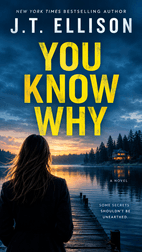
Inside this collection you will find the voices that make You Know Why stick with you long after the final page. There are sharp lines of dialogue, quiet passages of narration, and raw inner monologue from characters who are trying to survive their own choices. Together they give readers a chance to see the story from several angles, and every quote feels like a small window into something bigger.
What makes this novel so quotable is how honest it gets about complicated feelings. It does not soften jealousy, fear, grief, or anger. It also shows the tenderness underneath those feelings, especially when family and love are involved. The language is clean and direct, but the emotions are layered. That combination is why these lines feel easy to remember and hard to shake.
Top Quotes from You Know Why
“We all keep secrets. We all hide our true selves. We move through this life seeking meaning, connection, purpose, and we brush elbows with evil.”
— Eden
Eden warns listeners that evil hides in ordinary life.
It speaks to the unsettling truth that monsters can look like anyone around us.
“We sail through our lives not thinking of the way death lingers, waiting. Perhaps you need to see death to understand how quickly it comes. Fleet footed, self-assured, impossible to avoid. It takes us whether we're ready or not.”
— Brooklyn
Brooklyn is in her dark backyard at night and senses something watching from the woods.
It turns a quiet backyard moment into a meditation on mortality, creating an undertow of unease.
“I hated her, sometimes, yes, with a passion. That didn’t mean I wanted her to stop breathing. I loved her much more than I hated her, though she didn’t necessarily know that. Sisters always have friction. I don’t care what anyone says. You can love someone and still hate them, too.”
— Eden
Eden is thinking about her dead sister Chloe and the bitterness tangled with her grief.
The admission feels human and unsettling at once, exposing the complicated love behind Eden’s obsession.
“Love makes people do the most horrible things.”
Theresa sits alone at home with a beer, remembering crime after crime she has witnessed.
It is a bleak, universal thesis for the book’s intertwined crimes and misplaced devotion.
“Once upon a time, there was a little girl who tried very hard to be good. But there was a darkness inside her, a wilding, and no matter what, she ended up in trouble.”
The chapter’s final section opens as a dark fairy tale about two very different sisters.
The fairy-tale voice gives mythic weight to a damaged woman’s origin story and hints at the tragedy to come.
“He made her cool. He made her popular. He made her, period.”
Chloe watches Andrew look up at her as she descends the stairs, feeling defined by his attention.
The clipped sentences expose how completely her self-worth is tied to being Andrew's girlfriend—poignant and quietly devastating.
Themes Behind the Quotes
One of the strongest threads in these lines is the idea that people are not what they seem. Characters carry secrets, bury their true selves, and brush against darkness while trying to hold on to ordinary lives. The story moves through a world of facades, where marriage can become a trap, safety can vanish, and the people we trust may have pasts they refuse to reveal. That tension between appearance and reality gives the quotes a restless, uneasy energy.
Another major theme is complicated love. The novel looks at the bond between sisters, the fierce protectiveness of mothers, and the ways desire can turn destructive. Grief and loss run just beneath all of it, along with the instinct to keep going for the people left behind. Emotions are not simple. Caring for someone can coexist with anger or resentment, and love can push people toward terrible choices. The quotes are full of that contradiction, and it makes the characters feel achingly human.
Quotes by Chapter
Part 1 - Chapters 1 to 2
“A Charlie Brown Christmas was always her favorite. A holdover from childhood, one of those few things that weren't stripped away by the act of growing up.”
Narration of her Christmas ritual before the violence intrudes on the scene.
It captures the fragile innocence of a tradition that adulthood was supposed to preserve.
“There was no way. He did it. They can't prove it.”
The narration lays out the impossible position of the man suspected after the murders.
The staccato rhythm turns suspicion into an unforgettable verdict.
“Hi. Hello. It’s nice to meet you. My name is Eden.”
— Eden
Eden’s voice directly addresses the audience after the account of her sister’s murder.
The polite, almost friendly opening makes her hidden purpose feel instantly chilling.
Part 2 - Chapters 3 to 9
“It started like so many of the rest, the day my husband disappeared.”
— Brooklyn
Opening the section, Brooklyn recounts the morning before her husband vanished.
It instantly signals that the domestic happiness in the scene is doomed, casting everything that follows in an ominous light.
“Long for the open road. Oh, Trey. You have no idea.”
— Brooklyn
After Trey tells Brooklyn she must long for the open road, she reacts internally.
A sudden private aside that reveals a gap between what Trey believes and what Brooklyn knows, making the reader wonder what she is not saying.
“So many things said in anger, and unsaid in mercy, and then he was gone. A life unfinished. A complete and total waste of an incredible talent.”
— Brooklyn
Brooklyn reflects on the death of the chef Roger Bandolier.
It evokes grief and regret after a sudden death; the final image of wasted talent lingers.
Part 3 - Chapters 10 to 14
“Get on the plane. Remember what I told you. Anything. I love you.”
— Trey
Trey sends this text to Brooklyn after he disappears before they board the Milan flight.
The clipped, cryptic message feels like both a loving goodbye and an ominous warning, deepening the mystery around his vanishing.
“I especially love flying itself, being in the sky above everyone, jetting in and out of the clouds. It reminds me that we are very small, and the world is very big, and the commonalities that we share supersede our differences.”
— Brooklyn
Brooklyn moves through Atlanta’s international terminal and feels the excitement of travel before the trip unravels.
It captures her hopeful, open-hearted worldview, which makes Trey’s sudden disappearance feel even more jarring.
“Helping isn’t altruistic. It's pure, unadulterated survival instinct.”
— Eden
Eden thinks about why she is helping Brooklyn with the children after recognizing Trey as Andrew, the man who murdered her sister.
The line strips away any pretense of kindness and reveals Eden's calculating, survival-driven obsession.
“My sister, dead in the ground, and Andrew Locke out in the world, living, loving, enjoying his life. His freedom. I don’t like that. Not at all.”
— Eden
Eden reflects on the man who killed her sister living freely under a new identity with a new family.
It distills her grief and rage into a chillingly quiet declaration of unresolved justice.
Part 4 - Chapters 15 to 20
“I do not feel safe right now. I feel eyes on me. We're being watched. I don't know why, but I know to trust my gut. It’s time to leave.”
— Brooklyn
Brooklyn has just been unsettled by Eden’s intrusive comments and touch at the airport.
It captures how visceral her alarm is, and it validates her decision to trust instinct over social politeness.
“There are moments, mothering my children, that I long for my own mother—for any mother, really—to take care of me. To hold me and stroke my hair and tell me things will be okay. That nothing scary is under the bed, that the closet is empty, that all will be well.”
— Brooklyn
Brooklyn is sitting with her sleeping children after the chaos at the airport, missing her own mother.
It gives voice to the loneliness underneath her strength, showing a mother who still needs mothering.
“I imagined a hundred different scenarios, him and me, and yes, he died in them all.”
— Eden
Eden reflects on the man she believes murdered her sister and whom she has just seen again.
The word “yes” quietly owns the fantasy, making the vengeance wish both chilling and heartbreaking. It shows how unresolved loss can curdle into obsession.
Part 5 - Chapters 21 to 26
“I am strung wire tight. I will snap if touched wrongly.”
— Brooklyn
Brooklyn tries to relax over dinner in Eden's kitchen after a day of shocks.
It captures her suppressed panic with violent economy.
“I suppose he didn’t tell you he murdered his first wife?”
— Eden
Brooklyn has just asked what else may be hidden, and Eden answers with this.
Its quiet, matter-of-fact delivery makes the accusation land even harder.
“It's not my body, though—it’s my life. I've been sitting still, domesticated, and my husband has created a facade of existence for us all.”
— Brooklyn
Brooklyn processes the accusation that Trey murdered his first wife.
It personalizes the betrayal, turning numbness into a devastating verdict on her married life.
“I have to breathe again for them. They lived inside me. They need me now. I can’t leave them behind.”
— Brooklyn
Brooklyn is fighting off a panic attack outside Eden's house.
Maternal love becomes the literal breath that pulls her back; the short sentences feel urgent.
Part 6 - Chapters 27 to 30
“In one fell swoop, they lost their whole family, their next generation, their dignity, their power, and their moral high ground.”
Theresa drives past the Lockes’ house and thinks about how the family collapsed after Chloe’s murder.
It compresses a family’s total fall from grace into a single merciless sentence.
“Brook, please. I can’t lose you. I can’t lose you, too.”
— Trey
Trey sneaks into the hospital and pleads with the unconscious Brooklyn before forcing himself to leave.
The stumbling repetition and final “too” turn a bedside plea into a cry of accumulated loss.
Part 7 - Chapters 31 to 37
“She is security and safety. I am still a stranger to them.”
— Eden Barrow
Margot arrives at the emergency room and embraces Brooklyn’s children after their mother’s accident.
It captures the comfort the children finally get and Eden’s painful position on the outside.
“When I saw her body lying so still, when I realized what happened, how she'd been punished for her devotion, I knew he would have to be stopped one day.”
— Eden Barrow
Eden remembers her murdered sister Chloe and thinks about Andrew Locke’s danger.
In one long breath, grief hardens into certainty and gives Eden a mission.
“It is unique, this scent. It holds too much in its grip: fear, pain, sorrow.”
Theresa enters the Lockes’ house before dawn and is met by the smell of blood.
The lyrical, almost clinical description gives bodily weight to the horror waiting inside.
“She wants to run—any normal human would run as far away as they could from this, but she’s trained to move toward danger, and she does.”
Theresa pushes deeper into the dark house even though fear tells her to flee.
It draws a clean line between ordinary fear and the trained instinct that makes a cop move forward.
Part 8 - Chapters 38 to 42
“But tonight, he was hers. She would do anything to keep him. Anything he wanted. Anything.”
Chloe is about to go downstairs to Andrew before Grand March, aware that graduation will soon take him away.
Captures Chloe's desperate belief that one perfect night can outweigh the future she is about to lose.