Work With The Best Quotes
by Jay Yang
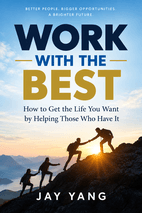
These quotes from Jay Yang's Work With The Best are for anyone who wants a career built on intention rather than luck. You'll find ideas about finding mentors, doing useful work before being asked, and aiming at a clear target. Some lines are blunt, some are practical, and some sound like advice you'd get from a friend who has already made the mistakes.
Yang is quotable because he keeps things simple. He turns vague ambition into steps you can act on, then adds enough edge to make you pause. The best lines here are short, direct, and easy to carry into a meeting, a job search, or a quiet moment when you're deciding what to do next.
Top Quotes from Work With The Best
“Everyone knows that it’s not what you know; it's who you know. What no one teaches is the how.”
The author introduces the book's focus on relationships and access.
It names the hidden barrier: everyone knows relationships matter, but few are taught how to build them.
“I identified the person I wanted to work with, figured out what they needed, did the work before anyone asked me to, and put it in front of them.”
The author distills the common approach behind every opportunity he landed.
It turns networking into a repeatable act of service: identify, understand, create, and deliver.
“You can be the most talented person in the world, but if no one knows you exist, it doesn’t matter.”
The author introduces Part Three on delivering value.
It reminds readers that talent alone is insufficient without visibility.
“Skill produces enjoyment. Enjoyment produces consistency. Consistency produces mastery. And mastery eventually produces both money and fulfillment.”
The author describes the compounding loop that starts with natural skill.
It offers a practical chain from skill to fulfillment, making passion a result rather than a prerequisite.
“The market rewards what is both rare and valuable.”
The author explains why the market pays more for some skills than others.
It distills the core economic logic of becoming undeniable: value alone is not enough; scarcity matters too.
“You don’t rise to the level of your potential. You fall to the level of your environment.”
It appears after the section on how expectations and environments shape performance.
It flips the usual focus on individual potential and emphasizes that environment often pulls people up or down.
“The discomfort of being the least experienced person in a new room is infinitely more valuable than the comfort of being the most experienced person in the wrong one.”
It appears in the discussion of Strategic Stress and choosing rooms that force growth.
It makes the cost of staying comfortable vivid and argues that growth requires being in rooms where you are not the best.
Themes Behind the Quotes
A big theme is taking ownership. Instead of waiting for permission or applying like everyone else, the book pushes you to choose a target, study the people who are already there, and create proof that you can help. It also stresses direction and limits, because ambition without a clear destination or personal boundaries can lead you somewhere you never wanted to be.
Another thread is compounding advantage. Skills, enjoyment, consistency, and mastery feed one another, while rare combinations make you harder to replace. The quotes also emphasize learning from experts, treating experiments as information, and choosing environments that stretch you. Success is framed less as a single win and more as a long game shaped by the rooms you enter and the standards you keep.
Quotes by Chapter
Introduction
“I didn’t apply through a job portal. I didn’t wait for someone to post an opening. I didn’t send my resume into a pile of thousands and hope for the best (in fact, I didn’t even have a resume).”
The author contrasts his unconventional path with a standard job search.
It rejects passive applications and champions initiative, making the reader feel agency.
1. Chapter 1: Define Your North Star
“The Cheshire cat says, “Then it doesn’t matter. If you don’t know where you want to go, any path will take you there.””
The author recounts the Cheshire Cat’s reply to Alice at a fork in the road.
It captures the cost of not defining your direction: without a destination, every choice is equally empty. The line makes vague ambition feel obviously dangerous.
“At the risk of stating the obvious, it's hard to hit a target you can’t see, yet many people are so busy being “productive” that they never actually get what they want.”
The author explains why busyness is not the same as intentional progress.
It names the trap of motion without direction. Readers recognize themselves in the gap between productivity and actually getting what they want.
“The value isn't in the answer. It's in the habit of reflecting.”
The author sets expectations before the North Star exercise.
It removes the pressure to find a perfect life plan and reframes clarity as a practice. That makes reflection feel sustainable rather than overwhelming.
“If you can only describe a life you'd love on Friday nights and vacations, you haven't designed a life, you've designed an escape.”
The author explains why the North Star exercise asks about an ordinary Tuesday.
It sharply distinguishes a real, daily life from a fantasy you flee toward. The contrast makes ordinary-day design feel urgent.
2. Chapter 2: Avoid The Pyrrhic Victory
“A Pyrrhic victory is what happens when the cost of winning exceeds the value of what you won.”
The author defines the chapter's central concept after telling the story of Pyrrhus of Epirus.
It gives a crisp name to the hidden cost of success. Readers can instantly apply it to careers, relationships, and ambition.
“Goals without boundaries are not just incomplete, they're dangerous.”
The author warns after giving examples of people who hit their targets but sacrificed too much.
It reframes boundaries as essential rather than restrictive. The line is short, punchy, and hard to forget.
“Call me soft, but I think defining the limits of your ambition is one of the most ambitious things you can do.”
The author makes this counterintuitive claim while discussing boundary-setting.
It flips the usual idea of ambition on its head. It suggests that self-limitation can be a strength, not weakness.
“Your North Star tells you where you want to go. But you also need a South Pole, a clear picture of where you refuse to end up.”
The author introduces a mental model for balancing goals and limits.
It turns abstract boundary-setting into a vivid directional metaphor. The North Star/South Pole pairing makes the idea memorable and usable.
3. Chapter 3: Find Your Unfair Advantage
“There's a point, around the age of twenty, when you have to choose whether to be like everybody else the rest of your life, or to make a virtue of your peculiarities.”
Ursula K. Le Guin's quote opens the chapter.
It frames the chapter's core choice: conform or turn your quirks into an advantage.
“You can't beat people at their own game. If you want to win, you have to play yours.”
The author reaches this conclusion after meeting exceptionally ambitious founders in San Francisco.
It captures the book's differentiation principle: don't compete on someone else's strengths.
“Passion without ability is a hobby. Don't confuse it with your unfair advantage.”
The author contrasts genuine unfair advantage with mere passion.
It cuts through romantic advice and reminds readers that aptitude matters.
4. Chapter 4: Reverse Engineer The Greats
“No, that's inaccurate. I learned everything from Sol Price.”
Jim Sinegal corrects a reporter who suggested he learned a lot from Sol Price.
It reveals the hidden mentor behind two retail giants and the value of total immersion in a teacher. It shows humility and depth can build enormous success.
“Instead of banging their head against the wall trying to learn everything from scratch, they found someone who had already solved the problem and reverse-engineered how they did it.”
The author describes how highly successful people avoid learning everything from scratch.
It provides the chapter's core shortcut: find solved problems and reverse-engineer them. It encourages proactive study over isolated trial and error.
“In my whole life, I have known no wise people, over a broad subject matter area, who didn’t read all the time. None. Zero. You'd be amazed at how much Warren reads, and at how much I read. My children laugh at me. They think I'm a book with a couple of legs sticking out.”
Charlie Munger explains the reading habits of wise people and describes himself and Warren Buffett.
It makes reading feel non-negotiable for wisdom and success. The humor about being a book with legs makes the habit memorable.
“The greats left us a map. The only question is: will you use it?”
The author ends the chapter by challenging readers to use the examples of history's greats.
It turns the chapter into a personal decision rather than an abstract lesson. The metaphor is simple, urgent, and memorable.
5. Chapter 5: Act Like A Mad Scientist
“I have no data yet. It is a capital mistake to theorize before one has data. Insensibly one begins to twist facts to suit theories, instead of theories to suit facts.”
Sherlock Holmes in the chapter-opening epigraph from A Scandal in Bohemia.
It warns against theorizing without evidence and frames experimentation as the way to avoid self-deception. The line feels timeless because it applies to careers, decisions, and life tests.
“A person who thinks all the time has nothing to think about except thoughts. So, he loses touch with reality and lives in a world of illusions.”
The author quotes philosopher Alan Watts while explaining why action and data matter.
It captures the trap of endless analysis and the need to engage with reality. It makes experimentation feel like a cure for overthinking.
“When a scientist runs an experiment and the hypothesis is wrong, that's not a failure. It's information. A data point. It tells them something they didn’t know before, which makes the next experiment better.”
The author reframes failure through the mad-scientist metaphor.
It turns mistakes into useful feedback and lowers the emotional cost of trying. Readers can use it to keep experimenting instead of fearing wrong turns.
“That's how I want you to approach your life. Every side project, job application, and conversation you have with someone in a field you're curious about... it’s all an experiment.”
The author applies the mad-scientist mindset to everyday career exploration.
It makes an intimidating life direction feel like a series of low-stakes tests. The line invites readers to act and learn rather than wait for certainty.
6. Chapter 6: Become Undeniable
“Your goal isn't to be the best in the world at one thing; it's to be great at a few complementary things that, in combination, make you extremely hard to replace.”
From the section on skill stacking and becoming hard to replace.
It reframes mastery as combinatory rather than singular, giving readers a practical path to leverage.
“The only real failure is never picking at all.”
The author urges readers to commit to one skill instead of endlessly researching.
It removes the fear of a wrong choice and emphasizes that action, not perfection, is the real requirement.
“The most successful people I know don’t view work-life balance in days; they view it in decades.”
From the Obsession Arc section about short-term imbalance for long-term gain.
It challenges the daily balance mindset and encourages patience through intense seasons of work.