Why We Get Sick Quotes
by Benjamin Bikman
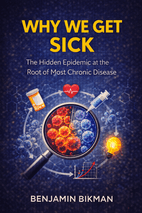
Here you will find the most striking lines from Benjamin Bikman's Why We Get Sick. These quotes zero in on insulin resistance as the hidden driver behind so many modern ailments, from dementia to fatty liver. What makes the book so quotable is how it transforms dense science into clear, memorable ideas. The sentences are direct, often surprising, and built to stick in your mind.
The quotes you are about to read challenge the usual story about health and disease. They give you a new lens to see problems like obesity, diabetes, and heart disease. Whether it is a bold metaphor or a startling statistic, each line is meant to be shared and remembered.
Top Quotes from Why We Get Sick
“NSULIN RESISTANCE is the epidemic you may have never heard of.”
Opening line of Chapter 1, introducing the concept of insulin resistance.
This line immediately grabs the reader's attention by highlighting a widespread yet unrecognized health crisis, setting the stage for the entire chapter.
“In the “story” of insulin resistance and diabetes, we've been treating glucose as the main character, but it’s really the sidekick.”
Author discussing the historical misdirection of focusing on glucose instead of insulin.
The metaphor is memorable and effectively reframes the reader's understanding, making a complex scientific point intuitively clear.
“What's becoming increasingly clear, however, is the remarkable contribution of insulin resistance to the disease—it's so relevant that it has given rise to a new term for Alzheimer's: “type 3 diabetes.””
This appears in the section 'A New Understanding of Alzheimer's' as the author summarizes the link between insulin resistance and Alzheimer's disease.
The phrase 'type 3 diabetes' is a powerful, memorable label that reframes Alzheimer's as a metabolic disorder, challenging traditional views. It gives readers a new lens for understanding the disease's origins and potential treatments.
“That's right—your fasting insulin carries a stronger statistical significance than your age!”
This is from the Finnish risk factor study for Alzheimer's, after listing statistical p-values for various variables.
The exclamation and direct address make the finding startling and empowering, suggesting that a controllable biomarker matters more than an unchangeable factor like age. It inspires readers to pay attention to their insulin levels.
“If female fertility is a complicated orchestra of hormones, insulin is the conductor.”
The author summarizes insulin's central role in female fertility while discussing fertility treatments.
The orchestral metaphor makes the complex hormonal interplay immediately understandable and memorable, emphasizing insulin's leadership.
“Still, one critical fact that supports this theory is that the longest-living humans are also the most insulin sensitive—true even after controlling for seemingly obvious variables, including body mass and sex.”
This is stated while discussing the insulin resistance theory of aging and its evidence in humans.
It provides a compelling, data-backed link between insulin sensitivity and longevity, challenging common assumptions and offering a hopeful avenue for intervention.
“Fructose is similar to alcohol, but without the hangover.”
The author comparing fructose metabolism to alcohol metabolism.
A succinct and memorable analogy that reveals how fructose can be just as damaging to the liver as alcohol. It sticks in the mind and reframes the perception of a common sweetener.
Themes Behind the Quotes
A central theme running through these quotes is that insulin resistance is the overlooked foundation of many chronic diseases. The book reframes common health issues by pointing to hyperinsulinemia and insulin resistance as the real culprits, not just blood sugar. It connects conditions as varied as migraines, infertility, and Alzheimer's to this single metabolic problem.
Another major theme is the need to challenge medical assumptions. The author argues that we have been looking at diabetes and other conditions the wrong way, focusing on glucose instead of insulin. The quotes also emphasize that insulin sensitivity is a marker of longevity and health. They reveal how lifestyle choices, like diet and medication use, directly affect insulin levels and overall disease risk.
Quotes by Chapter
Foreword by Dr. Jason Fung
“You’re about to learn that a lot of it comes down to one root cause: insulin resistance and hyperinsulinemia (meaning too much insulin in the blood).”
Dr. Jason Fung, in the Foreword, introduces the central thesis of Why We Get Sick.
This sentence crisply defines the book's core argument, giving readers a clear, memorable anchor for the entire discussion.
“As Dr. Benjamin Bikman explains in Why We Get Sick, we need to be looking at insulin; insulin resistance is a precursor to diabetes and is implicated in many other conditions.”
Dr. Fung explains the book's shift in focus from blood glucose to insulin.
It reframes a common medical perspective, making insulin resistance the key target for preventing multiple chronic diseases.
“Insulin emerges as a key player in many of the diseases that, unfortunately, are becoming remarkably common, from migraine headaches to fatty liver disease, high blood pressure, and dementia.”
Dr. Fung summarizes the wide-ranging impact of insulin resistance as revealed in the book.
By listing diverse conditions, it underscores the surprising and sobering reach of a single hormone, making the problem feel personal and urgent.
“Yes, insulin resistance may be “the epidemic you may have never heard of.” But if we're to curb our rising rates of obesity, diabetes, Alzheimer's, heart disease, and more, it's time for a closer look at insulin ... and to recognize that the key to good health is already in your hands.”
Dr. Fung concludes the Foreword with a call to action.
This quote combines a warning with empowerment, motivating readers to take control of their health through understanding insulin.
Chapter 1: What Is Insulin Resistance?
“My single greatest frustration is also the reason so many people with insulin resistance are undiagnosed—we look at it wrong.”
Author expressing personal frustration about the diagnostic approach to insulin resistance.
This line conveys authentic emotion and underscores the core problem, compelling readers to reconsider conventional medical thinking.
“In other words, any time you hear someone speaking about the evils of diabetes, you can just substitute in “insulin resistance” and it’s immediately more accurate.”
Author summarizing the relationship between type 2 diabetes and insulin resistance.
It provides a simple, actionable reframe that empowers readers to think more precisely about chronic disease, turning a vague concept into a clear target.
Chapter 2: Heart Health
“Those with cardiovascular disease not identified with diabetes [i.e. insulin resistance] are simply undiagnosed.”
The author quotes physician-scientist Joseph Kraft, who devoted his career to understanding insulin resistance.
This line powerfully asserts that insulin resistance is a hidden driver of heart disease, challenging the common medical view and making readers question whether they or their doctors are missing the real cause.
“It is the puzzle—insulin resistance and cardiovascular disorders are almost inseparable.”
The author argues that insulin resistance is not just a piece of the heart disease puzzle but the central one.
The metaphor of a puzzle and the word 'inseparable' emphasize the profound, overlooked link between a common metabolic condition and the world's leading cause of death.
“N the insulin- resistant state, the body has artificially elevated levels of aldosterone. When such a person eats salt, the kidneys disobey normal physiology by retaining salt rather than excreting it along with water.”
The chapter explains how insulin resistance leads to salt sensitivity and high blood pressure.
This vivid description helps readers understand a counterintuitive mechanism—why some people react badly to salt—and personalizes the danger of insulin resistance to a common dietary factor.
“Postmenopausal women who take statins may increase their risk of developing type 2 diabetes by up to 50%.”
The author discusses side effects of statins and their relationship to insulin resistance.
This startling statistic challenges the blanket use of a common drug, forcing readers to weigh the trade-offs between heart disease prevention and a major metabolic risk.
Chapter 3: The Brain and Neurological Disorders
“A recent study found that for every 10 years of insulin resistance, the brain looks two years older than the brain of an insulin-sensitive person of the same age.”
This comes from the opening discussion on how prolonged insulin resistance physically alters brain structure.
The quantitative comparison makes the abstract concept of brain aging concrete and alarming, driving home the personal stakes of insulin resistance. It resonates because it connects a modifiable lifestyle factor to cognitive decline in a vivid, relatable way.
“Bottom line: A healthy brain requires healthy insulin sensitivity.”
This sentence concludes the chapter, summarizing the core message about insulin and brain health.
Its brevity and clarity make it an easily remembered takeaway that encapsulates the entire chapter's argument. It serves as a call to action, emphasizing the critical role of metabolic health in neurological function.
Chapter 4: Reproductive Health
“After all, reproducing is risky business! It wouldn't be prudent to bring off-spring into a dangerous or unhealthy situation, such as a period of starvation.”
The author explains why insulin acts as a metabolic safety signal for reproduction.
This line vividly captures the evolutionary logic linking energy status to fertility, making a complex concept both memorable and intuitive.
“Pregnancy is one of very few instances where insulin resistance appears to be a normal and even helpful event.”
From the discussion of physiological insulin resistance during pregnancy.
It challenges the common negative perception of insulin resistance by highlighting a natural, beneficial context, which is both surprising and instructive.
“Yes, it’s true— infants born below the normal weight are the most likely to become obese and insulin resistant.”
From the section on over- and underweight babies and long-term metabolic consequences.
This paradoxical statement underscores the profound and lasting impact of early metabolic environment, compelling readers to rethink assumptions about birth weight.
Chapter 5: Cancer
“Despite over $160 billion being spent per year to cure cancer in the US, with a global economic burden of roughly $1.2 trillion, ever more people are dying. Clearly, this investment isn’t paying off.”
The author introduces the enormous financial cost of cancer treatment and research.
This line starkly contrasts massive spending with worsening outcomes, delivering a powerful indictment of the current approach to cancer.
“Perhaps cancer isn’t a disease of genetics, but rather of metabolism.”
The author challenges the prevailing genetic mutation theory of cancer.
It is a bold, paradigm-shifting statement that provokes readers to reconsider the fundamental nature of the disease.
“Cancer is a terrifying disease, partly due to its seeming randomness; healthy people who “do everything right” can still get cancer, while some lifelong smokers get nothing.”
Acknowledging the frustrating unpredictability of cancer onset.
This resonates deeply because it validates a common fear and highlights the injustice of the disease, while setting up the argument for controllable factors like insulin resistance.
Chapter 6: Aging, the Skin, Muscles, and Bones
“At its simplest, aging is the sum consequence of our cells losing the ability to replenish themselves, which translates to our organs and, ultimately, our entire body not working like it once did.”
This appears early in the chapter as the author introduces a basic definition of aging.
It distills the complex process of aging into a clear, cellular-level explanation that is both scientifically grounded and personally relatable.
“So much of what we've discussed is devoted to highlighting the serious and potentially life-threatening consequences of insulin resistance. While those deserve attention, they're also hard to see—you can’t see plaques developing in your brain or your blood pressure climbing, but you can see changes in your skin.”
This appears at the end of the skin section, summarizing why skin changes are a visible warning sign.
It powerfully contrasts invisible internal damage with visible skin changes, making the abstract concept of insulin resistance tangible and motivating readers to pay attention to their body's signals.
“The most common—and most overlooked—cause of vertigo is a disorder of glucose metabolism.”
This is a quote from Dr. William Updegraff, a prominent otolaryngologist, cited in the section on hearing loss and insulin resistance.
It is a bold, authoritative statement that reframes a common age-related complaint as a metabolic issue, encouraging readers to consider insulin resistance as a root cause.
Chapter 7: Gastrointestinal and Kidney Health
“This is utterly remarkable: A disease that was practically unheard of 30 years ago is now the most common liver disorder in Western countries.”
The author describing the rise of nonalcoholic fatty liver disease.
Highlights the shocking speed at which a once-rare disease became commonplace due to insulin resistance. It makes the reader realize how dramatically modern lifestyles have changed our health.
“Being insulin resistant is the strongest known predictor of developing NAFLD, increasing the risk of having it by 15 times compared with an insulin-sensitive person.”
The author stating the strong link between insulin resistance and nonalcoholic fatty liver disease.
Provides a striking statistic that underscores the critical role of insulin resistance in liver disease. It emphasizes how powerful a risk factor insulin resistance is, independent of weight.