We Are as Gods Quotes
by Peter H. Diamandis
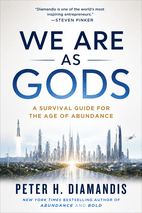
This collection brings together the most striking lines from Peter Diamandis's book. You'll find sharp observations about technology, abundance, and human nature. The book is packed with lines that make you stop and think, often with a mix of optimism and caution.
What makes these quotes so shareable is their ability to capture big ideas in a few words. They challenge how we see the future and our role in it. Whether you agree or disagree, each quote sparks a conversation.
Top Quotes from We Are as Gods
“The blind can now see. The paralyzed can walk. While no one has yet multiplied loaves and fishes to feed the hungry, we can now grow fish from stem cells to accomplish the same miracle of provision.”
The author summarizing modern technological achievements that parallel biblical miracles.
This line powerfully connects ancient religious miracles to real-world scientific progress, making the abstract concept of 'godlike' tangible and concrete.
“We don’t call these miracles. We call them Tuesday.”
End of a list of everyday technological acts that would have been considered miracles.
It starkly highlights the normalization of extraordinary technology, a central theme of the chapter about losing awe in the face of abundance.
“If we are literally walking the earth in an age of miracles, how come we don’t feel divine?”
After describing the everyday miracles we perform with technology.
This rhetorical question captures the cognitive dissonance between our immense power and our ordinary experience, driving the book's exploration of perception and analogy.
“We have Paleolithic emotions, medieval institutions, and godlike technology.”
Biologist E. O. Wilson's observation on humanity's predicament, quoted in the chapter.
This line starkly summarizes the core tension of the modern age—our ancient wiring struggles to manage immensely powerful tools. It's both a diagnosis and a warning that resonates across disciplines.
“The future is here, it's just not evenly distributed.”
Science fiction writer William Gibson's quote used to illustrate the unequal distribution of food abundance.
This classic line perfectly captures the paradox of abundance in one sentence—the coexistence of progress and deprivation. Its brevity and truth make it endlessly quotable.
“Our planet is hemorrhaging species at a rate not seen since an asteroid wiped out the dinosaurs. This time, the asteroid is us.”
The authors describe the ongoing mass extinction caused by human activity.
This metaphor powerfully conveys that humans, not an asteroid, are the driving force behind the current extinction crisis, making the threat feel immediate and self-inflicted.
“We're not rag dolls in raging winds of change. We are the raging winds of change.”
Author asserting human responsibility for AI and existential threats.
A powerful reclamation of power and identity, transforming passive victimhood into active creation.
Themes Behind the Quotes
One major theme is the gap between our technological capabilities and our emotional or institutional readiness. The book suggests we have godlike tools but still think and organize ourselves in outdated ways. Another theme is the redefinition of abundance: not as unlimited goods, but as access to capabilities that were once exclusive to the wealthy. This shift challenges traditional ideas of wealth and progress.
A third theme is agency and responsibility. The quotes repeatedly urge readers to see themselves as creators of the future, not passive victims. There is also a strong emphasis on collaboration, especially between humans and artificial intelligence, as the path forward. The book balances excitement about breakthroughs with a clear-eyed look at the risks, from job displacement to ecological collapse.
Quotes by Chapter
Chapter One: Theogony
“Technology has caught up to mythology, but we've misplaced the experience of awe.”
The opening of the chapter, setting up the central theme.
It captures the paradox of modern techno-miracles that have lost their power to inspire wonder, a core tension explored throughout the book.
Chapter Two: An Abundance of Abundance
“Technology is a resource-liberating mechanism. It transforms scarcity into abundance through accessibility.”
The authors describe the core function of technology.
This succinctly defines the central thesis of the chapter and frames technology as a tool for liberation, resonating with readers who see tech as empowering.
“If we use access to capability and not income as a metric for wealth, then nearly seven billion people became multimillionaires over the past decade.”
The authors reframe wealth based on technological capability.
This reframes wealth in a modern, inclusive way, highlighting the massive value created by smartphones and digital access, challenging traditional economic metrics.
“Abundance is a double-edged sword. There’s a vast upside and a very real downside.”
The authors acknowledge the negative consequences of abundance.
It captures the nuanced perspective of the book, acknowledging both the promise and the peril of technological progress, making the argument more credible and relatable.
“What once required a fortune is now a feature.”
From the Demonetization section, describing how communication costs have plummeted.
It's a succinct, memorable line that captures the essence of demonetization—turning expensive necessities into free features.
Chapter Three: Data-Driven Optimism
“If that doesn’t redefine the limits of impossible, what does?”
The author asks this rhetorical question after citing Zipline's halving of maternal deaths.
It challenges readers to re-evaluate their assumptions about progress and the power of individual entrepreneurs to achieve the seemingly impossible.
“We need complete overhaul of how we feed the planet.”
The author states this after presenting data on food insecurity and the unsustainability of current meat production.
It delivers a clear, urgent call to action, emphasizing that incremental change is insufficient for the scale of the global food crisis.
“Khanmigo doesn’t answer questions. Its anti-cheating feature refuses to give solutions, instead asking probing follow-ups that encourage curiosity and critical thinking.”
Describing the AI tutor Khanmigo integrated into Khan Academy.
It highlights a revolutionary shift in education—using AI not to spoon-feed answers but to cultivate genuine learning and problem-solving skills.
“The real story isn’t any single breakthrough; it's the velocity of change itself.”
The author introduces the chapter's theme of rapid technological progress across sectors.
This line encapsulates the central thesis that the speed of innovation matters more than individual achievements, inspiring a sense of momentum.
Chapter Four: One Billion Times Smarter
“If the rate of change continues, I think 2029, or maybe 2030, is when digital intelligence will probably exceed all human intelligence, combined.”
Elon Musk, speaking as a surprise guest at Peter's 2024 Abundance360 summit via Starlink from his plane.
This bold prediction from a tech visionary crystallizes the accelerating pace of AI and the imminent possibility of superintelligence, sparking both awe and anxiety about the future.
“Al isn’t just another tool in the exponential toolbox. It's now the architect of that toolbox.”
The author's commentary on AI's role as the central driver of technological progress in the age of abundance.
This concise, powerful metaphor reframes AI from a mere instrument to the master builder of future innovation, emphasizing its foundational and transformative influence.
“Instead of containing them or enslaving them, we should be aiming higher: we should aim not to need to contain them at all. The best way to raise wonderful children is to be a wonderful parent.”
Mo Gawdat, former chief business officer for Google and author of Scary Smart, argues for raising AI with kindness rather than controlling it.
This line reframes the AI safety debate from a technical containment problem to an ethical parenting challenge, urging humanity to model the values we want machines to learn.
“Al holds a mirror to humanity—that's the scary truth.”
The author reflects on how AI's behavior and values are shaped by observing human actions and biases.
This stark metaphor captures both the discomfort and the opportunity of AI development: our creations will ultimately reflect our own flaws and virtues back at us.
Chapter Five: Surfing the Tsunami
“Today, you're either on the innovation bus or under the innovation bus.”
Dean Kamen's saying about the need to embrace innovation, as quoted by the authors.
It's a memorable, binary metaphor that captures the urgency and inevitability of technological change.
“Every burst in speciation brings with it extinction. The new wipes out the old, and studies show that 47 percent of US jobs could be automated by 2030, which sure sounds like a lot of extinction.”
The author discussing the potential job displacement from robotics and automation.
It starkly frames the dual nature of technological progress—creation and destruction—and forces readers to confront the scale of change.
“If robots are taking on the dull, dirty, and dangerous, what remains are the creative frontiers—the work that draws on what is most distinctly human.”
The author's reflection on the future of work amid automation.
It offers an optimistic vision of human purpose and creativity as the enduring value in an automated world.
“By 2030, robots may take your job unloading trucks, cleaning offices, or stocking shelves, but then you'll be free to pursue your childhood dream of becoming an ‘artificial womb engineer.”
The author reframing job automation as an opportunity for novel careers.
It uses humor and a specific, futuristic job title to challenge fear of automation and open imagination to new possibilities.
Chapter Six: The Dark Side of Abundance
“Welcome to paradise, where the future isn’t just better than you think. It’s more complicated than you might imagine.”
The author's concluding thought in the opening section about the dark side of abundance.
It reframes the narrative of progress with a dose of realism, reminding readers that abundance brings complexity. The ironic tone makes it memorable and quotable.
Chapter Seven: Mind 2.0
“The moment we start believing the future is happening to us rather than being created by us, we surrender agency.”
Author explaining the cost of adopting an external locus of control in a rapidly changing world.
This line crystallizes the book's core argument: agency is a choice, and giving it away is the first step toward helplessness.
“Even the gods had to learn foresight, restraint, and collaboration.”
Author reflecting on myths to illustrate that wisdom must be practiced.
Humbles the human ambition of godlike powers and reminds us that mastery requires growth, not entitlement.
“Mindsets are the operating systems that stabilize how we think and behave.”
The author introduces the concept of mindsets as foundational frameworks for navigating change.
This metaphor vividly captures how deeply ingrained mental models shape our perception and behavior, making it instantly relatable and memorable.
Chapter Eight: The Androids Are Us
“We need technology to absorb the responsibility.”
Opening of the chapter, describing why mental architecture must evolve.
This line crisply captures the book's central argument that technology must bridge the gap between slow biology and accelerating change.
“The solution lies in collaboration: humans plus AI— a hybrid-model known as the centaur.”
After contrasting human-versus-AI framing, introducing the centaur model.
It encapsulates the core thesis that partnership, not competition, with AI is the path forward.