We Are as Gods: A Survival Guide for the Age of Abundance Key Takeaways
by Diamandis, Peter H.
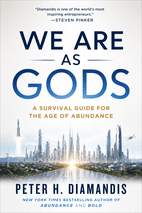
5 Main Takeaways from We Are as Gods: A Survival Guide for the Age of Abundance
Your brain is wired for scarcity, not exponential abundance
Our ancient prediction engine is overwhelmed by today's pace, causing dread and burnout. We must reclaim attention and retrain our minds to navigate the age of abundance.
Technology is making everything cheaper, smaller, and accessible
Demonetization, dematerialization, and democratization create a feedback loop driving abundance—from free communication to AI tools, enabling more minds to innovate.
Exponential breakthroughs are already reshaping food, energy, health, and education
Examples like Perennial Rice, super cows, EVs, CRISPR, and AI tutoring show compounding progress toward a systemic shift from scarcity to exponential abundance.
AI is our greatest threat and best hope—align it with human values now
The AGI arms race demands urgent ethical frameworks; AI's IQ is soaring, but bias, privacy, and existential risk require careful design before it becomes embedded in daily life.
Upgrade your mind with flow, curiosity, and neurotech to thrive in chaos
Five core mindsets stabilize purpose; flow triggers train lateral thinking; neurotech can accelerate enlightenment and compassion, enabling human-machine collaboration.
Executive Analysis
These five takeaways form a cohesive argument: humanity has created unprecedented technological power (abundance) but our cognitive hardware is obsolete, leading to crises of perception, inequality, and existential risk. The book argues that the same exponential forces causing problems can solve them, but only if we consciously evolve our mindsets and adopt neurotechnologies to bridge the gap.
This book matters because it offers a practical survival guide for individuals and leaders navigating an accelerating world. It sits in the futurism/tech optimism genre alongside works by Kurzweil and Kelly, but uniquely emphasizes cognitive training and neurotech as the missing link. Its impact lies in shifting readers from dread to purposeful action.
Chapter-by-Chapter Key Takeaways
Theogony (Chapter 1)
Awe has been replaced by dread; the real crisis is in our brains, not just in our culture.
The brain's prediction engine is mismatched with today's global, exponential pace of change.
Information overload physically rewires the nervous system, causing burnout and depression.
Cognitive biases layer into a cascade that distorts reality, making us blind to the extraordinary.
The path forward requires reclaiming attention and learning to use our godlike powers with purpose.
Try this: Practice daily attention audits—track your screen time and news consumption to rewire your brain away from dread and toward purposeful focus.
An Abundance of Abundance (Chapter 2)
Demonetization strips cost from core services: communication, computing, energy, education, and healthcare became radically cheaper, often free.
Dematerialization eliminates physical bulk: devices and infrastructure vanish into multi-purpose tools and cloud services, reducing resource use and increasing access.
Democratization makes powerful technologies available to everyone: AI, smartphones, internet, and the tools of abundance are no longer reserved for the wealthy.
The three stages form a feedback loop: lower costs + less physicality + wider access = more minds contributing to innovation, which accelerates abundance further.
Try this: Identify one area of your life where you can leverage a free or low-cost digital tool that was previously expensive, and integrate it into your routine.
Data-Driven Optimism (Chapter 3)
Perennial Rice PR23 doubles yields, cuts labor by 60%, and increases farmer profits by 161%—a scalable, non-GMO solution to agricultural and climate crises.
Super cows cloned in Hong Kong produce 70% more milk; smart farming with AI and drones has slashed water use and boosted crop productivity by over 25%.
Over 50 million EVs on the road; autonomous taxis and trucks are operational; flying cars (eVTOLs) are nearing commercial reality with a potential $9 trillion market.
CRISPR therapies are FDA-approved; stem cell treatments can reverse Parkinson’s symptoms; portable diagnostics broaden healthcare access.
250 million more children in primary school since 2010; AI tutoring reaches 200 million students; global literacy at 87%.
The true power is the compounding effect of these innovations across all sectors—a systemic shift from scarcity to exponential abundance.
Try this: Research one exponential technology in your field and commit to a small experiment or pilot project this quarter to experience its compounding potential.
One Billion Times Smarter (Chapter 4)
The debate over AGI timing is secondary to the arms race toward superintelligence, which demands urgent ethical frameworks.
Mo Gawdat proposes "raising" AI with kindness, while Bostrom and Russell advocate for containment and provable beneficence—different strategies for the same existential risk.
AI agents are quickly evolving from passive tools to proactive companions, embedding emotional intelligence into daily life across industries.
The blistering pace of IQ gains in AI models (from 101 to 148 in under two years) suggests we are already crossing into super-genius territory.
Ethical challenges—privacy, bias, accountability—are inseparable from the design choices we make now, especially as AI becomes embedded in consumer devices and children's toys.
Try this: When using any AI tool, actively question its ethical boundaries: set personal guidelines for privacy, bias, and accountability before relying on its outputs.
Next chapter: “The Dark Side of Abundance” is locked
Keep learning from We Are as Gods: A Survival Guide for the Age of Abundance — and unlock all 700+ book summaries with audio, mindmaps and AI Q&A.
$0.00 due today · 7 days free, then $89.99/year ($7.49/mo) · Cancel anytime before day 7
plus sales tax where applicable