Unstressable Key Takeaways
by Mo Gawdat
As an Amazon Associate, we earn from qualifying purchases.
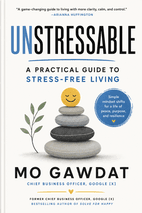
5 Main Takeaways from Unstressable
Stress Comes From Your Response, Not Life's Events
Mo Gawdat emphasizes that you have ultimate accountability over your stress. Instead of blaming external circumstances, recognize that your reaction is where the real work begins—this shift in perspective is the foundation of becoming unstressable.
Master the Three Ls: Limit, Learn, Listen
Repeat these three actions until they become second nature: Limit what drains you, Learn from every experience, and Listen to the languages of your mind, heart, body, and soul. They form a practical cycle that prevents burnout and builds resilience.
Address Stress in All Four Layers (MEPS)
Stress infiltrates your mental, emotional, physical, and spiritual layers. If you ignore any one, it reinfects the others. To truly resolve stress, you must learn each layer's unique language—mind exaggerates, heart blends emotions, body signals clearly, and soul whispers in intuition.
Visualize Positive Outcomes and Limit Media Intake
Train your brain by visualizing solutions all the way to a good ending, not just problems. Also, drastically reduce news consumption—most of it lies outside your control. Focus your attention on your Circle of Influence to stop unnecessary mental agitation.
Connect with Your Soul Through Daily Silence
Build an active relationship with your soul by practicing daily silence and learning to discern its whisper from your ego's fear. Act on that inner knowing even when it seems illogical. This alignment with your deeper self transforms stress into a manageable process you can choose to redirect.
Executive Analysis
These five takeaways form a coherent system: stress is not an external force but an internal response you can retrain. The book starts with the foundational insight of personal accountability, then provides a practical cycle (Limit, Learn, Listen) and a multi-layer framework (MEPS) to catch stress at every level. Specific tactics like visualization, media limitation, and soul connection offer daily tools, while the emphasis on practice over theory ensures the lessons become ingrained habits. Together, they shift the reader from passive sufferer to active architect of their own calm.
"Unstressable" matters because it bridges ancient wisdom (soul, intuition) with modern cognitive science (visualization, media detox) in a relentlessly actionable way. In a genre crowded with mindfulness platitudes, Gawdat delivers a structured, four-layer protocol that addresses the whole person—not just the mind. Its practical impact is immediate: readers can start applying the Three Ls today, and the emphasis on accountability and practice makes it a lasting resource rather than a quick fix. It sits alongside works like 'The Happiness Trap' and 'The Power of Now' but stands out for its systematic, no-nonsense approach to stress as a learnable skill.
Chapter-by-Chapter Key Takeaways
1. Welcome to the Machine (Chapter 1)
Practice builds skill, not just reading advice—commit to the exercises.
The third L, Listen, means learning the languages of your mind, heart, body, and soul.
Each part of you communicates stress differently; misinterpreting or ignoring them leads to burnout.
Repeat the three Ls (Limit, Learn, Listen) until they become habitual.
Ultimately, it’s your accountability: stress comes from your response, not from life’s events.
Try this: Commit to practicing one stress-reduction exercise each day for two weeks, treating it like building a muscle, and consciously repeat the three Ls (Limit, Learn, Listen) whenever you feel overwhelmed to turn them into automatic habits.
3. Carrying That TONN (Chapter 3)
Skills require practice, not just intellectual understanding—knowledge alone won’t make you unstressable.
Stress manifests in four layers: mental, emotional, physical, and spiritual (MEPS). Ignoring any one leaves residual stress that reinfects the others.
Each layer speaks its own language: mind exaggerates, heart blends emotions, body signals clearly but gets ignored, soul whispers in intuition.
To truly resolve stress, you must learn to listen and respond in all four languages—not just analyze your thoughts.
The journey starts with the mind, where most modern stress originates, and then moves through the other layers.
Try this: Identify which of the four MEPS layers (mental, emotional, physical, spiritual) you most often neglect, then schedule a five-minute check-in tonight where you ask each layer a single question and write down its unique language response.
4. It’s in Your Head (Chapter 4)
Visualize solutions, not just problems. Practice scenarios all the way to a positive outcome, training your brain to feel capable and prepared.
Limit media consumption. Most news is outside your control; focus your attention on your Circle of Influence to reduce stress.
Reconnect with nature regularly. Even small daily acts—observing a flower, listening to birds—restore a sense of belonging and calm that modern life disrupts.
Try this: Tonight, before bed, spend three minutes vividly imagining a stressful upcoming scenario resolving positively, and tomorrow replace your first ten minutes of news scrolling with a short walk outside to reconnect with nature.
8. The Unstressable (Chapter 8)
Build an active relationship with your soul through daily silence and intuitive practice.
Learn to discern the soul’s whisper from the ego’s fear, and act on that inner knowing even when it doesn’t make sense.
Live in alignment by extending kindness to yourself, surrendering to what unfolds, and trusting the guidance within.
Remember that stress is not permanent—it’s a process you can take charge of by choosing how you respond to the world.
Try this: Set aside five minutes of silence first thing tomorrow morning, close your eyes, and ask a question you truly care about—then trust the first subtle feeling or word that arises, acting on it even if it defies logic.