Unstressable Quotes
by Mo Gawdat
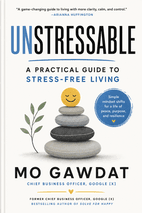
On this page you will find some of the most striking lines from the book Unstressable. Each quote captures a key insight about how stress works and how we can handle it. Some are sharp wake up calls. Others offer calm wisdom.
What makes this book so quotable is the way Mo Gawdat distills complex ideas into simple, memorable phrases. He draws from his own life and from science to give us words that feel both personal and universal. These are lines you will want to remember and share.
Top Quotes from Unstressable
“We are feeling creatures who think, not thinking creatures who feel.”
Neuroscientist Jill Bolte Taylor's insight, quoted in the chapter.
This line flips the common assumption about human cognition, highlighting the primacy of emotion over rational thought—a profound and memorable reframing.
“Our stress machine was not designed to deal with an endless stream of negativity.”
The author discussing the mismatch between modern mental triggers and biological stress response.
It succinctly captures why chronic stress is so damaging, resonating with anyone overwhelmed by today's constant negative input.
“We are dealing with ghosts created by our thoughts and emotions when they don't really exist in the present moment.”
Explaining how mental and emotional stressors are illusory compared to physical threats.
The poetic metaphor of 'ghosts' makes the abstract concept of imagined stress tangible and relatable, encouraging readers to question their own worries.
“Too much of anything is bad. Too much cortisol for too long is simply fatal.”
Describing the consequences of chronic stress on the body.
A stark, punchy warning that underscores the seriousness of sustained stress, making it hard to ignore.
“Fine is a state of ... meh! Able to cope with life. Not broken yet but not really doing well.”
In the 'Nuisances' section, the authors critique the automatic 'I'm fine' response people give when asked how they are.
It exposes the superficiality of a common social lie and encourages honest self-reflection about one's true emotional state.
“It’s not life that stresses us, because even as we're lying in bed, life is actually okay.”
The author explains that stress originates from mental interpretation rather than external events.
This reframes stress as a matter of perception, empowering readers to recognize that their environment is often safe. It offers a simple but profound shift in perspective that can reduce anxiety.
“I call this the Netflix of unhappiness—unhappiness on demand.”
The author describes the habit of replaying painful memories.
The metaphor is both humorous and devastatingly accurate, making the concept of rumination instantly relatable. It effectively conveys the voluntary nature of our suffering.
Themes Behind the Quotes
The quotes repeatedly point to one central idea: we are not victims of life but of our own thinking. Stress comes from how we interpret events, not from events themselves. Another major theme is the need to accept harsh realities without giving up. Committed acceptance turns struggle into growth.
A third theme is the importance of feeling our emotions fully instead of suppressing them. The book also emphasizes that our bodies remember what our minds try to hide. Finally, it blends science with spirituality, reminding us that not everything measurable matters, and not everything that matters is measurable.
Quotes by Chapter
2. Trigger (Un)Happy
“Hardship is a fact of life but, surely, not the only fact, and not even a prominent fact.”
In the 'Trauma' section, the authors argue that ease and health are the norm, while hardship is the anomaly.
This perspective reduces the fear of trauma by reminding readers that difficult times are rare exceptions, not the rule.
“The true damage we suffer is the obsession that results from our own obsessions.”
In 'The Biggest Demon of Them All', the authors discuss how obsessive thoughts can cause more harm than the original traumatic events.
It highlights the self-perpetuating cycle of destructive thinking and urges readers to interrupt the habit of obsessive rumination.
“Picture the mounting smaller stresses as a house of cards. One by one, a rickety structure is erected. As it gets higher, it gets closer to its inevitable collapse. Eventually, you add just one more, practically weightless card, and it all comes crashing down.”
The author uses the house of cards metaphor to explain how cumulative stress builds toward a breaking point.
This visual metaphor makes the concept of cumulative stress instantly relatable and helps readers stop blaming themselves for small stressors tipping them over.
3. Carrying That TONN
“When life hits you with harshness that you don’t have the means to alleviate—and life will hit you every now and again—accept the new reality of your life, then commit to the actions you can take to make your life and the lives of those around you better despite the presence of that harshness.”
The author introducing the concept of committed acceptance in the face of uncontrollable trauma.
It captures the essence of resilience; rather than fighting the unchangeable, we can choose to adapt and take positive action, turning adversity into growth.
“Accept, but don’t just stay there. There is also no point in resigning and surrendering, in lying down at the low point of your life and just giving in.”
The author clarifying that acceptance is not passive resignation but a springboard for commitment.
It delivers a powerful distinction between healthy acceptance and defeatism, motivating readers to move forward after acknowledging hardship.
“Committed acceptance turns the stones life throws at you to solid gold.”
The author summarizing the transformative power of committed acceptance.
This metaphor is memorable and uplifting, suggesting that even life's hardest blows can be refined into something valuable.
“The stress machine of the typical human is designed to deal with its immediate surroundings, not the opinion of a foreign correspondent about currency fluctuations in Latin America and floods in the Philippines.”
The author explains why we should avoid constant news consumption.
It reveals how our stress response is evolutionarily mismatched to modern information overload, reminding us to filter what we let into our minds.
4. It’s in Your Head
“Your thoughts, left unchecked, totally control your life, but what's obvious, though rarely discussed, is that you are in full control of your thoughts.”
The author highlights the paradox of thought control.
It directly counters the feeling of helplessness many experience with intrusive thoughts. The assertion that control is obvious yet rarely discussed invites reexamination of a core belief.
“Your brain's stressful thought cycles are identical to the repetitive loud sound of the fire alarm's a siren.”
The author uses an analogy to explain how the brain alerts us to perceived threats.
The fire alarm analogy clarifies that stressful thoughts are just alerts, not realities that require immediate action. It gives readers permission to question and disregard unnecessary mental noise.
5. Feel to Heal
“The heart will never fully heal until we're aware of what's been restricting it.”
Alice reflects on her journey of grieving her father and the necessity of acknowledging emotional pain.
This line encapsulates the core message of the chapter: that healing requires conscious recognition of what holds us back, not avoidance.
“We prioritize logic over intuition, intellect over empathy, and thinking over feeling.”
Alice critiques modern society's tendency to suppress emotions in favor of rational thinking.
It succinctly names a cultural imbalance many readers recognize in themselves, making it a powerful call to revalue emotional intelligence.
“Emotions in the modern world are seen as a vulnerability.”
Alice discusses how society treats emotions as weaknesses to be hidden rather than explored.
This statement validates the reader's experience of being told to suppress feelings, challenging that norm and inviting a new perspective.
“There is only one way to deal with the ever-growing power of your suppressed emotions: to feel them.”
Near the end of the chapter, after explaining the futility of distraction and numbing.
It delivers the chapter's thesis in a direct, unforgettable command, urging readers to confront rather than escape their emotions.
6. Your Hips Don’t Lie
“We have learned that trauma is not just an event that took place sometime in the past; it is also the imprint left by that experience on mind, brain, and body. This imprint has ongoing consequences for how the human organism manages to survive in the present.”
Bessel van der Kolk, author of The Body Keeps the Score, is quoted in the chapter.
This line powerfully reframes trauma as an ongoing physical and mental imprint, not just a memory, emphasizing why listening to the body is essential for healing.
“Your hips truly don't lie about the experiences they have been through, physical, mental, and emotional. Neither does any other part of your body. It all keeps the score. You just need to learn to listen to it.”
The author summarizes the core message of the chapter after referencing Shakira's song.
It encapsulates the chapter's central theme that the body holds every experience and that awareness of physical signals is the key to managing stress and emotions.
“Stress happens in a closed loop, and one thing leads to another.”
The author explains how thoughts, emotions, and physical pain feed into each other.
This concise statement reveals the self-reinforcing nature of stress, making it clear that breaking the cycle requires addressing all interconnected elements.
“The body turns what you think into your physical reality.”
The author reflects on the nocebo effect and the power of thoughts over health.
It is a striking reminder that our mental state directly shapes our physical health, urging readers to take responsibility for their thought patterns.
7. Soul-Renity
“That body was no longer Ali. Something left. The thing that made him Ali.”
Mo describing the moment after his son Ali was taken off life support, realizing his son's essence had departed.
This line makes the abstract concept of a soul visceral and heartbreakingly real, grounding spirituality in personal loss and love.
“We know that because we've all, including many scientists, felt love, and yet we could never measure it or have others observe it.”
Mo arguing that the soul exists just as love does, despite being immeasurable by science.
It bridges the gap between scientific skepticism and human experience, using a universal emotion to validate the intangible.
“If science is the discipline humans use to study all that is physical, spirituality is the philosophy smember/ we need to comprehend what lies beyond what we can see.”
The authors defining the complementary roles of science and spirituality in understanding reality.
It offers a constructive framework that honors both empirical knowledge and the unseen, encouraging integration rather than conflict.
“In the chaotic battle of life, your soul is your greatest ally.”
The authors describing the soul's role as a calm guide amid life's struggles.
This succinct, empowering sentence serves as a memorable mantra for resilience, reminding readers of their inner strength.
8. The Unstressable
“To be unstressable, we do not need to avoid the world as a monk or nun would do; we just need to behave in ways that evade the reasons for the types of repetitive stress that wear us down.”
Opening of the chapter defining what it means to be unstressable.
This reframes stress management as active engagement with life rather than retreat, making it accessible and empowering.
“We were not designed as humans for our stress to linger and last for weeks.”
Discussion on the importance of limiting the duration of stress.
A concise reminder that chronic stress is biologically unnatural, motivating readers to take immediate action.