UNSCRIPTED Quotes
by MJ DeMarco
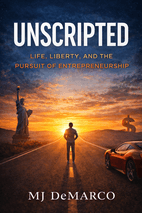
These quotes come from a book that doesn't hold back. Each line is like a cold splash of water, meant to jolt you awake from the comfortable numbness of everyday life. You will find sharp observations about work, ambition, and the routines we never question. The language is direct, sometimes harsh, but always honest.
What makes this book so quotable is its ability to flip familiar ideas on their head. It takes the things we take for granted like a steady job, a degree, or a weekend off and reveals the hidden costs. The metaphors stick with you long after you put the book down, because they hit on truths we often avoid.
Top Quotes from UNSCRIPTED
“How in the hell could a man enjoy being awakened at 6:30am by an alarm clock, leap out of bed, dress, force-feed, shit, piss, brush teeth and hair, and fight traffic to get to a place where essentially you made lots of money for somebody else and were asked to be grateful for the opportunity to do so?”
Opening epigraph attributed to Charles Bukowski.
This line perfectly captures the absurdity and resentment of the daily grind, resonating with anyone who has felt trapped in a soul-crushing routine.
“I wonder, Is a sheep who drives a Mercedes to the slaughterhouse still a sheep?”
The narrator asks this while stuck in traffic, observing other commuters in luxury cars.
It's a sharp metaphor for how material success can mask the same conformity and powerlessness, making readers question their own complicity.
“You're living, but you aren't alive. Your heart beats, but there is no pulse. Your mind is poisoned, but the toxicology is clean. Your soul has been stolen, but there are no thieves.”
The author sums up the paradox of a comfortable but soulless existence.
This series of paradoxes powerfully captures the dissonance between outward normalcy and inner emptiness, a haunting diagnosis of modern malaise.
“You aren't living by free will; you're living by a SCRIPT.”
The chapter's concluding call to action after the red-pill rhetoric.
This punchy, definitive statement crystallizes the entire chapter's argument into a single memorable line, making it easy to recall and reflect on.
“Wake up...the product being manufactured is you.”
The concluding line of the detailed portrayal of the Script's life cycle.
It delivers a jolting, memorable wake-up call that transforms the abstract concept of systemic control into a personal, urgent realization of one's own commodification.
“The illusion of free choice and deciding your slave owner: Door A, the Sidewalk; or Door B, The Slowlane. Both lead to the slaughterhouse. Neither makes you the boss of you.”
The author deconstructs the life paths presented by the SCRIPT.
The blunt, visceral imagery strips away the pretense of conventional success, forcing readers to question whether any mainstream path truly offers freedom.
“Is it any shock that straight-A students make great employees while the C-students are the guys hiring them?”
From the Education seeder section, critiquing how the school system rewards obedience over creativity.
This provocative inversion of conventional wisdom challenges readers to rethink the value of academic conformity versus entrepreneurial risk-taking.
Themes Behind the Quotes
A central theme is the idea of a hidden script that guides most people's lives without their awareness. This script programs people to trade their time for money, chase consumer goods, and measure success by external markers like job titles or car brands. The book argues that this path leads to a slow death of passion and purpose, leaving people alive but not truly living.
Another major theme is the illusion of freedom within the system. The quotes highlight how choices like career paths or spending habits are often just different doors to the same cage. They also emphasize the importance of waking up, questioning inherited beliefs, and taking ownership of your own direction through entrepreneurial thinking rather than obediently following the crowd.
Quotes by Chapter
1. Tales From the Script: A Monday Story
“Gratitude shouldn't feel like death row at San Quentin.”
The narrator tries to force positivity after arriving at work.
This line exposes the hollow nature of forced gratitude in a toxic work environment, striking a chord with anyone who has struggled to feel thankful for a job that drains them.
“My dreams are dead. The consolation prize for them has become a car and a weekend.”
The narrator realizes the reality of his life after being saddled with extra work.
A devastatingly honest summary of trading personal aspirations for shallow rewards, it encapsulates the book's central critique of the unscripted life.
2. Careless Whispers: Guilty Souls Have No Rhythm
“Even esteemed professionals, doctors and lawyers, have found that the most comfortably respected prison is still, well, a prison.”
The author argues that conventional career success can still feel like a cage.
This line challenges the assumption that prestige and respect guarantee fulfillment, resonating with anyone who feels trapped in a seemingly enviable life.
“They are not happy. The life is sucked out of them. No passion. No dreams. No goals. Just the same thing. Every. Single. Day.!”
A 19-year-old forum user describes observing his parents' unfulfilling lives.
The rhythmic, staccato delivery mirrors the monotony of the described existence, making it painfully vivid and relatable to many who see the same in their own families.
“Your soul will resonate its desires and discontent when faced with quiet or minimal distraction; for example sleeping, showering, or during a massage.”
The author advises how to hear one's inner voice.
It offers a practical and intimate insight — that our deepest truths emerge in stillness — encouraging readers to listen rather than drown out the whispers.
3. The Modern-Day Matrix: The Script
“When a well-packaged web of lies has been sold gradually to the masses over generations, the truth will seem utterly preposterous and its speaker a raving lunatic.”
Opening quote attributed to Dresden James, setting the chapter's theme.
It succinctly captures the central deception and the societal dismissal of truth, making readers question their own acceptance of normalized falsehoods.
“The sudden realization struck me—and frightened me: it was not free will at work, but conditioned instinct, like a bee buzzing to the hive or an ant marching to an anthill.”
The author's epiphany while observing the robotic movement of commuters from a cafe window.
The vivid metaphor of insects strips away the illusion of choice, forcing readers to confront the uncomfortable possibility that their daily routines are programmed rather than chosen.
5. Conventional Wisdom: The Road To A Conventional Life
“The problem is not people being educated. The problem is that they are educated just enough to believe what they've been taught, but not educated enough to question what they've been taught.”
An epigraph by an unknown author at the start of the chapter.
It brilliantly diagnoses the root of conformity—education without critical thinking—making readers question whether they are passive believers or active questioners.
“What few know is, we've been programmed for this existence, a willful modern-day slavery.”
Part of the description of 'The Script' as an invisible operating system controlling life.
This stark, provocative phrase forces readers to recognize the subtle societal programming that robs them of autonomy, equating compliance with voluntary servitude.
“/f I accept average advice from average people living average lives, can I expect to be anything but average?”
A rhetorical question posed in the section on the compromised party of convention (the crowd).
This simple yet powerful question challenges readers to evaluate the source of their guidance and exposes the logical fallacy of expecting extraordinary results from ordinary counsel.
6. The Scripted Operating System: The Web Of Servitude
“The ideal tyranny is that which is ignorantly self-administered by its victims.”
The author introduces the concept of voluntary enslavement in the chapter.
This line captures a chilling paradox about modern systems of control, making readers reflect on how willingly they participate in their own subjugation.
“Like a spider, the SCRIPT also weaves a web, an operating system that programs your mind to accept a voluntary slavery destined for obedience and economic servitude.”
The author describes the SCRIPTED operating system as a deliberate trap.
The vivid spider metaphor makes the abstract idea of societal programming feel immediate and predatory, emphasizing the hidden nature of the system.
“Your defense is knowledge. Life, liberty, and the pursuit of entrepreneurship is the offense.”
The author offers a call to action against the SCRIPTED OS.
This pairs a sobering warning with an empowering alternative, framing entrepreneurship as a form of resistance that resonates with readers seeking autonomy.
7. The Seeders: Our Life Sucks, Yours Should Too
“Asa child, you're as defenseless to imprinting as a toddler is to his stinky diapers.”
From the Friends & Family seeder section, discussing how parents imprint the SCRIPT onto children.
The vivid simile captures the helplessness of childhood indoctrination, making the abstract concept of conditioning visceral and memorable.
“Some parents would rather enjoy the prestige of having their kid be a miserable doctor ready to jump off a cliff over a happy human being.”
Discussing immigrant family expectations and the cost of SCRIPT compliance.
It starkly contrasts parental pride with a child's well-being, highlighting the tragic trade-off society often forces between happiness and status.
“There will never be a more wretched hive of scum and villainy. Washington DC, your government, is the insatiable mother ship of SCRIPTED doctrine.”
Opening the Government seeder section, describing the political system.
The Star Wars allusion makes the condemnation of government corruption both witty and devastatingly memorable.
8. Hyperreality: Your Illusionary Captors
“Monday is an illusion. Sunday equals Thursday. The Earth is indifferent, with the exception of one creature: humans.”
From the section on Hyperreality #1: Named Days, where the author argues that the seven-day week is a man-made construct.
It succinctly exposes the arbitrary nature of our weekly structure, challenging a deeply ingrained social convention and prompting readers to question their own relationship with time.
“If the SCRIPT was a jail cell, consumerism and the debt it creates are its bars of incarceration.”
From the discussion of Hyperreality #2: Consumerism, explaining how materialism traps people in the SCRIPTed life.
This powerful metaphor crystallizes how consumer debt and the pursuit of stuff can enslave individuals, making the abstract concept of the SCRIPT feel tangible and urgent.
“A college degree doesn’t produce jobs out of thin air. It entitles you to NOTHING. I repeat, NOTHING.”
From Hyperreality #3: A College Degree, where the author challenges the perceived value of higher education.
The forceful repetition and blunt language drive home a controversial perspective, forcing readers to reconsider the common assumption that a degree guarantees success.
“And yet the SCRIPTED worship these celebrities (and their opinions) to staggering levels of idolatry. It's actually frightening.”
From Hyperreality #4: Hyper-Personality, discussing how fame and social media create false idols.
It starkly highlights the absurdity and danger of celebrity worship, urging readers to see through the illusion and reclaim their own judgment.
9. Temporal Prostitution: Trading Good Time For Bad
“The things I wanted, specifically my amp, really didn’t cost money; they cost me fragments of my life.”
The author reflects on his teenage job at Sears Roebuck, realizing the true cost of a car stereo amplifier.
This line crystallizes the core concept that money is merely a proxy for life rations, making the reader confront the real price of every purchase.
“You work Monday through Friday, or you spend five life rations just so you can earn two. Five for two.”
In the section comparing time to money, the author illustrates the negative rate of return in the SCRIPTED work-for-retirement model.
The stark arithmetic of five days traded for two days of freedom reveals the absurdity of the standard life path, making it impossible to ignore.
“Retirement might as well mean “the flash of free time before I die.””
Describing the SCRIPTED OS's promise of retirement as a distant, brief reward for decades of indentured time.
The dark humor and blunt redefinition of retirement punctures the comforting illusion, forcing readers to question whether the trade is worth it.