UNSCRIPTED Key Takeaways
by MJ DeMarco
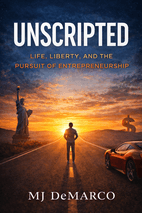
5 Main Takeaways from UNSCRIPTED
Reject the societal script that trades your time for money in a rigged system.
The book argues that conventional paths like the Sidewalk (consumption) and Slowlane (savings) lead to 'temporal prostitution,' where you sell your life's time for a paycheck. True freedom requires recognizing this trap and escaping through entrepreneurial action, as detailed in Chapters 1, 5, 8, and 9.
Shift from a consumer mindset to a producer mindset to create real wealth.
Wealth is not about saving or frugality but about creating value that scales. The 'consumption scam' teaches that debt is a production deficit, and you must focus on producing more than you consume, as emphasized in Chapters 18, 19, and 22.
Build a business using the CENTS framework to achieve scalable, autonomous income.
The Commandments of Control, Entry, Need, Time, and Scale guide you to create a 'productocracy' that generates passive income and freedom. This involves solving real market needs with systems that operate independently of your time, as outlined in Chapters 30 through 35.
Cultivate a growth mindset and interrogate your beliefs to overcome internal barriers.
The 3Bs (Beliefs, Biases, Bullshit) must be reprogrammed. Embrace the Kaizen principle of small daily improvements and reject fixed talent myths to persist through challenges, as discussed in Chapters 14, 15, 17, and 24.
Combine purpose, execution, and discipline to sustain long-term freedom and wealth.
Meaning-and-purpose fuel persistence, while kinetic execution and the four Unscripted disciplines (Comparative Immunity, Purposed Saving, etc.) ensure you don't lose what you've built. The 'Fuck You' stage is achieved holistically, as covered in Chapters 26, 28, 37, and 40-45.
Executive Analysis
The five key takeaways collectively form the book's central argument: that escaping the 'SCRIPTED' life of mediocrity requires a radical mindset shift from consumer to producer, coupled with a systematic approach to entrepreneurship. DeMarco posits that societal structures are designed to keep people in a state of economic servitude, but by rejecting conventional wisdom and building businesses based on the CENTS principles, individuals can reclaim their time and achieve authentic freedom. This journey begins with internal reprogramming of limiting beliefs and culminates in the disciplined execution of a value-creating venture.
'UNSCRIPTED' matters because it moves beyond motivational platitudes to offer a concrete, step-by-step framework for achieving financial independence through entrepreneurship. In a genre saturated with get-rich-quick schemes or passive investment advice, this book stands out by emphasizing that wealth is a side-effect of solving problems and creating scalable systems. It empowers readers to take control of their destiny by providing practical tools for business building, mindset development, and long-term wealth preservation, making it a vital manual for anyone seeking to escape the rat race.
Chapter-by-Chapter Key Takeaways
1. Tales From the Script: A Monday Story (Chapter 1)
The relentless routine of corporate life can create a cycle of existential dread, where individuals feel trapped by financial obligations and societal expectations.
Material possessions, like expensive cars and suits, often serve as ineffective bandaids for deeper dissatisfaction, failing to address the root causes of unhappiness.
Recognizing the soul crushing nature of such a existence is the first step toward seeking meaningful change, as superficial escapes only perpetuate the cycle.
True freedom requires confronting the structures that enforce this grind, rather than resorting to temporary appeasements that lead to further entrapment.
Try this: Acknowledge your existential dread from the corporate routine and decide to seek meaningful change beyond superficial escapes.
2. Careless Whispers: Guilty Souls Have No Rhythm (Chapter 2)
Discontent often manifests as both tangible symbols (like unfulfilling possessions or credentials) and intangible emotional whispers (such as regret or frustration).
These "careless whispers" serve as internal alerts that something is amiss in our lives, pointing to a gap between our current reality and our deeper aspirations.
The soul's voice is most audible in quiet, undistracted moments, offering opportunities for self-reflection and change.
Ignoring or suppressing these whispers can lead to a life of mediocrity and unfulfilled dreams, while acknowledging them is the first step toward authentic living.
Everyone, regardless of age or circumstance, experiences these whispers, and responding with honesty—rather than denial or distraction—is essential for personal growth and happiness.
Try this: Schedule regular undistracted time to hear your soul's alerts about unfulfilled aspirations and commit to addressing them honestly.
3. The Modern-Day Matrix: The Script (Chapter 3)
Modern society often operates on a hidden "script" that promotes cultural conformity and economic slavery, limiting authentic free will.
Personal awakening can come from observing the robotic routines of daily life, revealing how conditioned instincts drive many choices.
The metaphor of The Matrix's red pill encourages questioning societal norms and seeking a truth that liberates from mediocrity.
Entrepreneurship and conscious awareness are presented as tools to cut the strings of this puppet master and reclaim one's life.
Feelings of dissatisfaction may be internal signals urging us to reject the script and pursue a path aligned with our true aspirations.
Try this: Actively audit your daily choices for robotic conformity and research one entrepreneurial idea that aligns with your true aspirations.
5. Conventional Wisdom: The Road To A Conventional Life (Chapter 4)
The SCRIPT is sustained by two groups: the Compromised Crowd, who spread conventional wisdom out of genuine but limited belief, and the Profiteering Prejudiced, who economically benefit from your adherence to the system.
Accepting life and financial advice from average people living average lives virtually guarantees an average, or mediocre, outcome.
True wealth and freedom are often held by those who operate outside of the SCRIPT and profit from those trapped within it.
The loss of childhood dreams and personal autonomy is not natural but the result of systemic indoctrination. Reclaiming your life starts by identifying what—or who—has become "the boss of you."
Try this: List the sources of your financial and life advice, and critically assess whether they are compromised or profiting from your compliance.
6. The Scripted Operating System: The Web Of Servitude (Chapter 5)
Society is framed as a "SCRIPTED operating system," a pre-programmed framework designed to produce obedient, economically servile individuals.
The system is maintained by "Seeders"—compromised authorities and institutions—and reinforced by deceptive "Hyperrealities."
Its core mechanism is "Temporal Prostitution," the sanctioned trade of your life's time for money within a rigged game.
The celebrated "Life Paths" (Sidewalk and Slowlane) are revealed as an illusion of choice, with both leading to systemic servitude, not freedom.
Distraction acts as the system's cloak, preventing you from seeing and questioning the programming.
The end goal is to manufacture M.O.D.E.L. Citizens (Mediocre, Obedient, Dependent, Entertained, Lifeless), who then become new Seeders, perpetuating the cycle.
Try this: Calculate the true cost of your job in terms of life time sold and eliminate one major distraction that keeps you from seeing this trade-off.
7. The Seeders: Our Life Sucks, Yours Should Too (Chapter 6)
Modern media primarily functions as a propaganda arm, crafting narratives within a narrow spectrum to serve political and corporate power rather than informing the public.
This creates an "ineptocracy," a self-perpetuating system where distraction and trivial news prevent scrutiny of corrupt leadership and harmful policies.
Financial advice in mainstream media is often a dangerous oversimplification, promoting passive investment myths while ignoring the realities of wealth creation.
The entire "SCRIPTED" ecosystem is economically incentivized; fantasy and consumerism are profitable for all entities in the power structure.
The individual's participation in this cycle of consumption and distraction is what keeps the system alive, presenting a profound personal choice about complicity.
Try this: Consume news from diverse, independent sources for one week and track how often you act on corporate-driven marketing messages.
8. Hyperreality: Your Illusionary Captors (Chapter 7)
Virtual worlds are engineered to be addictive, offering hollow rewards that can supplant real-world achievement and relationships.
Entertainment becomes dangerous when it stops being a pastime and starts defining your emotional state or worldview.
Money has no intrinsic value; its worth is 100% based on collective belief and a fragile systemic trust.
Personal freedom is largely an illusion, as we live within a system of licensed privileges and are subject to asset seizure for non-compliance.
Corporations are not autonomous monsters; they are tools that reflect the values, greed, or benevolence of the people who control them.
Question to Ponder: Which of these hyperrealities plays a predominant role in your life?
The chapter's final movement shifts from analysis to application, encouraging a deeply personal engagement with the concepts discussed. It culminates by posing direct, reflective questions to the reader, turning theoretical understanding into a mirror for self-examination. This pivot emphasizes that the study of hyperreality is ultimately meaningless without considering its active role in one's own perceptions and choices.
Self-Reflection is Essential: Understanding hyperreality requires moving beyond abstract theory to examine its personal manifestations in our own lives.
Awareness Precedes Agency: Recognizing the hyperrealities that captivate us is the foundational act that makes choosing our relationship to them possible.
The Goal is Conscious Engagement: The chapter concludes not with a definitive answer, but with a call to ongoing, mindful interaction with the simulated layers of modern experience.
Try this: Conduct a daily log for three days to see how much time you spend in simulated environments and set one boundary to reclaim real-world interaction.
9. Temporal Prostitution: Trading Good Time For Bad (Chapter 8)
Time is your scarcest resource—non-renewable and more valuable than money. Honor it accordingly.
Every purchase costs life rations, not just dollars, often stealing future free time for present indentured time.
The retirement trade is flawed: selling youthful time for elderly freedom yields a negative return on your most precious asset.
Prioritize free time over indentured time to build a life rich in experiences, relationships, and fulfillment.
Visualize your own mortality to make wiser choices, ensuring you don't squander seconds on what doesn't truly matter.
Try this: Before any non-essential purchase, calculate how many hours of work it costs and decide if it's worth that portion of your life.
10. The Life Paths: Two Doors, One Slaughterhouse, No Difference (Chapter 9)
The SCRIPTED system presents a false dichotomy between living for today (Sidewalk) and saving for tomorrow (Slowlane). Both are traps that lead to "temporal prostitution," where your time is not your own.
The Sidewalk leashes you through consumption and debt, making you a servant to corporations and locking you into a cycle of earning to spend. Your stuff ends up owning you.
The Slowlane leashes you through deprivation and hope, making you a servant to Wall Street and the passage of time. It asks you to sacrifice your vibrant years for a precarious future.
Merely working hard within either of these broken systems is ineffective. The critical first step is to recognize which path you are currently on and honestly assess whether it can possibly lead to the freedom and life you truly desire.
Try this: Write down your current financial strategy and label it as Sidewalk or Slowlane, then brainstorm one change to move towards an Unscripted path.
11. Distraction: The Ministry Of Entertainment (Chapter 10)
Distraction is a Systemic Tool: Entertainment is not neutral; it is a "ministry" within a larger system designed to manage and control the populace by capturing attention.
Purpose is Pacification: Its primary objective is to keep people comfortably numb, turning them away from critical examination of economic, political, and social realities.
It Cultivates Resignation: By filling mental space with trivialities, distraction actively grinds down ambition and spirit, fostering acceptance of a mediocre, scripted life.
The "Train" Metaphor: The journey toward "M.O.D.E.L. Citizenship" is one of complacent consumption, where entertainment is the distraction that prevents passengers from seeing the troubling landscape outside or questioning their ultimate destination.
Try this: Audit your weekly entertainment consumption and replace 30 minutes of trivial content with an activity that fosters ambition or learning.
12. M.O.D.E.L. Citizenry: Serial #666-77-8888 (Chapter 11)
The M.O.D.E.L. Citizen represents the standardized, unfulfilling outcome of following society’s SCRIPT without critical examination.
The system operates not through forceful conscription but through gradual, comfortable entrapment, making it difficult to perceive the danger until you are deeply ensnared.
True dependency is twofold: financial (debt) and temporal (selling your time), both of which sacrifice autonomy.
The chapter’s ultimate purpose is to trigger a recognition of this trap as a necessary first step before presenting the alternative of an "Unscripted" life defined by ownership of one's self and destiny.
Try this: List one area where you are financially or temporally dependent on a system, and research one way to gain more control over it.
13. The Unscripted Life: “Fuck You” (Chapter 12)
A fake "Fuck This Event" (FTE) is a temporary complaint; a real FTE is a irreversible commitment born from unbearable pain with the current Scripted life.
Four primary threats choke off a real FTE: Mediocre Comfort (the system's pacifying bribe), Guarded Pride (being "too good" to start humble), Excessive Responsibilities (self-created anchors of debt and consumption), and Fear (of failure, judgment, or short-term discomfort).
The modern workweek is explicitly designed to create a cycle of work and consumption that stifles true freedom.
If you are unwilling to work for minimum wage or make short-term sacrifices, you are likely not yet committed enough for the entrepreneurial journey.
Pursuing an Unscripted life is the dream—the value is in the transformative process of growth, self-reliance, and execution, not just the end result.
Try this: Define one unbearable aspect of your current life and commit to a specific, irreversible action that requires working for minimum wage or making a significant sacrifice.
15. The Unscripted Entrepreneurial Framework (TUNEF) (Chapter 13)
Study Failure, Not Just Success: The most valuable entrepreneurial lessons are found in analyzing why efforts fail.
TUNEF is a Blueprint: The Unscripted Entrepreneurial Framework provides a structured, five-phase progression from a triggering event to self-actualization.
Transformation is Proven: Real people from all backgrounds have used these principles to build wealth and freedom, often outside of public recognition.
The Breakthrough is in the Intersection: Life changes at the "entrepreneurial G-spot"—the moment the framework's components align to generate real freedom, which precedes vast wealth.
Mindset Drives Action: Effective, repeated action (Macro-Process) is impossible without first rewriting your limiting beliefs and biases (Micro-Process).
There is No Silver Bullet: Success requires a committed process of adapted actions, not the discovery of a single secret or event. The search for a risk-free shortcut is a guarantee of failure.
Try this: Research one business failure in your field of interest, analyze its causes, and map how the TUNEF phases could have addressed them.
16. Our Self-Imposed Prison: Beliefs, Biases, And Bullshit(3B) (Chapter 14)
The 3Bs (Beliefs, Biases, and Bullshit) form the foundational "operating system" for a SCRIPTED life, automatically driving most of our thoughts and actions.
Beliefs hold tremendous psychological power, but this power is not tied to truth; a delusional belief can compel action or inaction just as forcefully as a true one.
Biases are mental reflexes that protect our current beliefs, filtering reality to confirm what we already think and preventing new, actionable knowledge from getting in.
Bullshit is the personal story we create to rationalize our beliefs and circumstances, serving as the final barrier to honest self-assessment and change.
The first and most critical step toward an UNSCRIPTED life is to interrogate and reprogram these internal constructs, as flawed mental premises will always yield flawed real-world results.
Try this: Write down one limiting belief about money or success, challenge its origin, and replace it with an empowering alternative.
17. The Lies We Believe: The 8 Belief Scams (Chapter 15)
Beliefs Are Often Borrowed: Most people's core beliefs are not products of independent critical thinking but are adopted from family, social groups, and media narratives.
The Crowd Guarantees Mediocrity: If you let the crowd (the 99%) do your thinking, you will inevitably get average, scripted results.
Freedom Requires Mental Rebellion: Achieving exceptional outcomes requires you to identify, question, and then deliberately polarize the common belief "scams" that govern most people's decisions.
Embrace Opposite Thinking: The path to an "unscripted" life involves training yourself to think in direct opposition to the crowd's consensus on key life dichotomies.
Try this: Identify one common belief held by your social circle (e.g., 'secure job equals security') and deliberately adopt the opposite perspective for a week.
18. Belief #1, The Shortcut Scam: Ordinary Doesn’t Compel Extraordinary (Chapter 16)
Fight on the Right Front: Lasting change requires battling habits at their point of origin (e.g., the grocery store), not at the point of temptation (e.g., the kitchen).
Engineer Friction: You can defeat bad habits by intentionally making them inconvenient and removing all shortcuts, thereby aligning laziness with your goals.
Commit to the Feedback Loop: Take consistent action not just until you feel like stopping, but until you receive a tangible "echo" or result that motivates continued effort.
Think in Dominoes: Major success is a cascade effect started by a single, small action. Focus on toppling the first small domino with consistency, not on moving the giant one through sheer force of will.
Try this: Choose one detrimental habit, remove all shortcuts to it (e.g., uninstall apps, cancel subscriptions), and commit to a daily 5-minute productive action.
19. Belief #2, The Special Scam, “I’m Not Good At That” (Chapter 17)
The "Special Scam" is the belief that talents are fixed, leading to either arrogance or resignation, both of which avoid hard work.
A fixed mindset, proven by Carol Dweck's research, causes avoidance of challenge, fear of failure, and fragility in the face of setbacks.
A growth mindset, supported by neuroplasticity, embraces effort and sees abilities as malleable through dedication and learning.
The Kaizen Principle emphasizes small daily improvements, mastery over external performance, and minimizing comparisons to foster continuous growth.
Praise the process—effort, improvement, and strategies—rather than innate talent, for yourself and others, to cultivate resilience and long-term success.
Try this: When faced with a challenge, say 'I can't do this yet' instead of 'I'm not good at this,' and dedicate 15 minutes daily to skill development.
20. Belief #3, The Consumption Scam: How Much Time Did That Cost? (Chapter 18)
Debt is a Production Deficit: It represents consumed value that you have not yet produced, mortgaging your future time and freedom.
The Scam is the Disconnect: Societal conditioning encourages us to desire goods without any conscious link to the labor and time required to obtain them, leading to financial insolvency.
Income is No Shield: Without a producer mindset, increased income only fuels greater consumption, as evidenced by countless bankrupt celebrities and lottery winners.
Freedom is Found in Producerism: The path to owning your time and life is to reject a consumer identity and polarize towards being a producer—creating and giving value to the world in excess of what you take from it.
Observe as an Owner: Train yourself to see transactions, marketing, and products from the perspective of the business owner and creator, not just the buyer.
Try this: Before buying something, ask 'How many hours did I work for this?' and spend one hour weekly analyzing a business's marketing tactics.
21. Belief #4, The Money Scam: I Can Get Rich By Wanting To Get Rich (Chapter 19)
Wealth is an effect, not a cause. Directly pursuing money repels it. Financial success is a side-effect of creating and delivering significant value to the marketplace.
Reframe your vocabulary. Replace "making money" with "earning value-vouchers." This cognitively shifts your focus from the trophy to the process that wins it.
Understand money's true function. Money is an intangible mediator that stores perceived value agreed upon in a transaction. It bridges the gap between what you offer and what someone wants.
Build an honorable value bridge. To attract value-vouchers sustainably, you must master the four-part process: create real value, communicate it effectively, reach a fair agreement, and deliver on the promise.
The "Why" matters. If your primary motive for entrepreneurship is money, freedom, or luxury, you are likely a "dreampreneur" ensnared by the money scam. The sustainable motive is a desire to solve problems and be valuable.
Try this: Replace the phrase 'making money' with 'earning value-vouchers' in your vocabulary and identify one problem you can solve for your community.
22. Belief #5, The Poverty Scam: “I’m Poor Because You’re Rich” (Chapter 20)
The "poverty scam" is the false, zero-sum belief that wealth is stolen, not created, and that being rich makes you inherently corrupt.
This scam is fueled by the "villain narrative," which is reinforced by cultural stereotypes, political class warfare, and the highly-publicized misdeeds of a minority of value-cheaters and corrupt corporations.
The true path to legitimate wealth is the fiduciary principle: selflessly serving the needs and wants of others. Great value creation for millions precedes great wealth.
Your relationship with money defines you as either a money-chaser, a value-cheater, or a value-voucherer (one who creates genuine value). Success and integrity lie in the last category.
Try this: List three ways you can provide genuine value to others without immediate monetary expectation, and act on one.
23. Belief #6, The Luck Scam: You Don’t Play; You Don’t Win (Chapter 21)
Luck is a Lagging Indicator: What we call "luck" is the observed result of probability in motion, not its source. The source is action.
You Control the Machine: Your daily choices—your career path, habits, and social circles—determine the contents of your "gumball machine." To get better outcomes, you must first get a better machine.
Probability Demands Participation: You cannot move statistical probability in your favor without repeated, consistent action. Failure is often just an "orange gumball" providing data for your next attempt.
Mindset Modifies Outcomes: Listening to intuition, breaking routines, and maintaining a positive, grateful perspective are not just feel-good advice; they are practical behaviors that alter your interaction with chance and open doors to new possibilities.
Try this: Commit to one small, repeated action daily (e.g., reaching out to a potential mentor) and track the outcomes to identify patterns.
24. Belief #7, The Frugality Scam: Live Poor; Die Rich (Chapter 22)
Extreme frugality as a primary wealth-building strategy is a "scam" that promotes living a deprived life for a potentially unreachable future payoff.
Wealth is created on the offense (increasing income) and preserved on the defense (managing expenses). A sole focus on defense is a losing game.
The key to rapid wealth creation is Controllable Unlimited Leverage (CUL)—building or engaging in ventures where income can scale exponentially without a predefined ceiling.
You must break the intrinsic value link (trading time for money) to unlock scalable income. Real wealth acceleration happens when your income is no longer tied to the hours you work.
With a strong offensive strategy generating high income, saving large percentages becomes easy, debt elimination is rapid, and financial freedom is achieved on a dramatically faster timeline.
Try this: Audit your income sources for scalability; if none exist, brainstorm one business idea where income isn't tied to your time.
25. Belief #8, The Compound-Interest Scam: Wall-Street Ain't Makin Ya Rich (Chapter 23)
Emotion Over Math: Human fear and greed consistently override the theoretical benefits of compound interest in real-world investing.
Inflation is the Hidden Tax: Long-term financial plans that ignore compound inflation are fundamentally flawed and likely overpromise future purchasing power.
Follow the Money: Scrutinize who is promoting the "get rich slowly" compound-interest narrative, as they are often the ones profiting from managing your money, not from following the advice themselves.
Redefine the Market's Role: Wall Street is best used for income generation, inflation hedging, controlled speculation, and liquidity—not as a primary engine for building wealth from scratch.
Wealth First, Then Interest: The celebrated power of compound interest is only effective and safe when applied to a large existing capital base, which must first be created through entrepreneurial action, not slow savings.
Try this: Review your investment portfolio to ensure it's for preservation and income, not reliance, and allocate time to entrepreneurial capital creation.
26. The Biases: Your Brain’s Delusions (Chapter 24)
Avoid "Podium Popping": Success stories are curated highlights, not blueprints. Your path is unique, dependent on your specific circumstances, and must be forged in the present, not copied from the past.
Beware Survival Spotlighting: For every visible success story, there are countless invisible failures. Celebrated outliers (like frugal millionaires) are not proof a strategy works for the majority.
Recognize Momentum Paralysis: Do not let sunk costs of time, money, or emotion dictate your future. The inability to quit a failing course of action—a stock, a relationship, or a business—is a cognitive trap that steals your future to justify your past.
Your Mind is the Battlefield: These biases are interconnected mental traps that distort reality. Overcoming them requires conscious effort to seek the full picture, respect your unique journey, and make logical decisions detached from past investments.
Try this: When inspired by a success story, research three failures in the same field and evaluate if your current project is worth continuing based on data, not past investment.
27. Bullshit From Bullshitters: Crutches, Cliches, And Cults (Chapter 25)
Identity Precedes Action: Lasting change follows the order BE → ACT → HAVE. You must identify as the thing before you can consistently do the things that lead to having it.
Shift Cataclysms Fuel Change: A powerful, often emotional, event is frequently needed to break an old identity and cement a new one. Lean into these moments.
Reinforce Identity With Daily Proof: Validate your new identity through small, consistent actions. Cumulative, minor improvements (the process-principle) build unshakeable self-evidence over time.
The Mind is the Arena: Entrepreneurship succeeds or fails internally first. Victory requires consciously reprogramming beliefs and biases away from societal "scripted" thinking.
Try this: Choose one identity you aspire to (e.g., entrepreneur) and perform one small action today that aligns with it, such as setting up a business email.
28. Meaning-And-Purpose: The Unstoppable Will To Win (Chapter 26)
Definiteness of purpose is the non-negotiable quality for winning. It is the knowledge of what you want paired with a burning desire to achieve it.
Sustainable commitment comes from meaning-and-purpose, not willpower. Purpose is the spark plug that powers the Motivation Cycle (Why → Action → Feedback → Value → Beliefs).
Your core "Whys" must be emotionally charged and personally significant. They are the fuel that keeps you moving through the "Desert of Desertion"—the difficult period of effort without reward or feedback.
A transcendent purpose acts as both a shield and a weapon. It protects you from criticism and ridicule and gives you the strength to persist where others quit.
Distinguish between a superficial desire and a profound why. Desires are transient; whys are firm and transcend time, forming the core of an identity that can withstand any storm.
Try this: Write down your core 'why' for pursuing freedom, ensure it's emotionally resonant, and review it every morning.
29. Beware! The Wonder Twins Of Epically Bad Life Advice (Chapter 27)
Passion is not a business model. The market pays for value and problem-solving, not for your personal enthusiasm.
Beware of survivor bias. For every passionate success, there are legions of passionate failures you never hear about.
Selfish focus leads to failure. Asking "What do I love?" is the wrong question. The right question is "What value can I create for others?"
Passion can be destroyed by monetization. The overjustification effect means turning a hobby into a job can kill your love for it.
"Follow your passion" encourages avoidance. It becomes an excuse to shun the difficult, uncomfortable work essential for growth.
Passion is a product, not a prerequisite. True, lasting passion is generated by a positive feedback loop—when the world values and rewards your contributions. Focus on creating value first; passion will follow as a result.
Try this: Identify a market need you can address, even if it's not your passion, and take one step to develop a solution.
30. Ignite Your Purpose, Invigorate Your Soul (Chapter 28)
Genuine purpose is obsessive and sacrificial, often ignited by a "fuck this" event (FTE). It is your driving "why," not a passive interest.
Autonomy—the feeling of controlling your own life—is a primary contributor to happiness, more than money, status, or even following a passion. Wealth is beneficial primarily when it buys freedom and options.
Psychological well-being is supported by autonomy, competence, and relatedness. A fulfilling job or venture successfully integrates these elements.
You must operate from an internal locus of control, believing your choices shape your life. Blaming external factors surrenders your power and suffocates potential.
Entrepreneurship is a powerful vehicle for this journey because it inherently combines purpose (solving problems), the creation of autonomy, and demands an internal locus of control.
Try this: Make one decision today solely based on your own judgment, without seeking external validation, and note the outcome.
31. How To Create A Business That Changes Your Life (Chapter 29)
Failure is a statistical certainty and a teacher. Even legendary entrepreneurs fail most of the time; what separates them is their persistence and willingness to learn from each swing and miss.
Passion alone is not a business strategy. While interest can ignite an idea, it cannot sustain a venture that lacks market demand and proper execution.
Fastlane Entrepreneurship (FE) is the systematic advantage. To escape the high-failure-rate trap, you must adopt a structured framework focused on creating a superior product (a productocracy) and adhering to the core CENTS Commandments.
Your odds are not fixed. By applying the Fastlane principles, you actively change the probability of success, moving from being a victim of statistics to an architect of your own results.
Try this: After any setback, document three lessons learned and how they apply to the CENTS commandments.
32. The Productocracy: How To Print Money (And Sleep Well) (Chapter 30)
The ultimate business advantage is a productocracy, where your product or service is so exceptional it generates its own marketing through customer delight and referrals.
Diagnose your business by its push/pull dynamic. A "pull" business has gravitational customer attraction; a "push" business relies on constant advertising spend to force sales.
Heavy advertising can be an inverse indicator of quality, often signaling a product that cannot survive on its own merits in the age of social proof and reviews.
Avoid the "push entrepreneur" trap of chasing money with mediocre, marketing-dependent products. Focus first on creating remarkable value.
Systematically build toward a productocracy using the CENTS framework (Control, Entry, Need, Time, Scale) as your foundational blueprint.
Try this: Assess if your product or service would attract customers organically; if not, brainstorm one improvement to enhance its inherent value.
33. The Commandment Of Control: Own What You Build (Chapter 31)
Choose to be the shark, not the guppy. Entrepreneurship is about directing your own destiny, not being at the mercy of another entity's decisions.
The central question of control is: "Can one decision from one external entity destroy my business overnight?" If the answer is yes, you are in a vulnerable, guppy position.
Avoid "hitchhiking" your business. Building a venture that is symbiotically dependent on a single platform (e.g., only Amazon, only Google SEO, only a franchise model) is walking a tightrope without a net.
Diversify from influence. You can use external channels, but your core, indispensable asset—typically your brand and your direct audience—must be under your command.
Control enables explosive returns. True wealth and business longevity are built on the solid ground of control, whether through owning the platform, controlling the brand, or influencing the assets, as demonstrated by the world's most successful entrepreneurs and investors.
Try this: List all platforms your business relies on (e.g., Amazon, Facebook) and develop one strategy to build a direct customer relationship.
34. The Commandment Of Entry: Difficulty Is The Opportunity! (Chapter 32)
Seek Difficulty, Not Ease: The most promising business opportunities are often masked as hard problems. The difficulty is a feature, not a bug, as it scares off competitors.
Easification is a Warning Sign: If starting a business is as simple as filling out a form, the market is likely already saturated with competitors chasing easy money, destroying profitability.
There Are No Secret Shortcuts: Stop looking for magic lists or guru blueprints. Authentic success is built through a unique, often arduous, process of problem-solving.
Build Your Moat: The time, skill, and effort required to enter your field are assets that protect your future profits from the easified crowd.
Excellence Trumps Easy Entry: If you choose to compete in a crowded, low-barrier field, your only path to victory is through superior execution and a commitment to a long-term process that others will abandon.
Try this: Identify one inconvenient process in your industry and research how to solve it, embracing the required learning curve.
35. The Commandment Of Need: How To Engineer Opportunity In Any Industry (Chapter 33)
Commoditization is a death spiral caused by isolating value to price alone. Surviving requires a unique value skew.
Entrepreneurial paralysis often stems from faulty myths: waiting for a blockbuster idea, fearing crowded markets, or misinterpreting empty ones.
You do not need to personally use your product; you need to believe in its value to others.
Real opportunities are found by listening to the market's language of complaint and inconvenience.
The most reliable paths are improvement (doing something better) and serving a trend (crowdfeeding), not chasing pure innovation.
Value can be created through numerous lenses: making things easier, providing exceptional service, arbitraging geography or information, repurposing materials, or simply applying better marketing to an existing asset.
Superior marketing and communication can unlock value in existing, overlooked products.
Adopt a fiduciary mindset: serve your customer first, and profit will follow.
Overcapitalism—the corporate profit "squeeze"—creates widespread consumer dissatisfaction, which in turn creates market opportunities for honest value creators.
Stakeholder demotion (prioritizing investors over customers) in large companies makes them vulnerable to disruption by customer-focused entrepreneurs.
Innovation is often about improvement or removement, not invention. Make something better or remove a negative to create a compelling need.
Get domain experience. A job within an industry is the most reliable path to uncovering the real problems worth solving. Embrace it as a strategic step, not a setback.
Try this: Spend one hour browsing online reviews for products in your interest area, noting common complaints, and ideate one solution.
36. The Commandment Of Time: Earn More Than Money, Earn Time (Chapter 34)
Passive income is a myth as a primary goal. It is the outcome of years of active, value-driven work building a system.
The goal is to earn through time, not in time. Create assets (Legacy Value Systems) that operate independently of your personal labor.
Focus on building a "productocracy," not chasing passivity. Value and systems come first; income and freedom follow.
Not all businesses are created equal. Money systems and software/internet systems offer the strongest legacy value; human-resource systems offer the weakest.
Build Legacy Structures. Create marketing and sales channels that work for you perpetually, maximizing your return on time invested.
Freedom is purchased with time. Be willing to invest immense effort upfront for long-term autonomy.
The ultimate upgrade is to a money system. The pinnacle of the UNSCRIPTED journey is converting business success into capital that generates income with near-zero time input.
Try this: Audit your business activities for time dependency and automate or delegate one task to create a system.
37. The Commandment Of Scale: In Life & Liberty, Not Dinner And A Movie (Chapter 35)
The million-dollar annual income benchmark is a manageable $2,740 in daily profit.
True scale is achieved through business systems (Controllable Unlimited Leverage), not financial leverage or stock accumulation.
Significant scale begins with small, repeatable actions (e.g., selling 110 units of a $25-profit product).
Scale is a progressive process that starts with mastering small victories; you must learn to make hundreds before you can make millions.
Analyzing past business failures through the lens of the CENTS commandments can reveal the root cause of their lack of scalability.
Try this: Set a goal to sell 10 units of a product with a $10 profit each, and focus on optimizing that process before scaling.
38. Executing Excellence: You Can't Predict The Unpredictable (Chapter 36)
Execution is action, not preparation. The real work is in the doing—the manufacturing, selling, and building—not in the endless planning, learning, or designing that precedes it.
You cannot predict the specific challenges. No amount of business planning can foresee every obstacle. The forest of entrepreneurship is inherently unpredictable.
Adaptability triumphs over pre-selection. Success depends less on having the "right" pre-chosen skills and more on your ability to identify problems as they arise and resourcefully find or create solutions.
Start with a need. The clearest path through execution's unknowns is to be led by a genuine problem or need, which focuses your actions and makes the next steps more apparent.
Try this: Choose one business idea and take the first physical step today, such as creating a prototype or landing page, without waiting for perfection.
39. Kinetic Execution: Everything Significant Started Insignificantly (Chapter 37)
Start Small, Start Now: Every monumental success begins with a modest, often imperfect action. Don't wait for perfect knowledge or conditions.
Engage, Don't Predict: The market is an unpredictable collective mind. Replace lengthy business plans with direct, low-cost market engagement to discover real opportunities.
Embrace the Cycle: Adopt the continuous loop of Act (take action), Assess (listen to feedback), and Adjust (pivot based on patterns). This turns uncertainty into a strategic advantage.
Listen to Echoes: Value direct market feedback over personal opinion or speculation. Patterned echoes are golden clues for improvement and innovation.
Solve Incrementally: Overwhelm is the enemy of action. Focus solely on the immediate problem or step in front of you; the larger solution will emerge through consistent execution.
Try this: Launch a small test campaign for your product, collect feedback, and make one adjustment based on customer responses.
40. The 7 Ps Of Process: Go From Idea To Productocracy (Chapter 38)
Test relentlessly: False failures often stem from poor channel, reach, or message—not the product itself. Use ample data to guide adjustments.
Celebrate sales, then dig deeper: A sale validates perceived value, but lasting success requires delivering actual value that fosters customer loyalty.
Build a productocracy: Engage users, act on feedback, and watch for signs like reorders and public praise to transform customers into disciples.
Scale with propagation: Expand reach, channels, and networks only after confirming a productocracy, ensuring growth is sustainable and organic.
Preserve cash for growth: Reinvest profits into expansion, avoid unnecessary expenses, and be cautious with funding to maintain control and customer focus.
Try this: After a sale, contact the customer for detailed feedback and use it to improve your product, aiming for repeat purchases.
41. Make Execution Matter: 13 Best Practices (Chapter 39)
Social proof is your most powerful marketing asset. Cultivate and showcase authentic testimonials and reviews; they build trust and drive sales more effectively than advertising.
Confront and set aside your personal biases. Let data and market feedback guide your decisions, not your preconceptions or comfort zones.
Don't build your business on SEO. Focus on creating real value for customers, and strong search rankings will often follow as a consequence, not a strategy.
Steer clear of fad-based businesses for long-term ventures, but consider them as potential learning experiences for beginners.
Keep politics out of your business to avoid unnecessarily alienating a large portion of your market.
Embrace criticism as a certainty. Learn from valid feedback, disregard baseless hate, and never let the fear of disapproval stop you from executing.
Try this: Ask one satisfied customer for a testimonial and feature it prominently on your website or social media.
42. The 4 Unscripted Disciplines: Design, Then Insure Your Future (Chapter 40)
Achieving wealth is only the "turn" of the magic trick; keeping and managing it wisely is the harder "prestige."
Without disciplined stewardship, rapid financial gains are often lost just as quickly, as evidenced by countless lottery winners.
The four Unscripted disciplines (Comparative Immunity, Purposed Saving, Measured Elevation, Consequential Thought) form the essential system for insuring your financial future.
These disciplines act as an invisible foundation, protecting your success from your own potential for reckless spending and shortsighted decisions.
True, lasting freedom ("Unscription") is not granted by money alone, but by the disciplined framework you build around it.
Try this: Schedule a monthly review to apply the four Unscripted disciplines: check comparison triggers, save a percentage of income, limit lifestyle inflation, and analyze decision consequences.
43. Comparative Immunity: Well-Dressed Slaves Are Still Slaves (Chapter 41)
Comparison is a trap: The endless drive to have "more" than others is a scripted path to guaranteed unhappiness, as there will always be someone with more.
Practice comparative immunity: Achieve peace by opting out of the comparison game, focusing on your own goals, and finding humor in the societal chase for status.
Gratitude defeats inadequacy: Shift your focus from what you lack to what you have. Gratitude for the present is a direct antidote to the anxiety fueled by comparison.
Recognize manipulative marketing: Consumer culture actively sells you feelings of inadequacy to move product. Your self-worth cannot and should not be bought.
Define your own success: A life of freedom and meaning is built by pursuing goals written by your own soul, not by appeasing public opinion or societal benchmarks.
Try this: When you feel envy or inadequacy, write down three things you're grateful for and refocus on your personal goals.
44. Purposed Saving: Prepping For Lifetime Passive Income (Chapter 42)
Purposed saving is essential for building a money system that generates lifetime passive income, ending reliance on forced work.
Three core objectives guide this discipline: achieving passive income, enabling early retirement and dream pursuit, and preparing for tax obligations.
Financial reconstruction involves five steps: reframing money mindset, reforming expenses, reducing debt, reallocating funds consistently, and rewarding milestones wisely.
Personal tactics like visual reminders and budgeted spending cards help maintain focus, especially as income grows.
The ultimate goal is financial freedom, where money works for you, allowing life choices driven by passion rather than necessity.
Try this: Calculate the monthly passive income needed for freedom and start saving a fixed percentage of your income towards that capital.
45. Measured Elevation: Reward And Enjoy The Ride (Chapter 43)
Financial discipline, like measured elevation, is essential to avoid the pitfalls of hedonic adaptation, even for high earners.
Affordability should be clear-cut; if a purchase requires justification, it's likely unaffordable and threatens long-term goals.
Rewarding oneself is part of the journey, but it must be balanced with disproportionate saving to ensure freedom and security.
Ultimately, controlling lifestyle inflation allows you to enjoy the ride while safeguarding your path to an unscripted life of independence.
Try this: For every luxury purchase, save double its amount in your freedom fund, and ensure affordability is unambiguous.
46. Consequential-Thought: Protecting Your Kick-Ass Life (Chapter 44)
Consequence Inequity is Real and Unfair: A single poor choice can destroy years of good work, but a single good choice cannot repair years of damage. This imbalance must be respected in every decision.
Audit Your Relationships: People are potential liabilities. Proactively identify and remove from your inner circle those whose negative inertia or dangerous behavior threatens your goals and safety.
Practice WCCA (Worst-Case Consequence Analysis): Before acting, habitually ask what the worst realistic outcome could be and if the risk is worth it. This seconds-long practice is your primary shield against life-altering mistakes.
You Are the CEO of Your Life: Own your choices and their outcomes. Stop making decisions like a child and start managing your life's trajectory with strategic foresight.
Discipline Outlasts Money: Financial success cannot protect you from the long-term consequences of poor choices. Discipline is non-negotiable, regardless of your income level.
Try this: Before making a decision, ask 'What's the worst realistic outcome?' and remove one person from your inner circle who consistently undermines your goals.
47. Welcome To “Fuck You” (Chapter 45)
The "Fuck You" stage—ultimate personal and financial freedom—is not an accident but the chemical result of combining five required elements: Belief, Meaning-and-Purpose, a CENTS Productocracy, Execution, and Discipline.
These components are not suggestions; they are interdependent necessities. A weakness in any one area creates a specific type of failure, preventing the system from working.
True, sustainable success requires holistic development. It is not enough to be a great executor or have a brilliant idea; you must also cultivate the right mindset, a deep purpose, a superior business model, and the personal discipline to sustain it all.
The chapter invites rigorous self-audit: identifying which of these deficient profiles most closely mirrors your current approach is the first step toward correcting course and building a life that is truly UNSCRIPTED.
Try this: Score yourself on each of the five elements for freedom (Belief, Meaning-and-Purpose, CENTS Productocracy, Execution, Discipline), identify the weakest area, and create a plan to strengthen it this month.
48. Your Last Business Ever (If You Want) (Chapter 46)
Societal norms often encourage passive consumption and financial dependency, making conscious, counter-cultural thinking a necessity for wealth-building.
Adopting a growth mindset—focusing on effort, learning, and resilience—is a more reliable predictor of success than following a pre-existing passion.
A successful business is built on the foundational principles of the CENTS framework, prioritizing solving market needs with systems that operate independently of the founder's direct labor.
This final portion anchors the chapter's principles in stark reality, using contemporary references to illustrate the financial vulnerabilities and ethical considerations that define modern entrepreneurship. The citation to Jackson Hewitt's tax calculators underscores a practical tool for prospective business owners, reminding us that understanding one's financial obligations—from the very beginning—is non-negotiable for longevity. It’s a mundane but critical piece of the puzzle, framing fiscal awareness as a foundational habit rather than an annual chore.
The sobering statistic from GOBankingRates, revealing that 62% of Americans have less than $1,000 in savings, paints a clear backdrop of widespread financial precarity. This isn't just a number; it's the driving force for many to seek autonomy through business, highlighting the urgent need to build something that can provide stability in an unstable economy. It serves as a silent call to action, emphasizing that a well-crafted business can be a personal lifeline out of this statistical reality.
The references to Chick-fil-A introduce a layer of public perception and personal consequence. The YouTube video of Adam M. Smith at the drive-thru likely captures a moment of brand interaction or controversy, which ties into how a business's values are lived out in public view. The subsequent ABC News article about the former CFO on food stamps after a viral video involving Chick-fil-A is particularly poignant. It demonstrates the fragility of traditional career success and how quickly public discourse can impact personal livelihood. This narrative thread warns that in the digital age, a business’s ethos and its leader's actions are inextricably linked, with real-world fallout that can undo even a seasoned professional’s financial security.
Finally, the Wikipedia link to RadioShack stands as a quiet epitaph for a once-dominant retailer. Its inclusion likely serves as a cautionary tale about the imperative of adaptation and relevance. In the context of building your "last business ever," RadioShack’s decline reminds us that no model is permanent without intentional evolution and connection to changing customer needs.
Financial Literacy is Foundational: Utilizing tools like tax calculators and heeding statistics on savings rates are not passive acts; they are proactive steps in designing a business that ensures personal financial resilience.
Public Narrative Has Real Cost: The Chick-fil-A examples illustrate that a business's public actions and the personal conduct of its principals can have rapid and severe financial implications, reinforcing the need for authentic and consistent values.
Adapt or Become a Footnote: The mention of RadioShack underscores that a "last business ever" must be built with a mindset for continuous evolution, lest it become a historical reference rather than a living enterprise.
Autonomy as Antidote: The collective evidence points to entrepreneurship as a potent response to systemic financial insecurity, but one that requires careful construction to avoid the very pitfalls it aims to escape.
Try this: Use a tax calculator to estimate your business obligations and study one failed company like RadioShack to avoid similar pitfalls.
Continue Exploring
- Read the full chapter-by-chapter summary →
- Best quotes from UNSCRIPTED → (coming soon)
- Explore more book summaries →