The Tipping Point Quotes
by Malcolm Gladwell
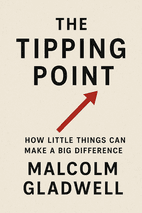
This page gathers some of the most memorable lines from Malcolm Gladwell’s The Tipping Point. You’ll find quotes that challenge how you think about social change, the unexpected power of small groups, and the hidden rules behind trends and behaviors. Each one captures a key idea in a way that sticks with you long after you read it.
The book is so quotable because Gladwell has a gift for turning complex social science into clear, surprising insights. He uses real stories and sharp observations to explain why ideas spread, why some things catch on and others don’t, and how tiny details can make a huge difference. These quotes are the kind you want to share, bookmark, and come back to.
Top Quotes from The Tipping Point
“It takes only the smallest of changes to shatter an epidemic's equilibrium.”
After discussing three different explanations for Baltimore's syphilis epidemic.
This line captures the core insight of the Tipping Point—that massive shifts can be triggered by tiny alterations.
“Unless you remember what I tell you, why would you ever change your behavior or buy my product or go to see my movie?”
The author discusses the Stickiness Factor and the importance of making messages memorable.
This rhetorical question highlights why stickiness is crucial for any idea or product to tip into widespread adoption.
“Six degrees of separation doesn't mean that everyone is linked to everyone else in just six steps. It means that a very small number of people are linked to everyone else in a few steps, and the rest of us are linked to the world through those special few.”
The author reflects on Stanley Milgram's small-world experiment and the role of Connectors.
It corrects a common misconception about six degrees of separation and highlights the critical function of a few highly connected individuals.
“The figure of 150 seems to represent the maximum number of individuals with whom we can have a genuinely social relationship, the kind of relationship that goes with knowing who they are and how they relate to us. Putting it another way, it’s the number of people you would not feel embarrassed about joining uninvited for a drink if you happened to bump into them in a bar.”
Robin Dunbar, the British anthropologist, presents his finding on the social channel capacity of humans.
It makes an abstract evolutionary concept instantly relatable by translating it into a vivid everyday experience, making the Rule of 150 memorable and intuitive.
“They are translators: they take ideas and information from a highly specialized world and translate them into a language the rest of us can understand.”
The author explains the role of Connectors, Mavens, and Salesmen in bridging the chasm between innovators and the mainstream.
This succinctly captures the core concept of 'translation' that is central to the chapter's argument about how epidemics cross from niche to mainstream.
“But they weren't cool because they smoked. They smoked because they were cool.”
The author analyzes why teenagers are drawn to smokers like Maggie and Billy G.
This line flips the conventional logic about smoking and coolness, making a memorable and counterintuitive point about influence and identity.
Themes Behind the Quotes
One major theme is that big changes often come from tiny, precise adjustments in our environment. The Broken Windows theory shows that fixing small signs of disorder can reverse an epidemic of crime, just as a subtle shift in context can tip a trend. This idea runs through the book: we are far more sensitive to our surroundings than we realize, and small tweaks can trigger enormous effects.
Another theme is the outsized role of a few rare individuals. Connectors bring together people from different worlds, Mavens gather and share knowledge, and Salesmen persuade with charisma. These types are the engines behind social epidemics. The book also explores the magic number 150, which defines the limit of our genuine social relationships, and the contagious nature of everything from fashions to suicides. Together, these themes reveal how order, influence, and behavior spread through networks.
Quotes by Chapter
ONE: The Three Rules of Epidemics
“When it comes to epidemics, though, this disproportionality becomes even more extreme: a tiny percentage of people do the majority of the work.”
The author explains the 80/20 Principle and extends it to the spread of epidemics.
It succinctly introduces the Law of the Few, emphasizing how a minuscule group can drive large-scale change.
“The Power of Context says that human beings are a lot more sensitive to their environment than they may seem.”
Concluding the section on the Kitty Genovese case and the bystander experiments.
It delivers the third rule in a memorable, counterintuitive statement that challenges our assumptions about behavior.
TWO: The Law of the Few
“The success of any kind of social epidemic is heavily dependent on the involvement of people with a particular and rare set of social gifts.”
The author explains why Paul Revere's ride succeeded while William Dawes's did not.
This line encapsulates the central thesis of the chapter, emphasizing that epidemics are driven not just by the message but by the people who spread it.
“These people who link us up with the world, who bridge Omaha and Sharon, who introduce us to our social circles—these people on whom we rely more heavily than we realize—are Connectors, people with a special gift for bringing the world together.”
The author summarizes the role of Connectors after tracing his own social network back to one person.
This powerful definition makes the abstract concept of Connectors concrete and memorable, showing how they shape our social lives.
“Horchow collects people the same way others collect stamps.”
The author describes Roger Horchow, a high-scorer on the acquaintance survey.
This simple, vivid simile perfectly captures the instinctive and passionate nature of a Connector, making the idea instantly relatable.
THREE: The Stickiness Factor
“Television is like a strain of the common cold that can spread like lightning through a population, but only causes a few sniffles and is gone in a day.”
The author describes the limitations of television as an educational medium.
This metaphor perfectly captures the paradox of television's wide reach but shallow impact, making the concept of stickiness tangible.
“Kids don't watch when they are stimulated and look away when they are bored. They watch when they understand and look away when they are confused.”
The author summarizes research by Lorch and Anderson on children's television viewing behavior.
It flips conventional wisdom on its head and provides a clear, memorable rule for creating engaging educational content.
“If you can hold the attention of children, you can educate them.”
This is the breakthrough insight that Sesame Street was built upon.
Simple, profound, and actionable; it distills the essence of educational television and the importance of stickiness.
“The gold box, Wunderman theorized, was a kind of trigger. It gave viewers a reason to look for the ads in TV Guide and Parade.”
Lester Wunderman explains the concept behind his successful direct marketing campaign for Columbia Record Club.
It illustrates how a small, seemingly trivial addition can dramatically increase stickiness and prompt action.
FOUR: The Power of Context (Part One)
“The kids would be in tears, but we'd just be going up and down, up and down. It was a message to them. If you want to spend three nights of your time vandalizing a train, fine. But it's never going to see the light of day.”
David Gunn, the subway director, describes his strategy of immediately painting over graffiti to send a message to vandals.
This quote illustrates the relentless, symbolic battle against disorder, showing how small actions send a powerful message, embodying the Broken Windows theory.
“This is an epidemic theory of crime. It says that crime is contagious—just as a fashion trend is contagious— that it can start with a broken window and spread to an entire community.”
Author explaining the Broken Windows theory of crime as an epidemic.
This memorable analogy makes the abstract concept of crime contagion concrete and intuitive, emphasizing that disorder can trigger a cascade of serious crime.
“Broken Windows theory and the Power of Context are one and the same. They are both based on the premise that an epidemic can be reversed, can be tipped, by tinkering with the smallest details of the immediate environment.”
Author summarizing the core idea linking Broken Windows theory to the Power of Context.
This is the central thesis of the chapter, succinctly stating that small environmental changes can trigger major behavioral shifts, a counterintuitive and powerful insight.
“It was simply inconceivable that someone could pull a gun on someone else on the subway and be called a hero for it.”
Description of the changed public attitudes in New York City by 1996 after crime had fallen dramatically.
This line captures the dramatic shift in perception, showing how context transformed what was once heroic into something inconceivable, highlighting the power of environment.
FIVE: The Power of Context (Part Two)
“Man evolved to feel strongly about few people, short distances, and relatively brief intervals of time; and these are still the dimensions of life that are important to him.”
Evolutionary biologist S. L. Washburn explains the limits of human emotional capacity.
This line powerfully reminds us that our deepest connections are naturally limited, grounding modern social dynamics in our evolutionary past.
“At 150, the Hutterites believe, something happens—something indefinable but very real—that somehow changes the nature of community overnight.”
Bill Gross, a leader of a Hutterite colony, describes their centuries-old practice of splitting groups once they approach 150 people.
It captures the dramatic tipping point effect of group size, showing how a small numerical change can fundamentally alter human relationships.
“The loss of transactive memory feels like losing a part of one’s own mind.”
Psychologist Daniel Wegner, explaining the emotional toll of divorce through the concept of transactive memory.
It makes an abstract psychological concept deeply personal and relatable, underscoring how shared knowledge systems bind relationships.
SIX: Case Study
“In their effort after meaning, the subjects would condense or fill in so as to achieve a better ‘Gestalt,’ a better closure—a simpler, more significant configuration.”
Allport describes how memory experiments show that people distort information to create a simpler, more meaningful story.
This quote illustrates the psychological mechanism behind how rumors and ideas are reshaped during diffusion, making them more contagious.
“If anyone wants to start an epidemic, then —whether it is of shoes or behavior or a piece of software—he or she has to somehow employ Connectors, Mavens, and Salesmen in this very way: he or she has to find some person or some means to translate the message of the Innovators into something the rest of us can understand.”
The author summarizes the key prescription for creating a social epidemic.
This is a powerful, direct statement of the chapter's practical takeaway, emphasizing the necessity of translation.
“The real retailers were these handfuls of men—these super-exchangers—who were prowling around the streets and shooting galleries, picking up dirty needles, and then making a modest living on the clean needles they received in exchange.”
Describing how needle exchange programs inadvertently rely on highly connected addicts to distribute clean syringes.
This vivid example shows how the same principles of Connectors and translation apply in public health, making the theory concrete and memorable.
EIGHT: Conclusion
“My life is coming to an end at this time. Now today is a day of sorrow for myself, also a day of suffering for me. But it is a day of celebration for Papa. Today Papa sent me away. Thank you for loving me so little. Sima. Give my farewell to Mama. Mama you won't have any more frustration or trouble from your boy. Much love from Sima.”
The suicide note of seventeen-year-old Sima, who hanged himself after a dispute with his father in Micronesia.
This note is heartbreakingly raw and encapsulates how a minor domestic conflict can trigger a tragic act, revealing the wounded pride and self-pity that characterizes the epidemic.
“What, in Western cultures, is something rare, random, and deeply pathological, has become in Micronesia a ritual of adolescence, with its own particular rules and symbols.”
The author summarizes the transformation of suicide into a cultural norm in Micronesia.
This line powerfully captures how social context can normalize an extreme behavior, making the unthinkable seem ordinary and even expected among teens.
“The “permission” given by an initial act of suicide, in other words, isn’t a general invitation to the vulnerable. It is really a highly detailed set of instructions, specific to certain people in certain situations who choose to die in certain ways.”
The author explains David Phillips's research on suicide contagion and the specificity of its influence.
It reframes suicide epidemics as precise, almost instructional phenomena, highlighting how subtle social cues can shape behavior in narrowly defined groups.