The Tipping Point Key Takeaways
by Malcolm Gladwell
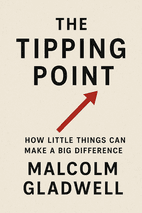
5 Main Takeaways from The Tipping Point
Small changes in key areas can trigger massive social epidemics.
Gladwell's three rules—the Law of the Few, Stickiness Factor, and Power of Context—show that tipping points occur from minor adjustments, not major overhauls. For instance, focusing on key influencers or tweaking environmental details can lead to widespread adoption of trends or behaviors, as seen in crime reduction or product launches.
Influential people spread ideas through subtle social cues and emotional contagion.
The Law of the Few emphasizes that connectors, mavens, and salesmen drive epidemics by mastering nonverbal signals, synchrony, and mood transfer. Historical trends, from revolutions to fads, often hinge on these few persuasive individuals who shape decisions more powerfully than logical arguments.
Memorable messages demand testing and subtle presentation adjustments for stickiness.
The Stickiness Factor reveals that content becomes infectious through narrative structure, active engagement, and repetition. Small changes in presentation—like pause length or clue sequencing—can dramatically enhance comprehension, as demonstrated by educational children's programming like Sesame Street.
Context shapes behavior more than character, so modify environments for change.
The Power of Context argues that behavior is context-dependent, such as how time pressure affects altruism or clean environments reduce crime. By addressing environmental cues and leveraging small groups under 150, we can tip social epidemics, as shown in community policing or organizational design.
Targeted interventions outperform broad campaigns in creating social change.
Gladwell advocates for 'Band-Aid solutions'—focused efforts on key influencers, sticky messages, and specific contexts—rather than sweeping initiatives. This is evident in case studies like smoking cessation, where targeting neurochemical pathways or addiction thresholds yields better results than generic anti-smoking ads.
Executive Analysis
The five takeaways interconnect to form Gladwell's central thesis: social epidemics tip not from grand efforts but from small, targeted changes in three areas—influential people, message memorability, and environmental context. Together, they illustrate a counterintuitive framework where minor adjustments, like focusing on key connectors or tweaking presentation details, can cascade into large-scale trends, from product adoption to behavioral shifts.
This book matters because it provides practical, evidence-based strategies for marketers, policymakers, and change agents to leverage these principles efficiently. As a cornerstone of pop sociology, it challenges conventional wisdom by showing how human behavior is malleable through context, offering a blueprint for creating or curbing epidemics in business, public health, and social movements.
Chapter-by-Chapter Key Takeaways
The Three Rules of Epidemics (Chapter 1)
Epidemics tip due to minor changes in three areas: influential people (Law of the Few), memorable messages or agents (Stickiness Factor), and environmental details (Power of Context).
Understanding these rules helps decode not only disease outbreaks but also social trends, from product adoption to behavioral shifts.
Small, targeted interventions—like focusing on key individuals, enhancing message retention, or adjusting contexts—can trigger widespread impact, offering practical strategies for creating or curbing epidemics.
Try this: Identify and leverage key influencers, enhance message memorability, and adjust environmental details to trigger change.
The Law of the Few (Chapter 2)
Subtle cues overpower logic: Small nonverbal signals, like smiles or nods, can shape decisions more powerfully than explicit arguments.
Synchrony builds bonds: Unconscious physical and conversational harmony enhances persuasion, making interactions feel natural and compelling.
Emotions are contagious: Expressive individuals ("senders") can transfer moods effortlessly, influencing others from the outside in.
Historical parallels: Social epidemics, from revolutions to trends, often hinge on a few persuasive people mastering these hidden dynamics.
Try this: Master nonverbal communication and emotional expression to build synchrony and persuade others effectively.
The Stickiness Factor (Chapter 3)
Narrative as natural learning: Children instinctively organize experiences through storytelling, making narrative structure particularly effective for educational content
Active engagement beats passive viewing: Direct address, strategic pauses, and opportunities to participate transform television from entertainment to interactive learning
Repetition as empowerment: For preschoolers, repeated exposure provides deepening understanding and predictive power rather than boredom
Small adjustments create big impact: Minor changes in presentation—like clue sequencing or pause length—can dramatically affect engagement and comprehension
Testing reveals invisible barriers: Intensive research uncovers subtle obstacles to stickiness that creators might otherwise miss
The stickiness of educational content often depends not on major overhauls but on careful attention to presentation details that align with how children naturally learn and process information.
Try this: Use storytelling and interactive elements while testing small presentation tweaks to make content stick.
The Power of Context (Part One) (Chapter 4)
Character is not fixed but context-dependent, emerging from a bundle of habits influenced by immediate circumstances.
Small environmental factors, like time pressure, can override personal convictions, as shown in the Good Samaritan study.
Crime and social epidemics can be tipped by addressing environmental cues, such as disorder, rather than focusing solely on individual dispositions.
Peer and community influences often surpass family impact in shaping behavior, reinforcing the power of external context.
Clean and orderly environments can promote better behavior, illustrating how context transforms potential actions into reality.
Try this: Alter immediate surroundings and social settings to encourage desired behaviors over relying on character appeals.
Next chapter: “The Power of Context (Part Two)” is locked
Keep learning from The Tipping Point — and unlock all 600+ book summaries with audio, mindmaps and AI Q&A.
$0.00 due today · 7 days free, then $89.99/year ($7.49/mo) · Cancel anytime before day 7
plus sales tax where applicable