The Spy and the Traitor Quotes
by Ben Macintyre
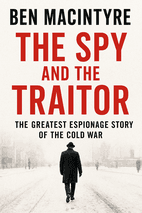
This collection gathers some of the sharpest lines from Ben Macintyre's account of Cold War espionage. You will find tense observations, dark humor, and surprising moments of humanity. The book is full of quotes that stick because they reveal the strange inner world of spies and the people who run them.
What makes these lines so shareable is how they balance high stakes with everyday absurdity. The characters think they are in control, but the quotes show how easily trust crumbles. You get a front row seat to the paranoia, the bravery, and the sheer weirdness of a life lived in secrets.
Top Quotes from The Spy and the Traitor
“The spy was being spied upon by his fellow spies.”
The final line of the chapter, after Gordievsky discovers his apartment has been bugged.
This line delivers a sharp, ironic twist that encapsulates the core tension of the narrative: the hunter becomes the hunted.
“For Oleg Gordievsky, KGB veteran, faithful secret servant of the Soviet Union, was a British spy.”
The narrator reveals Gordievsky's true allegiance after describing his KGB career.
The juxtaposition of 'faithful secret servant' with 'British spy' creates a powerful dramatic irony that defines the book's central conflict.
“Better that ten innocent people should suffer than one spy get away,” said Nikolai Yezhov, chief of the NKVD. “When you chop wood, chips fly.”
Yezhov justifies the Great Purge's brutality during Stalin's terror.
The chilling pragmatism of these words captures the ruthless calculus of the Soviet security state and the human cost of its paranoia.
“There was so much beauty, such lively music, such excellent schools, such openness and cheeriness among ordinary people, that I could only look back on the vast, sterile concentration camp of the Soviet Union as a form of hell.”
Gordievsky describing his blossoming in Denmark compared to life in the Soviet Union.
This vivid contrast between Western vibrancy and Soviet oppression captures the core of Gordievsky's personal and ideological awakening.
“Richard Bromhead was one of those Englishmen who put a great deal of effort into appearing to be a lot stupider than they really are.”
Narrator describing the MI6 head of station in Copenhagen.
This line captures the deceptive, theatrical nature of intelligence work, where appearing foolish is a clever strategy.
“But as the chief of the CIA, Richard Helms, observed, infiltrating an agent into the KGB was “as improbable as placing resident spies on the planet Mars.””
The narrator cites Helms to illustrate the extreme difficulty of running an agent inside the KGB.
The vivid Mars analogy makes the near-impossibility of Gordievsky's position tangible, highlighting how extraordinary his recruitment and survival are.
“In launching Operation RYAN, Andropov broke the first rule of intelligence: never ask for confirmation of something you already believe.”
The author's commentary on Andropov's flawed intelligence operation.
This aphorism encapsulates a timeless cognitive bias, making it a powerful warning about confirmation bias in intelligence and decision-making.
Themes Behind the Quotes
One major theme is the cost of living a double life. The quotes highlight how constant suspicion eats away at relationships, both personal and professional. Betrayal is not just a tool but a poison that infects everyone involved. Another thread is the moral fog of the Cold War, where loyalty becomes a matter of survival and ideology often takes a backseat to human weakness.
A second theme is the strange bureaucracy that surrounds intelligence work. The quotes poke fun at the absurd rules, the petty jealousies, and the way power can make people act foolishly. At the same time, there is a deep contrast between the repressive Soviet system and the relative openness of the West. Freedom becomes a tangible, dangerous thing, something worth risking everything for.
Quotes by Chapter
Introduction: May 18, 1985
“He was under suspicion. Someone had betrayed him. The KGB was watching him.”
Gordievsky's realization after finding his apartment door triple-locked.
Three short, declarative sentences build a crushing sense of paranoia and imminent danger, making the reader feel his fear.
“Everyone at the meeting understood the stakes: if he returned as official KGB rezident then MI6, the CIA, and their Western allies would hit the intelligence jackpot, but if Gordievsky was walking into a trap he would lose everything, including his life.”
The narrator explains the high-risk decision faced by Gordievsky and his MI6 handlers.
This sentence lays out the stark binary of espionage—immense reward versus total loss—heightening the suspense and underscoring the historical importance of Gordievsky's choice.
Chapter 1: The KGB
“All warmth disappeared,” Oleg recalled of the ensuing clampdown. “An icy wind set in.”
Oleg Gordievsky describes the atmosphere after the Soviet crackdown on the Hungarian Uprising in 1956.
This simple, vivid metaphor conveys the emotional and political freeze that followed Khrushchev's brief thaw, marking a turning point in Gordievsky's disillusionment.
“Only a physical barrier, reinforced by armed guards in their watchtowers, could keep the East Germans in their socialist paradise and stop them fleeing to the West.”
Gordievsky reflects on the Berlin Wall's construction, which he witnessed upon arriving in East Berlin.
The bitter irony of the phrase 'socialist paradise' highlights the regime's need for coercion to retain its citizens, a moment that deepened Gordievsky's doubts.
“It was I, rather than she, who was being tested.”
Gordievsky later realizes his first KGB task—contacting a former informant—was actually a loyalty test for him.
This line reveals the KGB's pervasive surveillance and manipulation, even of its own recruits, and underscores the theme of hidden motives that runs through the chapter.
Chapter 2: Uncle Gormsson
“Who but a fully indoctrinated KGB officer would be able to taste such freedoms and resist the urge to stay?”
Gordievsky reflects on why ordinary Soviet citizens were not permitted to travel abroad.
This line encapsulates the seductive power of Western freedom and the moral dilemma facing a KGB officer, hinting at Gordievsky's eventual transformation.
“This brutal attack on innocent people made me hate it with a burning, passionate hatred.”
Gordievsky's reaction to the Soviet invasion of Czechoslovakia in 1968.
It marks the turning point where his alienation from the regime crystallizes into active loathing, driving his later decision to spy for the West.
“Gordievsky was repelled by his own homeland: “How shabby everything seemed.””
The narrator describes Gordievsky's feelings upon returning to the Soviet Union in January 1970.
This line captures the stark contrast between the vibrancy of Denmark and the grim decay of the USSR, summarizing Gordievsky's deepening disillusionment.
Chapter 4: Green Ink and Microfilm
“Even the most ardent Danish Communists balked at treachery.”
Narrator explaining the difficulty of recruiting Danish spies.
It highlights the moral integrity of the Danish people, making the KGB's recruitment efforts in Denmark especially challenging.
“Gordievsky later claimed that he was primed and waiting for a tap on the shoulder from the opposition, but the reality was more complicated than memory, as it almost always is.”
Narrator reflecting on Gordievsky's retrospective account of his readiness to be approached by Western intelligence.
This line artfully underscores the tension between self-narrative and messy truth, a central theme in espionage memoirs.
“This was a trial, and a very dangerous one.”
Narrator describing Gordievsky's realization when his friend Kaplan, now a defector, unexpectedly visits him.
It succinctly conveys the life-or-death stakes of Gordievsky's covert gamble, heightening the suspense.
Chapter 5: A Plastic Bag and a Mars Bar
“Veronica Price was indoctrinated into the Gordievsky case, and so it was that she found herself grappling with a problem that had never faced MI6 before: how to smuggle a spy out of Soviet Russia.”
The narrator introduces the challenge that MI6 officer Veronica Price must solve after Gordievsky asks for an escape plan.
This line succinctly captures the unprecedented audacity of the mission and sets up the high-stakes tension that drives the entire chapter.
“We cannot make any promises, and we cannot give a hundred percent guarantee that you can escape.”
MI6 officer Guscott responds to Gordievsky's request for a guaranteed escape from the Soviet Union.
The blunt honesty of this statement underscores the immense risk Gordievsky faces and the limits of even the most sophisticated intelligence agencies.
“Oleg was too good to jeopardize. We had something so precious that we had to exercise restraint.”
An MI6 officer explains the decision not to run Gordievsky inside the Soviet Union.
This quote captures the rare self-discipline in intelligence work, emphasizing that preserving the agent was more valuable than immediate gains, and underscores Gordievsky's unique value.
Chapter 6: Agent BOOT
“The Crocodile was one of those people, familiar in every large bureaucracy, who dispenses patronage on the understanding that the recipient will thereafter be a slave.”
Description of KGB officer Gennadi Titov, nicknamed 'The Crocodile'.
This line captures the corrosive dynamics of power and sycophancy in any large organization, making it universally relatable and memorable.
“He would spy for Britain, in Britain, and one day, perhaps soon, perhaps years hence, he would tell MI6 he was finished. Then he could defect; he would finally reveal his double life to his wife, and they would remain in Britain, forever.”
Gordievsky's private fantasy about his future as a double agent, which he does not share with his wife Leila.
The emotional weight of his secret aspiration—and the poignant contrast with his wife's different dream—creates a powerful moment of dramatic irony.
“The BOOT file, if it became public, would put paid to that in an instant.”
Referring to the KGB file on Labour Party leader Michael Foot, who could have become prime minister.
This simple sentence underscores the staggering political stakes and the explosive potential of the intelligence Gordievsky has uncovered.
“I, senior operational officer Major Petrov, lvan Alexeyevich, herewith open a file on the agent Michael Foot, citizen of the UK, giving him the pseudonym Boot.”
The opening line of the KGB file on Michael Foot, as read by Gordievsky.
The cold bureaucratic language used to document a sitting opposition leader as a paid agent is chilling and highlights the scale of Soviet espionage.
Chapter 7: The Safe House
“Deep inside Rick Ames was a canker of cynicism, hard and inflamed, growing so slowly that no one had noticed it, least of all Ames himself.”
Describing Aldrich Ames' hidden resentment and moral decay.
This line captures the slow, unnoticed corrosion of loyalty that leads to betrayal.
“There is no business like it,” Nikitenko declared, reflecting on his work combating MI5 and MI6. “We are politicians. We are soldiers. And, above all, we are actors on a wonderful stage. I cannot think of a better business than the intelligence business.”
KGB counterintelligence chief Leonid Nikitenko explaining his view of the intelligence business.
Memorable boast encapsulating the theatrical, manipulative nature of Cold War espionage.
“The envy, the vicious thinking, the underhand attacks, the intrigues, the denunciations, all these were on a scale that made the Center in Moscow seem like a girls’ school.”
Oleg Gordievsky's impression of the KGB London station.
Vivid, darkly humorous comparison emphasizes the toxic paranoia and infighting.
“I knew that Michael Foot was thought to have had contacts with the KGB before he became leader of the Labour Party and that Tribune was believed to have received financial support from Moscow, probably from the KGB...Gordievsky confirmed this. I do not know how much of that was disclosed to the foreign secretary or to the prime minister.”
Cabinet Secretary Sir Robert Armstrong discussing what he knew about Michael Foot's KGB contacts.
It reveals the deliberate concealment of politically explosive information from the prime minister, demonstrating the ethical dilemmas faced by intelligence officials. The careful phrasing 'economical with the truth' echoes his later infamous testimony.
Chapter 8: Operation RYAN
“The only thing more dangerous than revealing your own ignorance is to draw attention to the stupidity of the boss.”
Describes the culture of the KGB where subordinates dared not correct Andropov's misunderstanding about blood banks.
It highlights the dangerous consequences of hierarchical fear and sycophancy, a lesson that resonates beyond espionage into any organization.