The Sirens' Call Quotes
by Chris Hayes
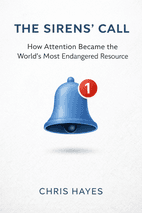
Chris Hayes' 'The Sirens' Call' is a sharp exploration of attention in the modern world. From the infant's cry to the endless scroll, the quotes here capture the book's core insight: that our attention is the most fundamental human need, and the systems around us are designed to exploit it.
What makes this book so quotable is its blend of neuroscience, economics, and cultural observation. Hayes writes in crisp, memorable lines that snap with insight. You will find metaphors that stick and blunt truths about how we live now. These are lines you want to underline and share. They force you to reconsider how you spend your time.
Top Quotes from The Sirens' Call
“Attention is the most fundamental human need. The newborn of our species is utterly helpless. It can survive only with attention—that is, if some other human attends to it. That attention will not itself sustain an infant, but it is the necessary precondition to all care. If you neglect a child, it will perish. We are built and formed by attention; destroyed by neglect.”
The author reflects on the biological and emotional necessity of attention for human survival and development.
This passage grounds the abstract concept of attention in the raw, universal experience of infancy and care, making its importance viscerally clear and unforgettable.
“Information is infinite and attention is limited. And value derives from scarcity, which is why attention is so valuable.”
The author presents a central axiom explaining the economic logic behind the attention economy.
This succinct, almost aphoristic statement crystallizes a complex economic shift into a single, memorable insight that readers can immediately grasp and apply.
“/t is easier to grab attention than to hold it.”
Author presents a core insight about the attention economy.
This simple, declarative sentence encapsulates the central thesis of the chapter and is immediately understandable yet profound in its implications for media and technology.
“The unoccupied mind can be a feral beast, and much of our lives, in Pascal's view, is spent trying to tame it.”
After exploring Pascal's meditation on diversion and boredom.
The metaphor of the feral beast vividly conveys the danger of an unoccupied mind and the human struggle to avoid confronting our own thoughts.
“Social attention is like sunlight for a plant: we need it to live. It warms and nourishes us. We stretch toward its presence; we shrivel in its absence.”
The author explains why social attention is as essential as sunlight for human flourishing.
The metaphor is instantly accessible and poetic, turning an abstract concept into a tangible, life-or-death necessity that resonates emotionally.
“If attention is the substance of life, then the question of what we pay attention to is the question of what our lives will be.”
The author reflects on the fundamental importance of attention after describing the negative effects of the attention age.
This line encapsulates the book's central philosophy, making readers reconsider how they spend their time and what truly matters.
“First, they are good to their users; then they abuse their users to make things better for their business customers; finally, they abuse those business customers to claw back all the value for themselves. Then, they die. I call this enshittification.”
Cory Doctorow's definition of 'enshittification' is quoted by the author to describe the lifecycle of online platforms.
The term has become a viral concept for explaining why digital services degrade, and the quote is both precise and darkly memorable.
Themes Behind the Quotes
The central theme is that attention is the most scarce and valuable resource in a world overflowing with information. Hayes argues that our evolutionary wiring makes us desperate for attention, both giving and receiving it, but modern systems exploit this need. The result is a constant battle for our focus, where easy diversion replaces deeper engagement.
Another key theme is the transformation of attention from a mere resource into the ultimate goal. In the attention economy, the pursuit of engagement often degrades the quality of content and interaction. Hayes also highlights the social necessity of attention, comparing it to a life giving force. Finally, the concept of enshittification describes how platforms inevitably become worse for users as they prioritize extraction over value.
Quotes by Chapter
Chapter 1: The Sirens’ Call
“Now our deepest neurological structures, human evolutionary inheritances, and social impulses are in a habitat designed to prey upon, to cultivate, distort, or destroy that which most fundamentally makes us human.”
The author describes the modern attention economy as an environment hostile to our innate human qualities.
It powerfully captures the existential threat posed by systems that exploit our most fundamental faculties, evoking a sense of urgency and alarm.
“A cable news show is powered by attention. It has no internal combustion engine to make it go. Yes, you can cover whatever you desire night after night, but if no one watches it, the show will be canceled.”
The author shares his firsthand experience as a cable news host learning that attention is the fuel that drives his show.
This vivid metaphor demystifies the media industry and reveals the precarious, dependence-laden reality behind the scenes, making the theory feel personal and grounded.
Chapter 2: The Slot Machine and Uncle Sam
“Information is abundant; attention is scarce.”
The author summarizes economist Herbert Simon's insight about the attention economy.
This line succinctly captures the fundamental economic paradox of the modern information age, making it instantly memorable and quotable.
“We are creatures whose very survival depends on attention. We perish in neglect.”
The author discusses human infants' helplessness and the evolutionary necessity of attention.
It starkly reminds us that attention is not just a luxury but a biological imperative, linking psychological need to survival.
“We cannot will ourselves to not suddenly hear the explosive crash of the tray of champagne glasses, no matter how attentively we are listening to the woman relay her experience with the chiropractor.”
The author uses a cocktail party example to illustrate involuntary attention.
This vivid, relatable scenario demonstrates the limits of voluntary control and the irresistible force of unexpected stimuli, making the concept tangible.
Chapter 3: The Root of Evil
“We want to have our attention taken, because it is pleasurable to be gripped in the hold of the Sirens’ song.”
The author discusses why Circe devised a plan for Odysseus to hear the Sirens rather than join his crew in silent safety.
This line encapsulates the central paradox of the attention age—we seek distraction because it is pleasurable, even when we know it may be dangerous.
“Boredom, it seems, is the by-product of a specific civilizational arrangement.”
Following anthropological evidence that many indigenous cultures lack a word for boredom.
This concise statement challenges the assumption that boredom is universal, grounding it in specific social and economic structures.
“The more diversion available, the more diversion we need, and the more intolerable we find its absence.”
Describing the 'king's paradox' in the context of endless diversions.
It captures the addictive cycle of needing more stimulation, a key insight for understanding modern media consumption and the nature of attention.
Chapter 4: Social Attention
“The cry is the original human siren call, and the attention it commands is the foundation of the propagation of our species.”
The author discusses the piercing wail of a newborn and its evolutionary purpose.
It vividly frames the infant's cry as an ancient, irresistible signal that ensures survival, connecting a mundane experience to deep biological imperatives.
“To be a parent, particularly the parent of an infant, is to have one’s attention always divided. This is the evolutionary bargain we have struck.”
The author reflects on the moment his attention permanently split after his daughter's birth.
It captures the universal, bittersweet trade-off of parenthood with stark honesty, making readers recognize their own divided loyalties.
“Nothing is more dehumanizing than the absence of human companionship.”
Nelson Mandela, after trying to bribe his prison guard for conversation, concludes this about solitary confinement.
This concise, devastating line from a revered leader underscores the fundamental human need for connection, making the horror of isolation visceral.
Chapter 5: Alienation
“People live cheek-by-jowl but don’t interact with each other.”
A Taliban fighter describes the anonymity of urban life in Kabul after the group's takeover.
This line succinctly captures the paradox of physical proximity without social connection, a core experience of alienation in modern cities.
“They have won the war only to become victims of a far more powerful foe.”
The author reflects on the Taliban fighters' transition from insurgents to office workers.
It highlights the ironic twist that victors become subject to a new form of domination—the alienation of modern life.
“He becomes an appendage of the machine, and it is only the most simple, most monotonous, and most easily acquired knack, that is required of him.”
Marx and Engels in The Communist Manifesto describe the factory worker under industrial capitalism.
This vivid metaphor for dehumanization remains powerful and directly parallels the commodification of attention in the modern era.
“The modern attention economy does to attention something quite similar to what industrial capitalism did to labor.”
The author draws an analogy between Marx’s theory of alienation and the attention industry.
This crisp statement encapsulates the chapter's central thesis, making the link between historical and contemporary alienation clear.
Chapter 6: Dawn of the Attention Age
“What information consumes is rather obvious: it consumes the attention of its recipients. Hence a wealth of information creates a poverty of attention and a need to allocate that attention efficiently among the overabundance of information sources that might consume it.”
Herbert Simon's 1971 lecture 'Designing Organizations for an Information-Rich World' as recounted by the author.
This is the foundational insight of the attention economy, expressing a logical inevitability that the information age is also the attention age.
“If humans had struggled for thousands of years with a dearth of calories, they were—at least in certain societies and classes—now wrestling with the ramifications of an abundance.”
The author draws an analogy between food scarcity and information overload in the information age.
This metaphor makes the problem of information overload visceral and relatable, likening our current plight to the obesity epidemic following food abundance.
“Most of us are constitutionally unable to throw a bound volume into the wastebasket.”
Herbert Simon's observation about people conditioned to informational poverty, as cited by the author.
It perfectly captures the psychological difficulty of filtering information in an age of abundance, a habit that persists despite the need for conservation of attention.
“UNDERSTANDING THAT ATTENTION IS A finite and scarce resource helps to explain one of the great economic mysteries of the last fifty years, which is why we haven't seen productivity grow more than it has.”
The author discusses the productivity paradox of the information age.
It succinctly ties the concept of attention scarcity to a major economic puzzle, making a complex idea immediately relatable.
Chapter 7: Public Attention
“It would be, inevitably and unavoidably, a far, far stupider, shallower enterprise.”
The author compares the Lincoln-Douglas debates to how they would be handled in a modern TV format.
This line succinctly captures the degradation of public discourse when complex ideas are compressed into soundbites, resonating with anyone frustrated by the shallowness of modern political debates.
“Attention ascends from a means to an end to the end itself.”
The author summarizes the collapse of attentional regimes in the attention age.
This concise phrase encapsulates the core problem of modern public debate: that capturing attention has become the ultimate goal, overriding persuasion and substantive discussion.
“And then “a guy walks in with a megaphone. He's not the smartest person at the party, or the most experienced, or the most articulate. But he's got that megaphone.””
The author recounts George Saunders' thought experiment about a man with a megaphone at a cocktail party.
It vividly illustrates how attention-grabbing but shallow discourse can dominate and degrade conversation, resonating with anyone who feels overwhelmed by loud, simplistic voices in media.
“And the conversation morphed into a game of telephone, of everyone shouting variations of the same snippets of language, phrases, slogans—an endless aural hall of mirrors.”
The author describes the outcome of giving everyone their own megaphone on social media.
It captures the chaotic and disorienting nature of online discourse where everyone shouts but no one listens, mirroring the reader's own experience of scrolling through social media.