The Sirens' Call Key Takeaways
by Chris Hayes
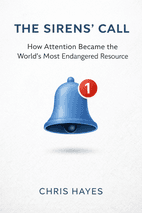
5 Main Takeaways from The Sirens' Call
Attention is the new capital, more valuable than data in modern economy.
Chris Hayes posits that the largest companies today are attention companies, monetizing our focus as a scarce resource. This shift has made attention a currency interchangeable with material wealth, defining power and influence in the digital age.
Digital platforms hijack your biology with slot machine designs.
Social media and games exploit the asymmetry between grabbing and holding attention, using constant interruptions and social cues like tags to capture involuntary, preconscious focus. This model prioritizes repetitive engagement over meaningful connection.
Genuine human recognition cannot be bought with social media likes.
The book distinguishes between fleeting attention and deep mutual acknowledgment, arguing that platforms offer synthetic validation that leaves users 'stuffed and starved.' True fulfillment requires relationships of equality, not asymmetric fame.
Commodifying attention alienates us and degrades public discourse.
Treating attention as a fictitious commodity leads to a race to the bottom in content, fostering sensationalism, conspiracy theories, and a fragmented culture. This competitive pressure undermines journalism and collective experience.
Reclaim your mind through personal discipline and collective action.
Resisting attention capitalism involves supporting ethical tech, advocating for regulation like child protections, and reviving analog experiences. The goal is to restore cognitive sovereignty over our precious hours and focus.
Executive Analysis
In 'The Sirens' Call,' Chris Hayes synthesizes these takeaways into a central thesis: attention has replaced labor as the primary resource extracted by modern capitalism, leading to a pervasive system of commodification that hijacks our biology and fractures society. The book argues that from social media's slot machine mechanics to the alienation of public discourse, we are trapped in attentional warfare that demands a strategic peace.
This book matters because it provides a crucial framework for understanding the invisible forces shaping our daily lives, linking personal habits to broader economic and political crises. It sits at the intersection of media criticism, political theory, and self-help, offering actionable pathways for individuals and communities to reclaim autonomy in an age of distraction.
Chapter-by-Chapter Key Takeaways
The Sirens’ Call (Chapter 1)
Attention is the fundamental, scarce resource upon which modern economic, social, and political life is built.
The largest companies today are not data firms but attention companies, which monetize our focus.
In modern capitalism, the brand (an attentional marker) often holds more value than the physical product or supply chain.
Political power has always been linked to attention, but digital mass media and social platforms have intensified this to an unprecedented degree.
Attention is a biological human need, making us uniquely vulnerable to systems designed to exploit it.
Professionals in media chase audience attention more than they dictate it, operating in constant fear of losing it.
The current era is defined by the commodification of attention, a shift as alienating and systemic as the commodification of labor during the Industrial Revolution.
The text begins by examining the fundamental difference in how labor and attention are extracted from individuals. Extracting labor historically requires a clear, conscious transaction—compensation through wages, or overt coercion and violence, like a whip or a threat. The person being forced to dig a ditch under threat understands they are being coerced; their conscious will is engaged, even if tragically.
Attention, however, operates on a different, more primal level. It can be hijacked at the sensory and preconscious stage, before rational thought or will can intervene. The startling sound of a gunshot automatically captures attention; it’s an involuntary reflex. This is the mechanism of a siren—it bypasses conscious choice entirely. This distinction reveals why the modern extraction of our attention feels so pervasive and insidious: it often happens before we even have a chance to decide whether to grant it.
Attention is extracted differently from labor: it can be captured involuntarily at a sensory, preconscious level, bypassing our conscious will.
Attention is the primary and foundational resource in modern society; all persuasion, communication, and power must first secure it.
Multiple domains of life—from politics and business to personal relationships—are now characterized as exhausting “wars for attention.”
The central aim of the book is to diagnose this condition of attentional warfare and to seek strategies for peace and reclamation.
Try this: Audit what captures your focus by recognizing that attention is extracted before conscious consent, making you vulnerable to economic and political manipulation.
The Slot Machine and Uncle Sam (Chapter 2)
A core structural rule of the attention economy is the profound asymmetry between grabbing attention (easy) and holding it (hard).
This asymmetry maps onto involuntary (biological) versus voluntary (conscious) attention.
Like our relationship with food, our attention has a universal biological layer that can be exploited (e.g., with clickbait), but also a vast, unpredictable realm of cultivated taste and deep engagement.
Because commanding voluntary attention is an unreliable art, the most potent economic model is the "slot machine": avoiding the hold altogether and engineering systems for continuous, repetitive grabs of involuntary attention.
The parallels between video games and slot machines extend far beyond the gaming console. Titles like Call of Duty master the art of constant, low-level threat and random reward through mechanics like loot boxes, capturing attention for millions of collective human years. This model has become the blueprint for the most pervasive platforms of our time.
The dominant attention model of the digital age is the “slot machine,” perfected by social media feeds, which relies on constant, low-commitment interruption rather than sustained engagement.
Our fundamental need for social attention is a primary target for capture, enabled by technology that allows for personalized identification and hails, mimicking the cocktail party effect.
Platform features like tags and mentions are actively designed to orchestrate and amplify our natural desire for social approval, driving compulsive use.
The attention extraction process can be summarized as hail (social attention), grab (involuntary attention), and hold (voluntary attention), with immense resources focused on the first two, easier methods.
Try this: Identify and reduce digital triggers by understanding how apps use slot machine mechanics to hijack your involuntary attention through constant, low-commitment interruptions.
The Root of Evil (Chapter 3)
Boredom is framed not as a trivial annoyance but as an existential and spiritual crisis, identified by thinkers like Kierkegaard as the “root of all evil.”
Our current age traps us in a cycle: we seek escape from discomfort through digital diversion, which only heightens our need for stimulation and makes deep focus (flow) harder to achieve.
Historical wisdom, from Kierkegaard to the Buddha, suggests the solution is internal—cultivating comfort with idleness and stillness rather than seeking more amusement.
The lost practice of unstructured mind-wandering or daydreaming is a vital creative and restorative state, eroded by constant digital engagement.
Ultimately, the pervasive boredom of modernity is linked to social structures that create isolation; the most profound escape from the “king’s paradox” may be found in genuine human connection.
Try this: Schedule time for unstructured mind-wandering to cultivate comfort with boredom, breaking the cycle of digital diversion that erodes deep focus and genuine connection.
Social Attention (Chapter 4)
Attention is not recognition. The chapter argues for a crucial distinction: attention is a fleeting, often shallow notice, while recognition is a deep, mutual acknowledgment of shared humanity and subjectivity.
Social media offers a synthetic, unsatisfying substitute. Platforms are engineered to provide endless cheap attention (likes, replies), which mimics but cannot fulfill the fundamental human need for genuine recognition, leading to addictive cycles.
The master-slave paradox is central. True recognition requires mutual respect between equals. Asymmetric relationships (Star/Fan, influencer/follower) are structurally incapable of providing the recognition sought, resulting in existential dissatisfaction even amidst massive fame.
The condition is universal but amplified by technology. The Willy Loman struggle for notice is a timeless human dilemma, but the architecture of the attention economy systematically exploits this vulnerability, turning the quest for recognition into a compulsive hunt for validation.
The result is a state of being "stuffed and starved." We live in an unprecedented age where one can be inundated with global attention yet remain profoundly isolated and unrecognized in the meaningful, existential sense.
Try this: Invest in relationships that offer mutual recognition, not just online validation, to satisfy the fundamental human need for acknowledgment that social media cannot fulfill.
Next chapter: “Alienation” is locked
Keep learning from The Sirens' Call — and unlock all 600+ book summaries with audio, mindmaps and AI Q&A.
$0.00 due today · 7 days free, then $89.99/year ($7.49/mo) · Cancel anytime before day 7
plus sales tax where applicable