As an Amazon Associate, we earn from qualifying purchases.
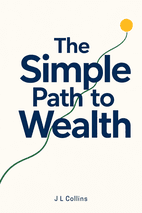
J L Collins's The Simple Path to Wealth lays out a three-rule framework—spend less than you earn, invest the surplus, avoid debt—built around low-cost Vanguard index funds like VTSAX, with guidance on account types, withdrawal rates, and RMDs. Written for ordinary investors, especially young people and middle-class earners seeking financial independence.
On Insta.page you also get an Apply This Book tool that lets you combine insights from up to 3 books to solve your specific situation.
Chapter mindmaps
Free preview: chapters 1–4 are fully interactive. Click any node to expand or collapse. Subscribe to unlock the rest.
Chapter 1: How We Got Here
Key concepts: How We Got Here
How We Got Here
The Money Control Gap
Money is powerful, yet few want to think about it
Ignoring money lets it control you; control it instead
Complexity profits scammers and sellers, not investors
Prefer plain approaches you can explain to yourself
The Three Rules
Spend less than you earn
Invest the surplus
Avoid debt
Treat these as the whole framework, not a beginner version
Freedom as the Goal
Get money into a state where it runs itself
Judge results by freedom gained, not balance built
The point is the life it opens up
Chapter 2: My Story: It Has Never Been About Retirement
Key concepts: My Story: It Has Never Been About Retirement
My Story: It Has Never Been About Retirement
Financial Independence as Options, Not Retirement
Money buys the ability to say no, not an exit from work.
Work was enjoyable; being paid always was.
Saving came naturally; watching the balance grow felt thrilling.
The Origin of F-You Money
Term from James Clavell's Noble House gave the goal a name.
In the novel, a woman seeks ten million to escape control.
For him, enough can be smaller: just enough to step aside.
First Taste of Freedom
At twenty-five, saved $5,000 over two years on $10,000 a year.
Followed two postcollege years of minimum-wage work.
The goal was to travel, not to retire.
Lessons from Financial Risk
A promised red convertible at sixteen never arrived.
Father's health failed, then his business; savings went to college.
Middle-aged broke after twenty years on one job is a management failure.
Practical Steps to Build Your Cushion
Aim for the amount that lets you walk away from a bad situation.
Build the cushion during ordinary years while paychecks arrive.
Assume promised help and family money can disappear without warning.
Give the goal a blunt name and a fixed figure.
Chapter 3: Start Here
Key concepts: Start Here
Start Here
F-You Money as Leverage
Savings turn a refused leave request into a negotiation
He left jobs five times, pausing three months to five years
Pauses funded travel, career changes, and caregiving
Money buys room to choose, not just time off
Family and Work Tradeoffs
Wife left her job to stay home with their daughter
Caregiving was worth more than any paycheck
Net worth grew during three years neither worked
They moved beyond F-You Money into financial independence
The Three Pillars That Saved Them
A steady 50% savings rate
Avoiding debt, including never having a car payment
Broad low-cost index funds following Jack Bogle's lessons
Settle Logistics Before Stopping Work
Secure health coverage before either partner stops earning
One income can carry the family without financial emergency
Define household roles so caregiving isn't a crisis
Consulting and a client hire replaced a failed business search
Skip Stock Picking
A $50,000 penny-stock loss proved picking is a losing pursuit
The worry and attention cost more than the money lost
His only regret is the time wasted worrying
Chapter 4: Things Change; the Principles Remain
Key concepts: Things Change; the Principles Remain
Things Change; the Principles Remain
The Daughter Test
Revision co-created with the author's daughter
Her financial education began with childhood conversations
By her early thirties she neared financial independence
Lessons absorbed on her own timetable, decades later
Principles Survive Disruption
Each decade brings new crises, technologies, and speculation
Inflation, pandemic, Bitcoin, meme stocks, wars all felt unprecedented
Details shift but uncertainty never goes away
S&P 500 averaged 12.2% a year from 1975 to 2025
Think in Lifetimes
Judge strategy across seventy or eighty years
Then repeat the same span for heirs
Shorter frames turn ordinary ups and downs into reasons to sell
Author learned these lessons the hard way over many years
Expect the Feeling, Not Each Instance
Treat each new crisis as a repeat with different details
Assets, villains, and headlines change; uncertainty stays
Living through the unanticipated is the one certainty
Expect the feeling rather than predicting each event
Hold Principles, Drop Predictions
Forecasts are tied to a moment already passed
Principles were paid for over fifty years of trial and error
Put reasoning in writing instead of relying on one conversation
Teach by written reasoning, not a single talk
You've reached the end of the free mindmaps
Read less, remember more
See every chapter of The Simple Path to Wealth as an interactive mindmap — and unlock all 800+ book summaries with audio and AI Q&A.
$0.00 due today · 7 days free, then $89.99/year ($7.49/mo) · Cancel anytime before day 7